



















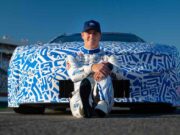

Ford Racing’s all-new 2027 NASCAR Cup Series Mustang has successfully completed its first major on-track evaluation, with NASCAR driver Zane Smith logging an impressive 630 laps at Charlotte Motor Speedway. Inspired by the road-going Mustang Dark Horse SC, the redesigned race car promises more aggressive styling, improved aerodynamic performance and potentially greater competitiveness on intermediate tracks. Smith’s initial impressions suggest Ford could have a promising new contender for the 2027 NASCAR season.
A New Chapter Begins for Ford’s NASCAR Mustang
The Ford Mustang has become one of the most recognizable competitors in the NASCAR Cup Series, combining the heritage of America’s iconic pony car with the demanding requirements of modern stock car racing.
For 2027, Ford Racing is preparing to introduce an extensively redesigned Mustang based on the new Mustang Dark Horse SC production model.
The project represents more than a visual update. Ford’s engineers have worked to refine the car’s aerodynamic characteristics while maintaining a strong connection to the Mustang’s unmistakable road-car identity.
Following its official unveiling in November 2026, the new NASCAR Mustang has already reached an important development milestone.
During a two-day tire testing program at Charlotte Motor Speedway, NASCAR driver Zane Smith became one of the first drivers to experience the new machine under demanding track conditions.
And judging by his initial feedback, Ford Racing has plenty of reasons to be optimistic.
630 Laps Provide Valuable Real-World Testing Data
The Charlotte Motor Speedway evaluation provided Ford Racing with an extensive opportunity to assess the new Mustang’s behavior.
Smith completed 630 laps over two days, covering a substantial distance while experiencing changing track conditions.
What made the evaluation particularly valuable was its timing.
Just days earlier, Smith had competed in a NASCAR race at the same circuit, completing another 267 laps behind the wheel of the existing Mustang.
That gave him a relatively fresh reference point for comparing the current-generation car with Ford’s new 2027 contender.
Although weather conditions differed between the race and testing sessions, the experience allowed Smith to evaluate the new car’s handling characteristics, cornering behavior and overall responsiveness.
His initial assessment was overwhelmingly positive.
The new Mustang appeared to offer better grip and more confidence when entering corners, two characteristics that could become particularly important on NASCAR’s intermediate oval tracks.
Improved Grip Could Make the 2027 Mustang More Competitive
One of Smith’s most encouraging observations concerned the new Mustang’s handling performance.
According to the driver, the redesigned car demonstrated improved grip compared with the current version, allowing him to approach corners with greater confidence.
That improvement could prove significant in NASCAR competition, where maintaining momentum through corners is essential for achieving competitive lap times.
Intermediate tracks such as Charlotte Motor Speedway place considerable demands on a car’s aerodynamic efficiency and mechanical grip.
Drivers must balance high cornering speeds with tire management, particularly during longer runs when track temperatures and surface conditions change.
Smith believes the new Mustang could help Ford teams become more competitive at these circuits.
However, the test also demonstrated just how dramatically track conditions can influence vehicle behavior.
During the early morning sessions, Charlotte’s racing surface provided unusually high levels of grip.
As the day progressed toward lunchtime, those favorable conditions gradually disappeared.
Later in the afternoon, grip began returning.
This variation provided Smith and Ford’s engineers with an opportunity to evaluate the Mustang across a broader range of conditions rather than relying on a single ideal testing window.
Although the early results are promising, Ford has not published comparative lap times or detailed aerodynamic measurements. The driver’s observations therefore represent an encouraging first assessment rather than definitive proof of a competitive advantage.
Mustang Dark Horse SC Styling Comes to NASCAR
The new NASCAR Mustang’s visual identity is closely connected to the production Mustang Dark Horse SC.
Ford Racing has worked to ensure that the competition car retains the recognizable character of its road-going counterpart while incorporating aerodynamic features required for top-level stock car racing.
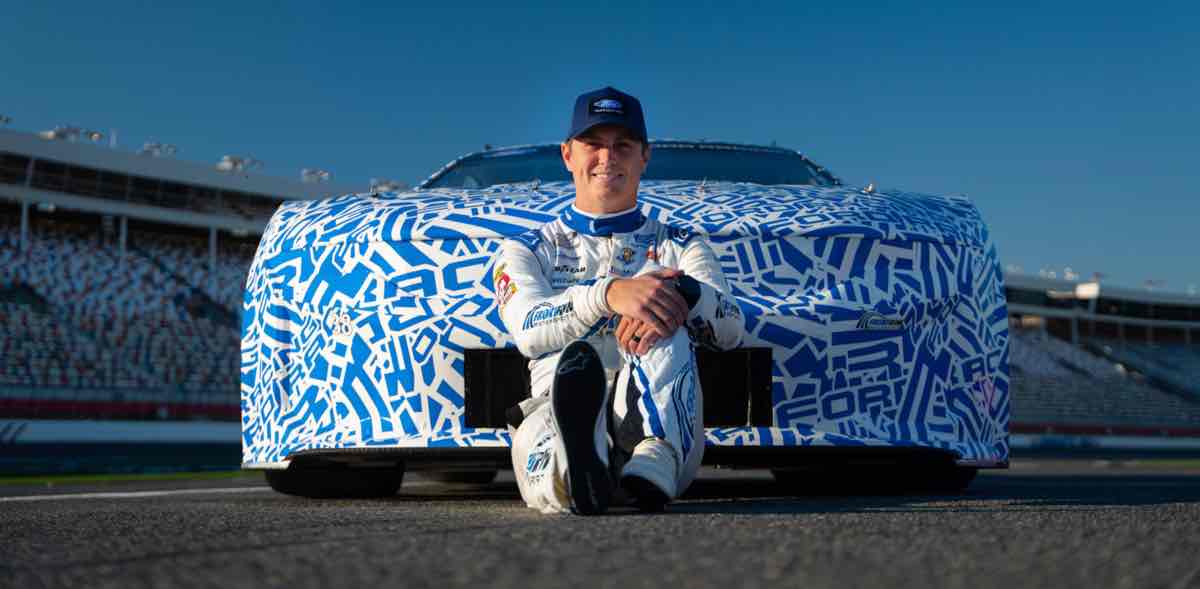
Smith immediately noticed the resemblance when he first saw the new car at Charlotte.
Even beneath its distinctive Ford Racing camouflage wrap, the redesigned Mustang displayed a more aggressive appearance.
The front end was particularly striking, reflecting the design language introduced on the production Dark Horse SC.
At the rear, the bodywork appeared equally purposeful, emphasizing the car’s performance-oriented character.
The relationship between the road car and its NASCAR counterpart is particularly important for Ford.
While NASCAR Cup Series vehicles are purpose-built racing machines, their exterior styling helps maintain a recognizable connection with the production models available to customers.
For the 2027 Mustang, Ford has placed considerable emphasis on strengthening that connection.
Aerodynamics Play a Central Role in the New Design
The most important changes extend beyond the Mustang’s appearance.
Ford Racing’s engineers have worked closely with the company’s design teams to develop a body that combines recognizable Mustang styling with improved aerodynamic performance.
One of the most significant elements is the redesigned front fascia.
The aggressive nose takes inspiration from the Mustang Dark Horse SC road car, where its design contributes to improved cooling.
On the NASCAR version, the corresponding aerodynamic treatment is intended to generate additional downforce.
Downforce is particularly important in stock car racing because it helps press the vehicle against the track surface at speed.
Greater aerodynamic grip can allow drivers to carry more speed through corners, although the final benefit depends on numerous factors, including drag, tire behavior and vehicle setup.
Smith’s observations at Charlotte suggest the new Mustang’s development direction is promising.
The increased confidence he experienced during corner entry could be especially valuable at intermediate tracks, where aerodynamic efficiency plays a major role in determining performance.
However, Ford will need to validate these improvements through further development and competitive racing.
The First Run Was Fast Enough to Lose a Ford Badge
Beyond the technical evaluation, Smith’s first experience with the new Mustang also produced an unexpected moment.
During his initial run at Charlotte, the blue Ford oval decal attached to the car’s hood detached while he was driving at speed.
Smith humorously attributed the incident to the Mustang’s impressive performance.
While a flying decal is hardly a scientific measurement of speed, the incident became a memorable part of his first encounter with Ford’s new NASCAR contender.
It also highlighted the enthusiasm surrounding the project.
For Smith, being selected to drive the new Mustang before its competitive debut was a special opportunity.
The driver had already seen the production Mustang Dark Horse SC earlier in the year and had briefly experienced the road car during a television feature involving fellow Ford driver Joey Logano.
However, spending two days behind the wheel of the NASCAR version provided a considerably deeper understanding of the new car’s capabilities.
From Digital Development to the Racetrack
The development timeline behind the 2027 Mustang is another notable aspect of the project.
Ford officially introduced the Mustang Dark Horse SC production model in January 2026, simultaneously confirming that its design would form the basis of the company’s next NASCAR Cup Series race car.
Less than a year later, the competition version had progressed through digital engineering, aerodynamic development and wind-tunnel evaluation to reach its first major track test.
Modern motorsport engineering increasingly relies on sophisticated computer modeling and simulation.
These technologies allow engineers to investigate aerodynamic behavior and evaluate design changes before physical prototypes reach the racetrack.
Wind-tunnel testing then provides another important development stage, helping teams understand how air moves around the vehicle under controlled conditions.
However, real-world track testing remains essential.
Actual racing surfaces introduce variables that cannot always be fully reproduced in a digital environment, including changing temperatures, tire degradation and the interaction between vehicle setup and track conditions.
The Charlotte test therefore represents a significant transition from engineering development to practical validation.
Completing 630 laps gave Ford Racing valuable running time and driver feedback ahead of the Mustang’s competitive debut.
The Road-Going Mustang Dark Horse SC Provides the Inspiration
The production Mustang Dark Horse SC is itself an important part of Ford’s performance strategy.
Positioned as an exceptionally capable member of the Mustang family, the Dark Horse SC features a supercharged 5.2-liter V8 engine producing up to 795 horsepower and 660 lb-ft of torque.
Its aggressive styling and performance-focused engineering establish a strong visual foundation for the NASCAR competition model.
However, the road car’s mechanical specifications should not be confused with those of the NASCAR Mustang.
The Cup Series version is built to NASCAR’s technical regulations and uses a dedicated racing powertrain and chassis configuration.
The connection between the two vehicles is therefore primarily expressed through their design identity and Ford’s broader approach to performance engineering.
Ford Racing believes that the exchange of knowledge between road-car development and motorsport can benefit both programs.
The Mustang Dark Horse SC and its NASCAR counterpart demonstrate how that philosophy can translate into recognizable production-car styling combined with specialized racing technology.
Ford Mustang Has Already Built an Impressive NASCAR Legacy
The Mustang’s arrival in the NASCAR Cup Series in 2019 marked a major change for Ford’s stock car racing program.
Replacing the Ford Fusion, the Mustang brought one of the automaker’s most famous performance nameplates into NASCAR’s premier division.
Since then, the model has established a successful competitive record.
By the time Ford unveiled its 2027 successor, the Mustang had accumulated 80 NASCAR Cup Series victories and three drivers’ championships.
Those championship achievements include:
- 2022: Joey Logano
- 2023: Ryan Blaney
- 2024: Joey Logano
The Mustang has also secured victories in several of NASCAR’s most prestigious events, including the Daytona 500, Coca-Cola 600, Southern 500 and Brickyard 400.
These achievements have helped strengthen the Mustang’s identity as a serious competition platform rather than simply a production sports car adapted for racing.
Ford’s objective with the 2027 version is to build upon that record.
The redesigned body could provide an important opportunity to improve competitiveness as the manufacturer prepares for another demanding NASCAR season.
Joey Logano and Ryan Blaney Are Looking Forward to the New Mustang
Ford’s established NASCAR stars have also expressed enthusiasm about the upcoming race car.
Joey Logano, who has won multiple championships driving Ford machinery, has consistently praised the Mustang’s appearance and competitive potential.
The new Dark Horse SC-inspired design introduces an even more aggressive interpretation of the familiar Mustang silhouette.
Ryan Blaney has similarly emphasized the importance of beginning the new generation with a strong result.
For both drivers, the ultimate objective is clear: translating Ford Racing’s engineering work into victories.
The Daytona 500 will provide the first major opportunity to demonstrate what the new Mustang can accomplish in competition.
Although Smith’s Charlotte evaluation produced encouraging feedback, the true competitive picture will only emerge once Ford’s teams begin racing against their rivals.
2027 Daytona 500 Will Be the Ultimate First Test
Ford Racing’s new NASCAR Mustang is scheduled to make its competitive debut during Daytona Speedweeks in February 2027.
The program will culminate in the 69th Daytona 500 on February 21, 2027, one of the most important events on the American motorsport calendar.
Daytona presents a substantially different challenge from Charlotte.
While Charlotte’s intermediate oval places considerable emphasis on cornering performance and aerodynamic balance, Daytona’s high-speed superspeedway racing introduces the complexities of drafting, pack racing and sustained high-speed stability.
That means the encouraging handling characteristics observed at Charlotte will represent only one part of the new Mustang’s overall performance potential.
Ford Racing must ensure that the car is competitive across NASCAR’s diverse range of circuits.
The Cup Series calendar includes intermediate ovals, superspeedways, short tracks and road courses, each presenting unique engineering challenges.
A successful NASCAR race car must deliver a versatile performance package rather than excelling at only one type of venue.
An Encouraging Beginning for Ford Racing’s 2027 Campaign
The first major test of the 2027 NASCAR Ford Mustang has delivered exactly the kind of early feedback Ford Racing would have hoped to receive.
Zane Smith’s 630-lap evaluation demonstrated that the new car is capable of sustained track running while providing an opportunity to assess its behavior against the outgoing Mustang.
The driver’s positive comments about grip and corner entry suggest that Ford’s aerodynamic development could produce meaningful improvements on intermediate tracks.
At the same time, the new Mustang Dark Horse SC-inspired styling reinforces the connection between Ford’s road-going performance cars and its motorsport activities.
There is still considerable work ahead.
Additional development, race preparation and real-world competition will ultimately determine whether the redesigned Mustang can deliver the results Ford expects.
Nevertheless, the first signs are encouraging.
With a more aggressive appearance, a promising initial handling assessment and an established NASCAR championship legacy behind it, the 2027 Ford Mustang is shaping up to be one of the most interesting new contenders on next season’s Cup Series grid.
And when the lights illuminate Daytona International Speedway in February, Ford Racing will finally discover whether its latest Mustang can turn that early promise into race-winning performance.