



























While modern hybrids and electric vehicles are rapidly replacing traditional taxis across major European cities, the Portuguese island of Madeira offers a fascinating glimpse into a different automotive era. In the streets of Funchal, the island’s capital, decades-old Mercedes-Benz sedans remain a familiar sight, with the legendary W124 generation standing out as one of the most recognizable examples. Wearing their distinctive yellow-and-blue taxi liveries, these German classics are far more than nostalgic attractions. Many continue to serve passengers every day, demonstrating how exceptional engineering, proper maintenance, and long-term durability can keep a vehicle working decades after it first left the factory.
A Journey Back in Time: Classic Mercedes-Benz Taxis Everywhere
Walking through Funchal, visitors quickly notice something unusual about the local taxi fleet.
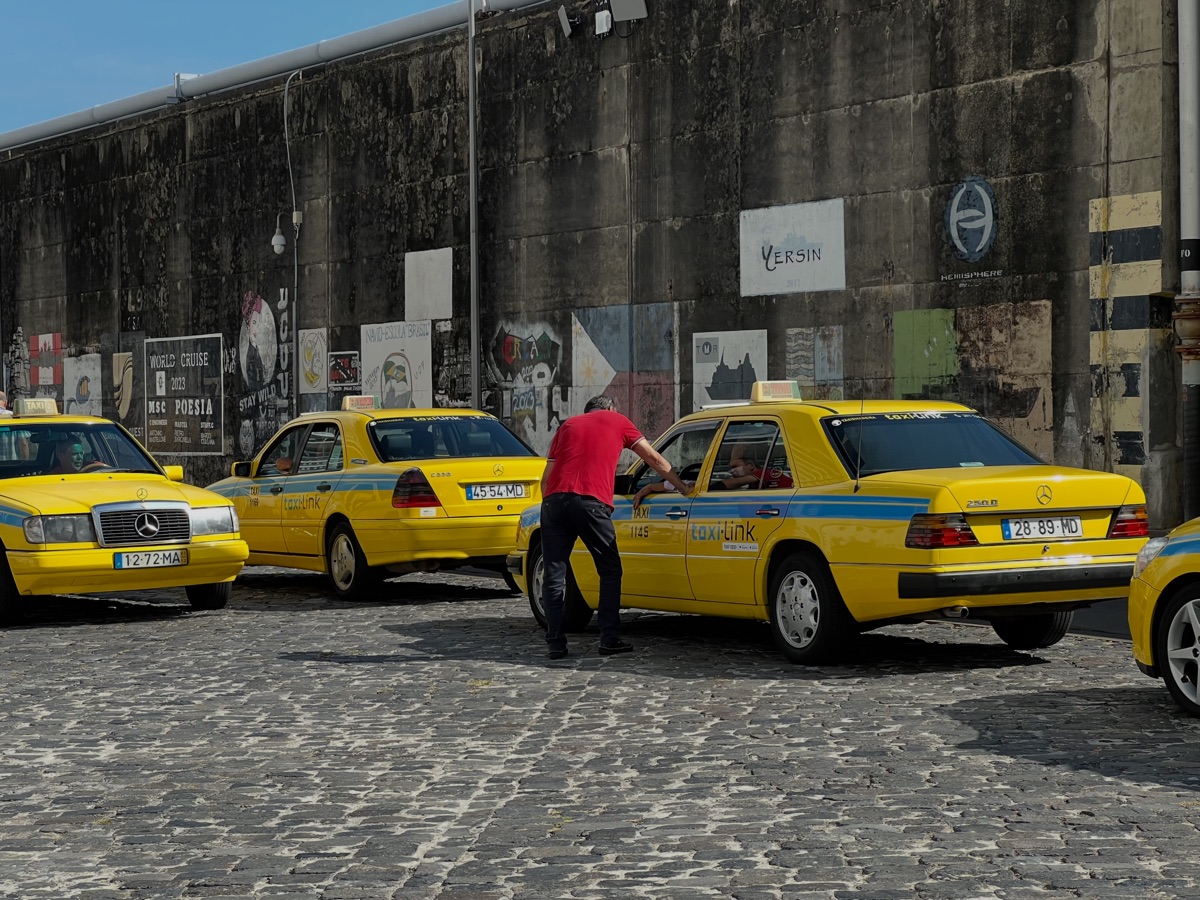
Among modern vehicles, there are still surprisingly large numbers of older Mercedes-Benz sedans that would be considered collectible classics in many other parts of Europe.
One of the most recognizable is the Mercedes-Benz W124, a model produced in sedan form between 1984 and 1995.
The W124 became one of the most respected model generations in Mercedes-Benz history, earning an outstanding reputation for mechanical durability, robust construction, and remarkably long-lasting diesel engines.
However, the W124 is not the only classic Mercedes-Benz still associated with Madeira’s taxi industry.
The smaller Mercedes-Benz W201, commonly known as the 190 series, along with later W202 and W210 models, also forms part of the island’s automotive landscape.
What makes the situation particularly interesting is that many of these vehicles are not preserved exclusively for shows or weekend drives.
They remain genuine working taxis.
They pick up passengers, transport luggage, and navigate Madeira’s steep, winding roads as part of everyday transportation.
For automotive enthusiasts visiting the island, the experience can feel like stepping into a living Mercedes-Benz museum.
Why Did the Mercedes-Benz W124 Become So Popular?
To understand the W124’s enduring popularity, it is worth looking back at a period when Mercedes-Benz placed extraordinary emphasis on mechanical longevity, repairability, and engineering quality.
The W124 was designed to withstand demanding operating conditions, making it especially attractive to professional drivers who accumulated substantial mileage every year.
Taxi operators needed vehicles capable of covering tens of thousands of miles annually while remaining comfortable, dependable, and relatively economical to maintain.
The W124 delivered precisely those qualities.
Its most important advantages included:
- Exceptionally durable diesel engines: The 200 D, 250 D, and 300 D variants became particularly famous for their impressive longevity.
- Robust body and suspension construction: The W124 was engineered to tolerate intensive daily use.
- Straightforward mechanical repairs: Many common issues could be addressed without the complex electronic diagnostic equipment required by modern vehicles.
- Excellent passenger comfort: Spacious interiors and comfortable seating made the W124 ideal for longer journeys.
- Reasonable operating costs: Naturally aspirated diesel engines offered relatively economical fuel consumption and simpler mechanical systems.
The W124’s reputation was further strengthened by numerous examples reaching exceptionally high mileage.
Some well-maintained vehicles have exceeded 620,000 miles, equivalent to approximately one million kilometers.
Naturally, achieving such figures requires regular servicing, replacement parts, and occasionally major mechanical repairs.
Nevertheless, the fact that these vehicles can remain operational after such extensive use illustrates the strength of their original engineering.
Madeira’s Mountain Roads Put Every Vehicle to the Test
Madeira presents a driving environment very different from that of most mainland European cities.
The volcanic island is characterized by dramatic elevation changes, steep hills, narrow streets, and winding mountain roads.
In certain parts of Funchal, gradients are steep enough to place considerable stress on engines, transmissions, clutches, braking systems, and suspension components.
For a taxi operating in these conditions every day, mechanical reliability becomes especially important.
This is one reason why older Mercedes-Benz diesel models can remain attractive to operators familiar with their maintenance requirements.
Their relatively straightforward mechanical construction allows experienced technicians to diagnose and repair many problems without relying on sophisticated electronic systems.
Local mechanics may also have decades of experience working with these particular models.
However, Madeira’s challenging terrain is demanding even for the legendary W124.
Frequent brake inspections, cooling system maintenance, suspension repairs, and proper servicing remain essential.
The W124’s reputation for durability does not eliminate the need for careful maintenance, particularly when operating on steep mountain roads.
One Million Kilometers? Not Impossible for a Madeira Taxi
Few vehicles have developed a reputation for extraordinary mileage quite like the Mercedes-Benz W124.
Over the decades, the model has become almost synonymous with long-distance durability.
Madeira has also attracted attention from automotive enthusiasts who have encountered W124 taxis displaying exceptionally high odometer readings.
In one traveler’s account from 2022, a Madeira-based W124 taxi reportedly showed nearly 996,000 kilometers, approximately 619,000 miles.
Another vehicle mentioned in the same account reportedly displayed more than 1.38 million kilometers, equivalent to roughly 857,000 miles.
These figures represent individual traveler observations rather than independently verified fleet statistics.
Nevertheless, they help explain why the W124 has achieved such legendary status among taxi drivers and Mercedes-Benz enthusiasts.
Of course, an exceptionally high odometer reading does not necessarily mean every mechanical component remains original.
Engines, transmissions, suspension systems, and numerous other parts may have been repaired or replaced throughout a vehicle’s working life.
The important distinction is that the W124 provided a durable platform that could remain economically viable for professional use over an unusually long period.
The Yellow-and-Blue Paint Scheme Has Become a Madeira Icon
The appearance of Madeira’s taxis is almost as distinctive as the vehicles themselves.
Their bright yellow bodywork, combined with blue side stripes, has become one of the island’s most recognizable transportation features.
Interestingly, Madeira’s taxis once followed the traditional black-and-green color scheme commonly associated with Portuguese taxis.
In 1985, the regional government decided to introduce the yellow-and-blue appearance, providing financial assistance to support the transition.
Over time, this color combination became closely associated with the island’s taxi industry.
It looks particularly striking on classic Mercedes-Benz sedans.
The W124’s angular bodywork, chrome grille, prominent three-pointed star, and unmistakably 1980s design create an appearance that stands out in modern traffic.
For visitors arriving in Funchal, these taxis often become unexpected photographic attractions.
Automotive enthusiasts, in particular, frequently stop to admire or photograph vehicles that would be increasingly unusual to encounter in regular commercial service elsewhere.
Why Does Operating a 30-Year-Old Mercedes-Benz Still Make Financial Sense?
At first glance, it may seem surprising that a modern European tourist destination continues to use vehicles that are more than three decades old.
However, several practical and economic factors help explain the situation.
A fully paid-off vehicle that remains mechanically sound can sometimes be less expensive to operate than purchasing and financing a new car.
For established taxi operators, avoiding the substantial initial cost of a replacement vehicle may be particularly attractive.
The Mercedes-Benz W124 offers additional advantages.
Its mechanical systems are well understood, many replacement components remain obtainable, and numerous repairs can be performed using conventional workshop equipment.
Madeira’s island location can also influence vehicle ownership costs.
Transporting new vehicles and certain replacement parts to the island may involve additional logistical expenses.
However, keeping an older Mercedes-Benz on the road is not automatically inexpensive.
Age-related deterioration, corrosion, worn suspension components, increasingly scarce parts, and major mechanical repairs can significantly increase maintenance costs.
Older diesel engines may also consume more fuel and produce higher emissions than modern alternatives.
Ultimately, the economic viability of an aging taxi depends on its mechanical condition, maintenance history, operating requirements, and the costs associated with replacing it.
Classic Mercedes-Benz Engineering in a Modern Automotive World
Funchal’s taxi fleet is certainly not composed exclusively of vintage Mercedes-Benz vehicles.
Modern cars also operate throughout the city, and the local fleet continues to evolve.
Nevertheless, the continued presence of older German sedans gives Madeira’s transportation landscape a distinctive character.
The W124 represents an era when mechanical durability, serviceability, and long-term ownership were central engineering priorities.
Modern vehicles offer substantial improvements in numerous areas.
Advanced safety systems, improved emissions performance, modern infotainment technology, and sophisticated driver-assistance features provide benefits that older cars simply cannot match.
Even so, a properly maintained W124 can still perform the fundamental task for which it was designed: transporting passengers comfortably and reliably.
That contrast is part of what makes these vehicles so fascinating.
They demonstrate that technological progress does not necessarily make every aspect of an older vehicle obsolete.
Mercedes-Benz and Madeira: A Relationship Spanning Generations
The relationship between Mercedes-Benz and Madeira’s taxi industry began long before the W124 appeared.
Mercedes-Benz diesel vehicles were already being used for passenger transportation on the island during the 1950s.
One notable example was the Mercedes-Benz 180 D, which offered the robust construction and economical diesel operation valued by professional drivers.
At a time when private car ownership was far less widespread, taxis played an important role in local mobility.
Mercedes-Benz established a reputation not merely as a prestigious automobile manufacturer, but as a producer of dependable working vehicles.
That reputation continued through successive generations.
Models such as the W123, W201, and W124 became part of a long tradition of Mercedes-Benz taxis operating on Madeira.
For many drivers, familiarity with the brand and confidence in its engineering helped reinforce this relationship.
Today, the surviving examples represent several decades of automotive history.
A Living Automotive Museum in the Middle of the Atlantic Ocean
For enthusiasts of classic European automobiles, Funchal offers a particularly memorable experience.
It is possible to encounter multiple Mercedes-Benz generations parked alongside one another at local taxi stands.
These vehicles represent different periods of German automotive engineering, yet many remain part of the island’s everyday transportation network.
The W124 is especially noteworthy.
In numerous countries, well-preserved examples have already entered the collector-car market.
Enthusiasts restore them, preserve original specifications, and increasingly recognize their historical significance.
In Madeira, however, some examples continue performing the same commercial duties they were built to handle decades ago.
For local taxi drivers, these Mercedes-Benz sedans are primarily working tools.
For visitors and automotive enthusiasts, they are rolling reminders of an era when long-term mechanical endurance was one of the most important measures of automotive quality.
This unusual combination of practicality and nostalgia gives Madeira’s classic taxis their special appeal.
Could the Mercedes-Benz W124 Still Survive Another Decade?
The continued operation of W124 taxis naturally raises an interesting question.
How much longer can these vehicles remain in commercial service?
From a purely mechanical perspective, a properly maintained W124 can continue operating for many years.
Its longevity depends heavily on the condition of the engine, transmission, body structure, suspension, and other major components.
However, mechanical durability is only one consideration.
Future emissions regulations, vehicle licensing requirements, replacement-part availability, operating costs, and changing customer expectations may influence how long these classic sedans remain economically practical.
The growing adoption of modern hybrid and electric vehicles could gradually reduce the number of older diesel taxis.
For that reason, Madeira’s surviving W124 fleet may become increasingly interesting from a historical perspective.
The opportunity to ride in a genuine working example of this Mercedes-Benz generation is something automotive enthusiasts should not take for granted.
Conclusion: The Mercedes-Benz W124 Legend Is Still Alive in Funchal
Madeira provides a remarkable example of how a well-engineered automobile can remain useful decades after its introduction.
The Mercedes-Benz W124 earned its reputation through mechanical durability, dependable diesel engines, comfortable passenger accommodations, and a design intended for demanding long-term use.
Those qualities made it a natural choice for taxi operators around the world.
In Funchal, they have helped preserve the model’s presence on public roads long after many comparable vehicles disappeared from commercial service elsewhere.
Although modernization continues to reshape the island’s transportation network, classic Mercedes-Benz taxis remain an unmistakable part of its automotive identity.
For car enthusiasts visiting Madeira, there are few experiences quite like riding through the island’s spectacular mountain scenery in the back seat of a yellow-and-blue Mercedes-Benz W124.
In Funchal, the Mercedes-Benz W124 is more than an old taxi. It is a rolling symbol of durability, engineering excellence, and an automotive era that continues to inspire enthusiasts around the world.