






















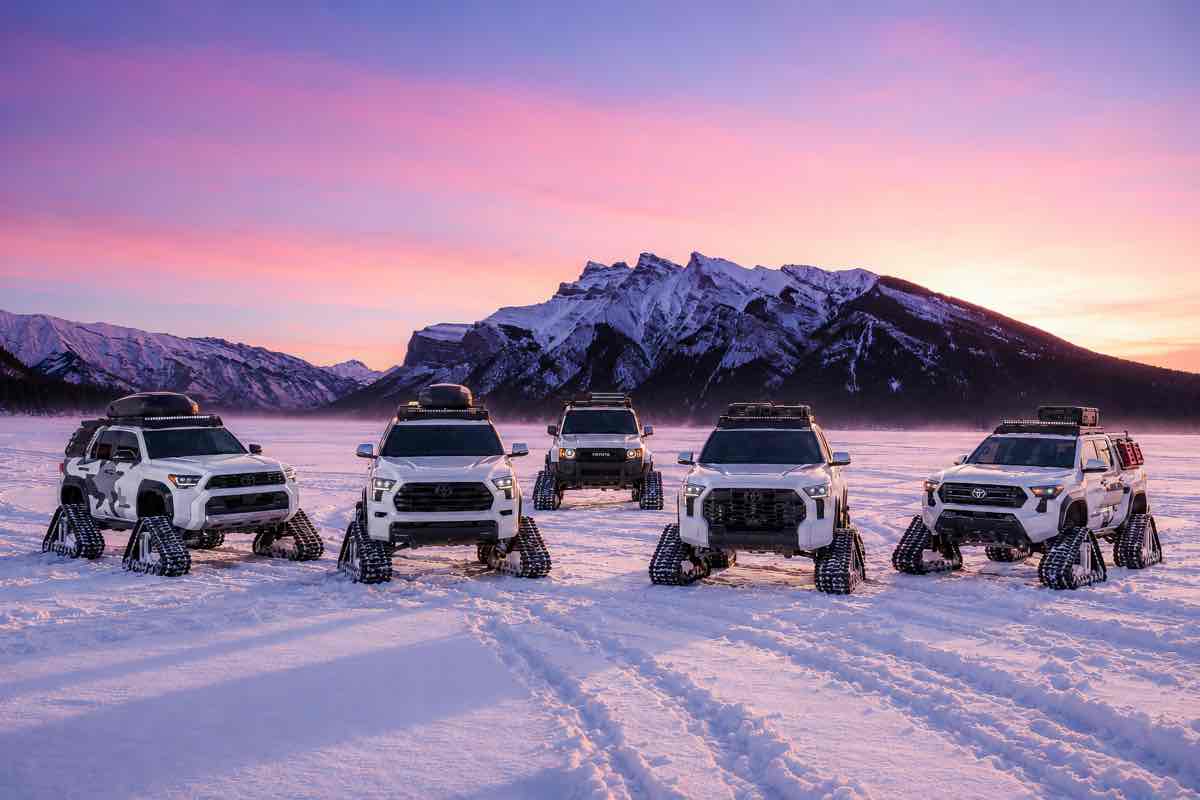
Toyota is bringing extreme winter adventure to the 2026 SEMA Show with five dramatic Snowhunter concepts based on the Tundra, Tacoma, 4Runner, Land Cruiser, and Sequoia. Equipped with massive snow tracks, specialized expedition gear, and distinctive camouflage graphics, these modified trucks and SUVs showcase Toyota’s vision of off-road capability when conventional trails disappear beneath deep snow.
Toyota Snowhunter: Five Vehicles Built for Extreme Winter Exploration
Developed by Toyota’s CALTY Design Research team in Ann Arbor, Michigan, the Snowhunter family transforms five of the automaker’s most capable body-on-frame vehicles into specialized winter expedition machines.
The most striking modification is the replacement of conventional wheels with enormous white tracked drive systems. Designed to distribute vehicle weight across a larger surface area, tracks can improve mobility in deep snow where traditional tires may struggle.
All five concepts share Snowhunter camouflage graphics, exclusive badging, gloss-black accents, Rigid Industries auxiliary lighting, and suspension modifications using Toyota Genuine Parts and Toyota Racing Development (TRD) components.
However, each vehicle has a distinct personality and purpose.
Toyota Tundra Snowhunter: The Ultimate Winter Basecamp
The full-size Tundra Snowhunter emphasizes extended expeditions and equipment-carrying versatility.
Its most innovative feature is the CALTY-designed Toyota TrailLift Pro Rack System Concept, which transforms the pickup bed into a flexible cargo platform.
The system incorporates an articulating upper rack that can be lowered to simplify loading bulky equipment, including bicycles, kayaks, and other outdoor gear.
Additional modifications include TRD rear billet control arms, Predator Steps, and auxiliary lighting.
Combined with the tracked drive system, these upgrades create a mobile basecamp designed for remote winter adventures.
Toyota Tacoma Snowhunter: Compact, Capable, and Adventure-Ready
The Tacoma Snowhunter takes a more maneuverable approach.
Designed for narrow trails and challenging terrain, the midsize pickup combines its snow tracks with practical expedition equipment.
A roof rack and full-length bed rack with MOLLE panels provide flexible cargo storage. Additional accessories include an awning, recovery equipment, auxiliary storage, and dedicated bed lighting.
The result is a compact winter exploration vehicle built around self-supported adventures where efficient storage and versatility are essential.
Toyota 4Runner Snowhunter: Serious Backcountry Capability
The 4Runner Snowhunter builds on the SUV’s established reputation for rugged off-road performance.
Toyota Genuine rock rails provide additional lower-body protection, while a Prinsu roof rack with accessory panels expands equipment-carrying capacity.
A Thule Pulse 2 cargo box adds enclosed storage without compromising interior passenger space.
Combined with its elevated suspension and oversized snow tracks, the 4Runner Snowhunter becomes a compelling vision of an all-season adventure SUV capable of tackling demanding winter environments.
Toyota Land Cruiser Snowhunter: Legendary Toughness Meets Deep Snow
The Land Cruiser Snowhunter brings Toyota’s iconic expedition heritage into extreme winter territory.
Its equipment package emphasizes durability, protection, and outdoor recreation.
Toyota Genuine rock rails and skid plates help protect vulnerable components, while a Prinsu roof rack provides additional cargo flexibility.
A Thule SnowPack ski rack makes the Land Cruiser particularly appealing to winter sports enthusiasts.
With its tracked drive system and specialized accessories, the concept looks ready for remote mountain expeditions and snow-covered wilderness exploration.
Toyota Sequoia Snowhunter: Full-Size Winter Adventure
The Sequoia Snowhunter demonstrates how Toyota’s largest SUV could become a spacious winter expedition vehicle.
Its modifications include a TRD front skid plate, Toyota Genuine cast aluminum running boards, and a Prinsu roof rack with accessory panels.
A Thule Pulse 2 cargo box adds enclosed storage for equipment and supplies.
The Sequoia’s generous interior space makes it particularly suitable for expeditions involving multiple passengers and substantial gear.
Its enormous snow tracks complete the transformation from conventional family SUV to specialized winter adventure machine.
Why Snow Tracks Change Everything
The defining feature of the Snowhunter family is its tracked drive system.
Compared with conventional tires, tracks can distribute weight over a greater surface area, reducing ground pressure and potentially improving traction in deep, soft snow.
That advantage can be significant in environments where even capable four-wheel-drive vehicles struggle.
However, tracked conversions also bring compromises, including increased mechanical complexity, additional drivetrain loads, and potential limitations involving speed, steering, and road legality.
Toyota has not released detailed specifications for the Snowhunter track systems, including their operating limits or measured performance.
These vehicles therefore remain engineering and design concepts rather than production-ready winter transportation solutions.
CALTY Brings a Unified Design to Toyota’s Winter Fleet
Toyota’s CALTY Design Research team has given the five Snowhunter vehicles a consistent identity without sacrificing their individual character.
Distinctive camouflage, white tracks, specialized lighting, and exclusive graphics connect the entire lineup.
The Tundra emphasizes expedition equipment, the Tacoma prioritizes agility, the 4Runner focuses on backcountry versatility, the Land Cruiser highlights winter sports capability, and the Sequoia offers passenger space and comfort.
Together, they demonstrate how Toyota’s existing truck and SUV platforms could be adapted for dramatically different environments.
Toyota Snowhunter Debuts at SEMA 2026
The Snowhunter family will be showcased at the 2026 SEMA Show, November 3–6, at the Las Vegas Convention Center.
The annual event provides an ideal setting for Toyota to demonstrate unconventional vehicle modifications, specialized accessories, and new engineering ideas.
Beyond their dramatic appearance, the Snowhunter concepts also highlight equipment from Toyota Genuine Parts, TRD, and aftermarket manufacturers.
Roof racks, protective components, lighting systems, and cargo accessories illustrate practical customization possibilities even for owners who have no intention of installing snow tracks.
Could a Production Toyota Snowhunter Become Reality?
Toyota has not announced plans to manufacture the Snowhunter concepts or offer factory-installed tracked drive systems.
The vehicles are specialized prototypes, and some modifications may affect safety, warranty coverage, or road legality.
Nevertheless, Toyota has previously used SEMA concepts to explore ideas that later influenced production vehicles and accessory programs.
The Trailhunter name is one notable example of an adventure-focused concept evolving into a factory off-road grade.
Among the Snowhunter innovations, the Tundra’s TrailLift Pro Rack System Concept stands out as a potentially practical accessory idea.
Whether any of these developments eventually reach production remains uncertain.
Toyota Pushes Winter Adventure Beyond Conventional Limits
The 2026 Snowhunter family shows how Toyota’s most capable trucks and SUVs can be reimagined for extreme environments.
Each vehicle approaches winter exploration differently, combining distinctive engineering concepts with practical adventure equipment.
The Tundra delivers mobile basecamp functionality, the Tacoma offers maneuverability, the 4Runner balances capability with versatility, the Land Cruiser emphasizes rugged exploration, and the Sequoia provides room for passengers and equipment.
Together, they reinforce Toyota’s adventurous spirit while demonstrating that even the deepest snow can inspire new approaches to off-road mobility.