


















Few movie cars capture the personality of a film quite like the bright yellow Volkswagen Type 2 from Little Miss Sunshine. It isn’t fast, luxurious or particularly reliable — and that’s exactly why it works. Nearly two decades after the acclaimed 2006 road movie reached theaters, the unmistakable VW bus remains one of the film’s most memorable stars, and one of the vehicles used during production has become a fascinating piece of Hollywood automotive history.
The Yellow Volkswagen That Became Part of the Hoover Family
Released in 2006, Little Miss Sunshine tells the story of the dysfunctional Hoover family and their increasingly chaotic journey across the American Southwest.
Their mission sounds simple enough: get young Olive Hoover to California in time to participate in the Little Miss Sunshine beauty pageant.
Getting there proves considerably more complicated.
The family piles into an aging yellow Volkswagen Type 2, and what follows is one of the most memorable road trips in modern American independent cinema.
Greg Kinnear plays Richard Hoover, while Toni Collette portrays his wife, Sheryl. Abigail Breslin stars as Olive, with Steve Carell, Paul Dano and Alan Arkin completing the wonderfully mismatched group of passengers.
Yet there’s another character accompanying them for virtually the entire journey.
The Volkswagen.
The bus gradually becomes so important to the story that it’s difficult to imagine Little Miss Sunshine without it.
A Perfectly Imperfect Road Trip Machine
The Volkswagen Type 2 was almost ideally suited to the movie.
By the time Little Miss Sunshine takes place, the vehicle already feels old, slightly worn and thoroughly removed from the polished SUVs and minivans normally associated with American family transportation.
Its bright yellow paint makes it impossible to overlook.
But its mechanical problems are even more important.
Throughout the movie, the Volkswagen suffers from a collection of increasingly ridiculous problems. One of the most famous involves its troublesome transmission and starting procedure, forcing members of the Hoover family to push the van until it gathers enough speed before everyone jumps aboard.
It’s hilarious, but it also serves a much deeper purpose.
Every time the Volkswagen causes another problem, the family has to work together.
The bus therefore becomes a physical representation of the Hoovers themselves: imperfect, dysfunctional, occasionally frustrating, but somehow capable of continuing forward.
Five Volkswagen Buses Were Used During Filming
As is often the case with vehicles playing major roles in movies, there wasn’t just one Little Miss Sunshine Volkswagen.
Five matching Volkswagen Type 2 buses were reportedly prepared for production.
Different vehicles could therefore be used depending on the requirements of a particular scene. Some remained relatively conventional, while others were modified to accommodate cameras, equipment or specific driving sequences.
This is standard practice for movie cars, particularly when a vehicle appears extensively throughout a production.
Having multiple examples also protects the shooting schedule. If one vehicle develops a mechanical problem — particularly relevant when dealing with decades-old Volkswagens — filming can continue with another.
For viewers, however, they’re effectively one vehicle.
And that vehicle became unmistakable.
What Exactly Is the Little Miss Sunshine Volkswagen?
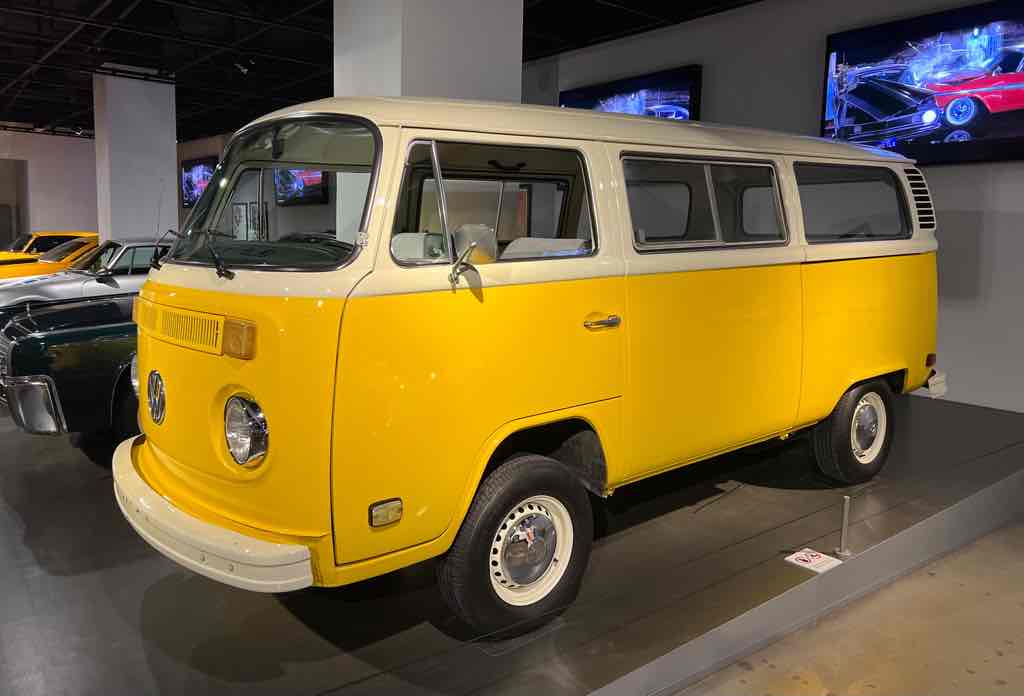
The vehicle is generally identified as a Volkswagen Type 2, commonly known in the United States as the VW Bus, Transporter or Microbus.
The movie vehicle is frequently described as a 1971 model, although conflicting information surrounding some of the buses used during production has occasionally resulted in different model years being mentioned.
What matters visually is immediately obvious.
It’s a second-generation Volkswagen Type 2, better known among enthusiasts as the T2 or Bay Window.
The enormous windshield, upright body, rear-mounted engine and wonderfully simple proportions made the Type 2 one of the most recognizable vehicles of its era.
And then there’s that color.
The vivid yellow finish became inseparable from Little Miss Sunshine.
Put a similarly colored T2 on an empty road today and there’s a good chance somebody will immediately think of the movie.
Simple Air-Cooled Engineering Underneath
The Volkswagen Type 2 came from an era when mechanical simplicity was one of Volkswagen’s defining characteristics.
Typical early-1970s examples used a rear-mounted, air-cooled horizontally opposed four-cylinder engine. A 1.6-liter configuration was common around this period.
Performance was modest even when these vehicles were new.
But outright speed was never the point.
The Type 2 was designed around practicality, simplicity and packaging efficiency. With the engine mounted behind the passenger compartment and a relatively compact mechanical layout, Volkswagen could dedicate an enormous percentage of the vehicle’s footprint to passengers and cargo.
That made it a van, camper, commercial vehicle, family transporter and eventually a cultural icon.
In Little Miss Sunshine, however, its modest performance and aging mechanical components become part of the comedy.
This isn’t some impossibly glamorous Hollywood hero car.
It’s a battered old family van desperately trying to complete a road trip.
The Volkswagen Is Essentially the Seventh Hoover
Calling the VW Bus another member of the Hoover family isn’t much of an exaggeration.
Its problems repeatedly change what the characters have to do.
When the bus refuses to cooperate, everyone has to push. When something else goes wrong, everyone has to adapt. The characters who begin the movie emotionally separated are repeatedly forced into physical cooperation simply to keep moving.
That’s what makes the vehicle’s role unusually effective.
Many famous movie cars are memorable because they’re desirable.
James Bond’s Aston Martins are sophisticated. The Back to the Future DeLorean is futuristic and extraordinary. Steve McQueen’s Mustang in Bullitt represents raw performance.
The Little Miss Sunshine Volkswagen is memorable for almost the opposite reason.
It’s flawed.
And that’s precisely what makes audiences care about it.
The Bus Helped Define the Movie’s Visual Identity
The yellow Volkswagen also gave filmmakers an extraordinarily effective visual tool.
Against the enormous landscapes and desert highways of the American Southwest, the little yellow bus immediately stands out.
Wide shots become instantly recognizable.
Even without seeing any of the actors, a yellow Volkswagen Type 2 crossing an empty American highway communicates the identity of Little Miss Sunshine almost immediately.
That visual contrast helped make the vehicle one of the defining images associated with the film.
It also fits perfectly with the movie’s unusual combination of comedy, melancholy and optimism.
The Volkswagen looks cheerful.
The people inside it are frequently anything but.
One of the Movie Buses Reached the Petersen Automotive Museum
At least one of the Volkswagen buses associated with the production eventually became part of the collection of the Petersen Automotive Museum in Los Angeles.
That’s an appropriate destination.
The Petersen isn’t simply dedicated to expensive supercars and historically significant production automobiles. Its enormous collection also explores the relationship between cars, Los Angeles, entertainment and popular culture.
Movie vehicles therefore occupy an important place within the museum’s broader story.
And few modern independent movie cars are as immediately recognizable as the yellow Volkswagen from Little Miss Sunshine.
For enthusiasts, seeing the actual vehicle creates an interesting crossover between automotive history and filmmaking.
It isn’t valuable merely because it’s an old Volkswagen.
Its significance comes from what happened around it.
Volkswagen’s Type 2 Was Already a Cultural Icon
Of course, Little Miss Sunshine didn’t make the Volkswagen Bus famous.
The Type 2 had already spent decades accumulating cultural significance.
Volkswagen introduced its original Type 2 in 1950 as a practical companion to the Beetle. Its basic mechanical architecture was closely related to Volkswagen’s famous passenger car, but the box-shaped body transformed the platform into something dramatically more versatile.
The first-generation T1 eventually became one of the defining automotive symbols of the 1960s.
Campers, surfers, musicians, travelers and counterculture communities embraced it. Volkswagen buses became associated with road trips, freedom and unconventional lifestyles.
The T2 arrived later with a substantially revised body and the large curved windshield responsible for its familiar Bay Window nickname.
It retained the fundamental Volkswagen formula: rear engine, air cooling, simple engineering and enormous interior flexibility.
By the time Hollywood began regularly using these vehicles, the VW Bus already carried decades of cultural meaning.
That History Makes the Casting Even Better
Choosing a Volkswagen Type 2 for Little Miss Sunshine wasn’t simply a matter of finding an amusing old van.
The vehicle brings its own cultural baggage to the movie.
The VW Bus has always represented travel differently from a conventional automobile.
It encourages the idea that the journey matters as much as the destination.
That concept sits directly at the center of Little Miss Sunshine.
The Hoovers believe they’re traveling to California because Olive needs to reach a beauty pageant.
But the pageant isn’t really what the movie is about.
The road trip changes the family.
And the Volkswagen is the object that keeps all of them physically together while that happens.
A Movie Car Doesn’t Need Horsepower to Become Legendary
Automotive movie history is filled with extraordinary machines.
Muscle cars. Supercars. Race cars. Police cars. Exotic prototypes.
The Little Miss Sunshine Volkswagen demonstrates that none of those ingredients are necessary to create a memorable movie vehicle.
It doesn’t need 700 horsepower.
It doesn’t need to jump over anything.
It doesn’t need weapons, gadgets or futuristic technology.
It barely needs to start.
What matters is that the vehicle has personality and serves the story.
Every scratch, mechanical failure and awkward moment makes the Volkswagen feel more authentic. By the end of the movie, audiences don’t simply recognize the yellow bus — they’ve developed an emotional connection to it.
That’s a remarkably difficult achievement for what is ultimately an inanimate object.
From Aging Volkswagen to Hollywood Artifact
Today, surviving Volkswagen Type 2 models have become desirable classics in their own right.
Restored buses can command serious money, particularly desirable early examples, camper conversions and vehicles with documented histories.
But a Volkswagen connected directly to Little Miss Sunshine occupies an entirely different category.
Its importance isn’t defined primarily by engine specification, mileage or factory originality.
It’s a piece of filmmaking history.
The movie earned widespread critical acclaim and multiple major awards while helping cement the careers of several members of its cast. Abigail Breslin received an Academy Award nomination, while Alan Arkin won the Academy Award for Best Supporting Actor.
The film itself won the Oscar for Best Original Screenplay.
And through all of it, that yellow Volkswagen remained one of its defining images.
Why the Little Miss Sunshine VW Bus Still Matters
Almost anyone can understand the appeal of a pristine collector car.
The appeal of the Little Miss Sunshine Volkswagen is different.
It’s lovable because it’s imperfect.
The bus breaks down, creates problems and forces its passengers to improvise. Yet it keeps moving, just like the family traveling inside it.
That’s ultimately why it became such an effective movie car.
The yellow Volkswagen Type 2 isn’t merely transportation in Little Miss Sunshine. It’s part of the storytelling, part of the comedy and eventually part of the emotional identity of the film.
Nearly two decades later, countless newer, faster and considerably more expensive cars have appeared on movie screens.
Few are easier to recognize.
Place a bright yellow Volkswagen T2 on an American highway, fill it with one spectacularly dysfunctional family and point it toward California.
You don’t even need to mention the title.
It’s Little Miss Sunshine.