


















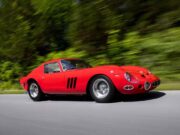






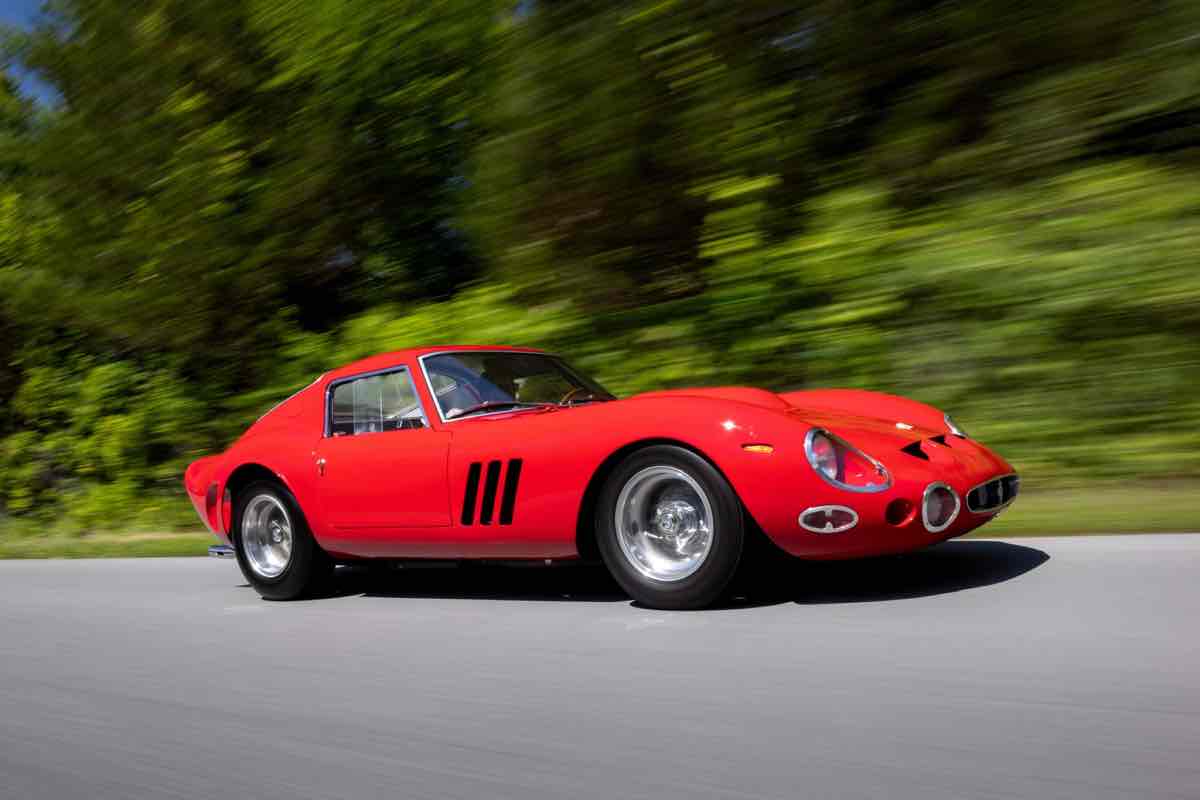
It isn’t one of the impossibly valuable original Ferrari 250 GTOs, nor is it one of the three genuine 330 GTOs built by Maranello. Yet this extraordinary Ferrari-based 330 GTO re-creation still crossed the seven-figure barrier. Built in the early 1990s by respected Ferrari specialist Terry Hoyle with hand-formed aluminum bodywork by Rod Jolley, the V12-powered machine sold for an astonishing $1,000,999 on Bring a Trailer after attracting 39 bids.
Not a Genuine GTO — But Far More Than an Ordinary Replica
Few combinations of letters and numbers carry more weight in the collector-car world than Ferrari 250 GTO.
Original examples rank among the most valuable automobiles ever created, combining extreme rarity, competition history, Scaglietti bodywork and Colombo V12 power.
The car recently sold on Bring a Trailer occupies a very different — but fascinating — corner of the Ferrari world.
This is a Ferrari 330 GTO re-creation, reportedly constructed during the early 1990s by English Ferrari specialist Terry Hoyle. Rather than using a modern reproduction chassis or unrelated platform, the project was based on components and the identity associated with a genuine 1964 Ferrari 330 GT 2+2, chassis 5807GT.
The distinction is important: this is not an original Ferrari GTO. But with genuine Ferrari roots, period-style mechanicals and hand-formed aluminum bodywork, it is considerably more serious than a typical replica.
That was reflected in the auction result.
After 39 bids, the car sold on September 15, 2026, for exactly $1,000,999.
Inspired by One of Ferrari’s Rarest Competition Cars
The 250 GTO was already establishing itself as a formidable competition machine when Ferrari explored a larger-displacement version for endurance racing.
Changes to Le Mans regulations had created a 4.0-liter prototype category, encouraging Ferrari to install a larger Colombo V12 into a GTO-related chassis.
Only three examples of what became known as the 330 GTO were built.
Closely related visually to the 250 GTO, these exceptionally rare cars incorporated distinctive details required by their larger engines, including a prominent hood bulge.
The re-creation sold on Bring a Trailer takes its inspiration specifically from Ferrari 330 GTO chassis 4561SA.
Rather than merely approximating the GTO shape, its builders went to considerable lengths to reproduce the proportions and details of the original competition machine.
The aluminum body rides on a 94.5-inch wheelbase and was reportedly fabricated by Hampshire-based panel craftsman Rod Jolley.
Its shape captures the essential GTO formula: long hood, low roofline, muscular fenders and dramatically abbreviated tail.
Up front are faired-in Marchal headlights and fog lamps with three distinctive D-shaped air openings. Triple angled vents appear behind the front wheels, while additional ventilation, a rear spoiler, Monza-style fuel filler and four SNAP exhaust outlets complete the competition-inspired exterior.
Built by Ferrari Specialist Terry Hoyle
Builder Terry Hoyle had substantial experience with Ferrari machinery.
He worked for Maranello Concessionaires during the 1960s before establishing his own operation and eventually specializing in classic Ferrari restoration.
The 330 GTO re-creation was reportedly completed in the early 1990s using the identity of a first-series Ferrari 330 GT 2+2 that had been dismantled during the 1980s.
Ferrari serial-number documentation identifies 5807 as originally belonging to that 330 GT 2+2 and subsequently being rebodied by Hoyle in the style of 330 GTO chassis 4561SA.
That provenance helps explain why this car occupies an unusual position between a conventional replica and an original competition Ferrari.
A 4.0-Liter Colombo V12 Is the Star of the Show
Under the long aluminum hood sits arguably the most important component of the entire build: a 4.0-liter Ferrari Colombo V12.
The engine features dry-sump lubrication and breathes through six Weber carburetors, complete with twin intake trumpets.
There is no modern fuel injection, turbocharging or hybrid assistance here. The experience is built around twelve naturally aspirated cylinders, carburetors and old-school mechanical engineering.
A riveted aluminum fuel tank sits at the rear alongside a similarly constructed aluminum oil tank, further reinforcing the period competition character.
Power is sent to the rear wheels through a Colotti close-ratio five-speed manual transmission, operated through a proper gated shifter.
The suspension combines coil-sprung independent front suspension with a leaf-sprung solid rear axle located by a Watt’s linkage. Telescopic shock absorbers are fitted at all four corners, while Dunlop disc brakes handle stopping duties.
It is an appropriately mechanical specification for a machine designed to evoke a 1960s Ferrari racer.
Borrani Wire Wheels and a Purpose-Built Cockpit
The Ferrari rides on 15-inch Borrani wire wheels secured by traditional three-eared knock-offs and wrapped in Michelin XWX tires measuring 205/70R15 at the front and 225/70R15 at the rear.
A matching spare is carried in the rear compartment.
Inside, luxury gives way to competition functionality.
Two fixed-back bucket seats are trimmed in blue leather and cloth, contrasting beautifully with the red exterior and exposed aluminum cabin.
Red Willans four-point harnesses secure the occupants, sliding side windows reinforce the racing theme, and a wood-rimmed Moto-Lita steering wheel sits ahead of the driver.
The crinkle-finished dashboard houses Veglia instrumentation, including an 8,000-rpm tachometer and gauges for fuel level, coolant temperature, fuel pressure, oil temperature and oil pressure.
A modern SPA Design digital speedometer has also been fitted.
There is little here that could be described as luxurious in the traditional Ferrari grand-touring sense. Instead, the cockpit looks focused almost entirely on the act of driving.
Its History Includes an Interesting Chassis-Number Complication
The car reportedly spent time in Belgium and Switzerland and was once owned by a former Formula One team principal, although that individual was not publicly identified in the Bring a Trailer listing.
By the time of the auction, it was located in North Salem, New York, and carried a Montana title identifying it as a 1964 Ferrari.
Its documentation also contains an unusual complication.
Tags in the engine compartment and on the dashboard display chassis number 5807, and the same number appears on a plate attached to the frame.
However, the auction listing disclosed that the 5807 chassis number has also been used on a separate Ferrari 250 GT California Spyder re-creation built around the late 1980s.
That makes the documented history particularly important.
The listing referenced Matthias Urban’s Ferrari serial-number guide, which describes 5807 as originally belonging to a first-series Ferrari 330 GT 2+2 and later being rebodied by Terry Hoyle as a replica of 330 GTO 4561SA.
Why Is a Re-Creation Worth $1 Million?
This is where the car becomes particularly interesting.
One million dollars opens the door to an extraordinary selection of genuine collector cars, yet judging this Ferrari simply as a replica arguably misses much of its appeal.
It combines a genuine Ferrari connection with a 4.0-liter Colombo V12, six Weber carburetors, a Colotti five-speed manual, hand-formed aluminum coachwork, Borrani wire wheels and period-style competition hardware.
It was also constructed more than three decades ago by specialists familiar with classic Ferraris rather than being a recently assembled visual imitation.
Then there is the driving experience.
A genuine 250 or 330 GTO has become such an enormously valuable historical artifact that using one aggressively on the road or track inevitably carries extraordinary financial consequences.
This car offers much of the visual and mechanical theater without putting an irreplaceable original at risk.
Its bodywork also captures one of Ferrari’s defining competition-era shapes. The long hood, compact cabin, muscular fenders and truncated tail weren’t created merely for appearance; they emerged from the requirements of racing and aerodynamics.
The result remains spectacular more than six decades later.
A Remarkable Seven-Figure Result
The $1,000,999 final price demonstrates how far the upper end of the re-creation market can extend when the right ingredients come together.
Construction quality, period-correct components, mechanical specification, builder reputation, donor-car origins and documentation can dramatically separate a serious re-creation from an ordinary replica.
This car has many of those attributes.
It remains emphatically not an original Ferrari 330 GTO, and its historical significance cannot be compared directly with one of the three genuine cars.
But that doesn’t prevent it from being an extraordinary automobile in its own right.
It combines genuine Ferrari origins with a glorious Colombo V12, Weber carburetors, a five-speed manual transmission, hand-formed aluminum bodywork and one of the most celebrated silhouettes in automotive history.
The bidders knew exactly what it was — and what it wasn’t.
One of them still decided it was worth $1,000,999.
And perhaps the most appealing part is that, unlike an original GTO now worth an almost unimaginable amount of money, this Ferrari still feels like a machine built to be driven.