

























Ford Racing is reaching all the way back to the moment that helped create the Ford Motor Company. For the 2026 Motul Petit Le Mans, the factory Mustang GT3 EVO race cars will wear a special livery inspired by “Sweepstakes,” the legendary machine Henry Ford drove to victory on October 10, 1901. The tribute connects 125 years of Ford racing history with the company’s modern global motorsports program — and when darkness falls at Road Atlanta, the cars will reveal another spectacular surprise.
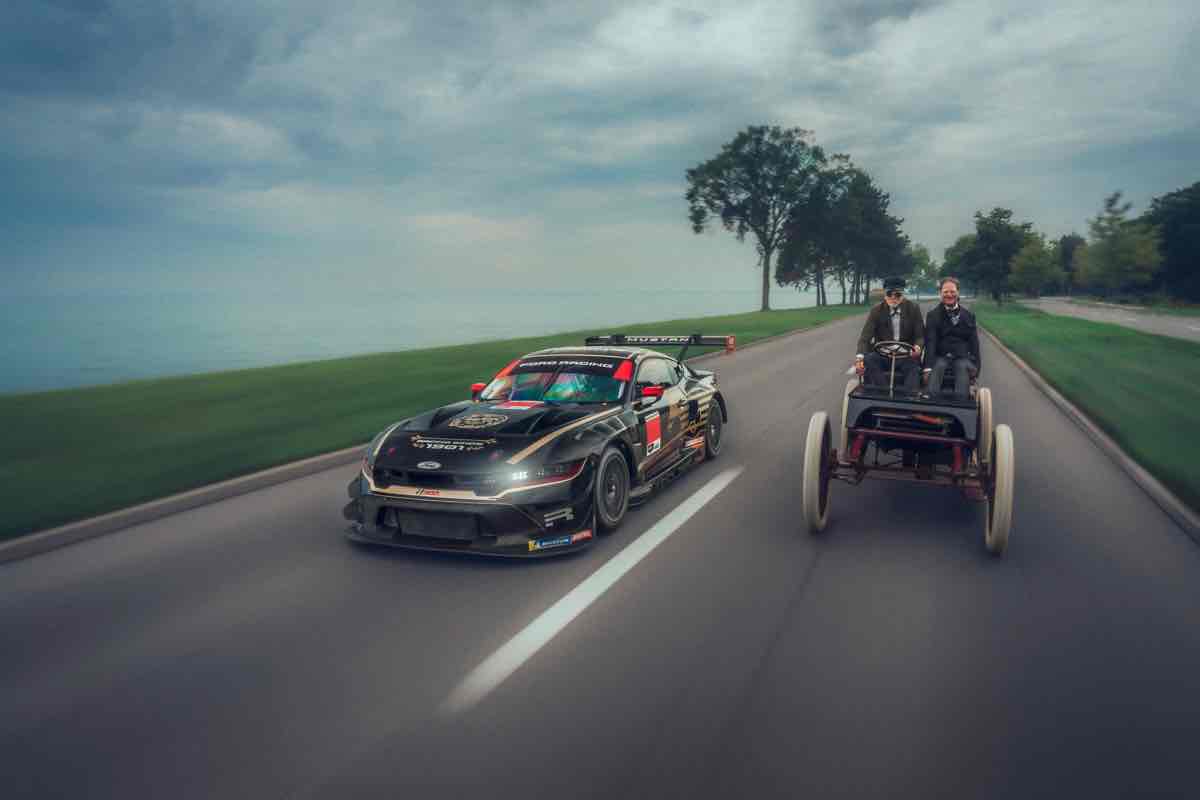
A 125-Year-Old Race Car Inspires Ford’s Modern Mustang GT3
Long before the Mustang, the GT40, NASCAR victories or Ford’s legendary triumphs at Le Mans, there was Sweepstakes.
The small and remarkably simple race car occupies an enormously important place in Ford history. Henry Ford drove it in a 10-mile race at the Grosse Pointe track in Michigan on October 10, 1901, defeating Alexander Winton, one of America’s best-known automobile manufacturers and racers at the time.
It was far more than another early automobile race.
Ford’s victory helped establish his reputation as an engineer and automobile builder at a time when he was still trying to secure the financial support necessary to turn his automotive ambitions into a sustainable business.
Now, 125 years later, Ford Racing is bringing Sweepstakes back to the racetrack — at least in spirit.
The No. 64 and No. 65 factory Ford Mustang GT3 EVO race cars will compete in the season-ending Motul Petit Le Mans at Michelin Raceway Road Atlanta wearing a special design inspired by Henry Ford’s historic racer.
And the symbolism is difficult to miss.
Ford’s modern GT3 race car represents more than a century of technological development, but the fundamental philosophy behind it remains remarkably similar: race, learn, improve and use competition to push the company forward.
Why Henry Ford’s 1901 Victory Changed Everything
The story behind Sweepstakes is especially significant because Ford Motor Company did not yet exist when Henry Ford entered that famous race.
Ford was still trying to establish himself in the rapidly developing automobile industry.
Alexander Winton, meanwhile, was already a major name. He had experience, reputation and machinery on his side, making Henry Ford very much the underdog.
Ford nevertheless won.
That victory generated publicity and helped demonstrate his engineering capabilities to potential investors. Less than two years later, in 1903, Ford Motor Company was founded.
It is therefore difficult to separate Ford’s motorsports history from the origins of the company itself.
Racing wasn’t something Ford discovered after becoming an automobile manufacturer.
Racing helped him become one.
That makes Sweepstakes fundamentally different from a typical heritage race car. It represents one of the earliest building blocks in the history of what eventually became one of the world’s largest automobile manufacturers.
The Mustang GT3 EVO Becomes a Modern-Day Sweepstakes
For Petit Le Mans, Ford Racing has translated the visual identity of the original Sweepstakes into a modern GT3 racing machine.
The familiar Ford Racing blue-and-white appearance of the factory Mustang GT3 EVO cars gives way to a special heritage-inspired design that incorporates elements referencing the original racer.
Among the most important details is the use of the historic Ford Motor Company logo.
The design also includes a reference to 1903, the year Ford Motor Company was officially established.
Putting those details onto a modern Mustang GT3 creates a fascinating visual bridge between two machines separated by 125 years of automotive development.
The original Sweepstakes was created during an era when the automobile itself was still experimental technology.
The Mustang GT3 EVO, by contrast, is an extraordinarily sophisticated competition machine developed using advanced aerodynamics, electronics, simulation, data analysis and more than a century of accumulated automotive engineering knowledge.
Yet both exist for essentially the same reason: competition.
The Idea Started at The Henry Ford Museum
Interestingly, the modern Sweepstakes tribute wasn’t simply created as another anniversary marketing exercise.
The idea developed after Ford Racing’s Scott Bartlett visited The Henry Ford museum while delivering a Mustang GT3 to customer team Myers Riley Motorsports.
The delivery took place near the original Sweepstakes display.
Seeing the historic race car alongside the modern Mustang GT3 helped inspire the idea of combining the two eras.
Working with the Ford Archives, Ford Racing subsequently developed the heritage treatment that will appear at Petit Le Mans.
The result is more than a retro paint scheme.
It is effectively a visual timeline of Ford Racing, placing the machine that helped begin Henry Ford’s automotive career alongside a modern Mustang competing at one of America’s most important endurance races.
Then the Mustang Changes When the Sun Goes Down
Ford isn’t stopping with the Sweepstakes tribute.
Petit Le Mans is an endurance race, meaning the cars will continue competing as daylight disappears over Michelin Raceway Road Atlanta.
And that’s when the Mustang GT3 EVO’s appearance changes dramatically.
At night, Ford’s factory racers will transition into a modern illuminated design described as the second version of the “Glow Pony.”
The nighttime appearance incorporates an American flag motif rendered in black and gold, adding another layer of historical significance to the project.
The design recognizes the United States’ 250th anniversary while simultaneously connecting Ford’s earliest motorsports history with the company’s current racing program.
That means the same Mustang effectively tells two stories during a single race.
During daylight, it looks back to Henry Ford and Sweepstakes.
At night, it turns toward modern America and Ford Racing’s future.
Ford Racing Still Believes Competition Requires Taking Risks
There is another reason Sweepstakes fits particularly well with Ford’s current motorsports strategy.
Henry Ford’s decision to race Alexander Winton in 1901 was a genuine gamble.
Losing could have damaged his already uncertain prospects. Winning, however, could provide exactly the attention and credibility he needed.
The gamble worked.
That willingness to take risks remains central to the way Ford Racing describes its modern competition programs.
Today’s stakes are obviously very different, but motorsports remains an environment where manufacturers must commit enormous engineering resources without any guarantee of success.
Racing forces engineers to make decisions quickly, operate machinery at its limits and compete against rivals facing exactly the same challenges.
For Ford, that pressure is part of the value.
The racetrack isn’t simply a place to advertise vehicles. It can also function as an accelerated development environment where technologies, materials, software, aerodynamics and engineering concepts are tested under extreme conditions.
From Sweepstakes to Mustang GT3
The difference between Ford’s first racing machine and today’s Mustang GT3 is almost impossible to overstate.
Sweepstakes was powered by a two-cylinder engine producing approximately 26 horsepower.
Its engineering was primitive by modern standards, but for 1901 it represented serious competition machinery.
The Mustang GT3 EVO comes from another universe.
Developed for international GT3 competition, the race car is based around the Mustang platform but transformed extensively for professional motorsports.
Power comes from a race-prepared 5.4-liter naturally aspirated V-8 developed by Ford Performance and assembled by longtime Ford racing partner M-Sport.
The Mustang GT3 architecture includes a rear-mounted transaxle, short-long arm suspension, sophisticated aerodynamic components and extensive use of lightweight materials.
Multimatic plays a major role in the program, including development and assembly of the competition chassis.
The result is a Mustang capable of competing on some of the world’s most demanding circuits against GT3 machinery from manufacturers including Porsche, Ferrari, BMW, Mercedes-AMG, Chevrolet, Lamborghini and others.
That international competition makes the connection to Sweepstakes even more meaningful.
Henry Ford entered racing partly because competition offered a way to prove what his engineering could accomplish.
A century and a quarter later, Ford is still using the racetrack to do essentially the same thing.
Petit Le Mans Provides the Perfect Stage
The 2026 Motul Petit Le Mans at Michelin Raceway Road Atlanta provides an appropriate venue for the anniversary celebration.
The race is one of the premier endurance events in North America and serves as the season finale for the IMSA WeatherTech SportsCar Championship.
Ford’s two factory Mustang GT3 EVO entries will compete in the highly competitive GTD PRO category.
The No. 65 Mustang will be driven by Christopher Mies and Fred Vervisch, joined for the endurance race by Seb Priaulx.
The No. 64 Mustang arrives with momentum following a class victory at Indianapolis Motor Speedway and will be driven at Petit Le Mans by Dennis Olsen, Ben Barker and Mike Rockenfeller.
For the No. 65 crew, the season finale also carries championship significance, giving Ford’s heritage celebration a very real competitive purpose.
This isn’t a demonstration run.
These cars are going racing.
The Mustang GT3 Is Part of a Much Bigger Ford Racing Strategy
The Sweepstakes tribute also arrives during one of the most ambitious periods in Ford’s modern motorsports history.
Mustang has become the centerpiece of a global racing strategy spanning numerous disciplines and championships.
Different versions of the Mustang compete in everything from NASCAR and Australian Supercars to GT4 and GT3 racing.
Ford has also dramatically expanded its international racing ambitions.
The company has committed to a top-level prototype program aimed at returning Ford to the highest category of endurance racing, continuing a story forever linked with the legendary Ford GT40 and its historic victories at the 24 Hours of Le Mans.
That makes the timing of the Sweepstakes celebration particularly appropriate.
Ford Racing is simultaneously looking backward and forward.
The company is honoring the race that helped establish Henry Ford while investing heavily in the next generation of Ford competition vehicles.
Racing Has Been Part of Ford Since Before Ford Motor Company
Few automotive manufacturers can trace their motorsports involvement to a period before the company itself officially existed.
Ford can.
That is what makes Sweepstakes such an important machine.
It isn’t simply the first chapter in Ford’s racing history. In many ways, it belongs to the prologue of Ford Motor Company itself.
The 1901 victory helped give Henry Ford the recognition he needed at precisely the moment when his future as an automobile manufacturer remained uncertain.
What followed became automotive history.
Ford Motor Company was established in 1903. The Model T transformed personal transportation. Ford developed mass-production techniques that changed manufacturing. Decades later, the GT40 conquered Le Mans, Mustang became an American performance icon, and Ford accumulated victories across virtually every major form of motorsport.
All of those achievements came later.
Sweepstakes came first.
125 Years Later, Ford Is Still Racing Toward the Future
Putting a Sweepstakes-inspired livery on a Mustang GT3 EVO could easily have been little more than a nostalgic anniversary gesture.
Instead, the contrast between the two cars highlights just how much has changed — and how much hasn’t.
The technology is almost unrecognizable.
The speeds are dramatically higher. The engineering teams are larger. The data is more sophisticated. The competition has become global.
But racing remains fundamentally about risk.
It requires manufacturers to push machinery beyond the demands of ordinary road use, challenge competitors with equally ambitious engineering programs and accept that failure is always possible.
Henry Ford took that gamble in 1901.
On October 3, 2026, Ford’s Mustang GT3 EVO cars will carry the visual legacy of Sweepstakes around Michelin Raceway Road Atlanta at Petit Le Mans.
One hundred and twenty-five years separate those two moments.
But for Ford Racing, the philosophy connecting them remains remarkably familiar: sometimes, creating the future means being willing to put everything on the line.