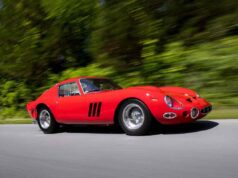





















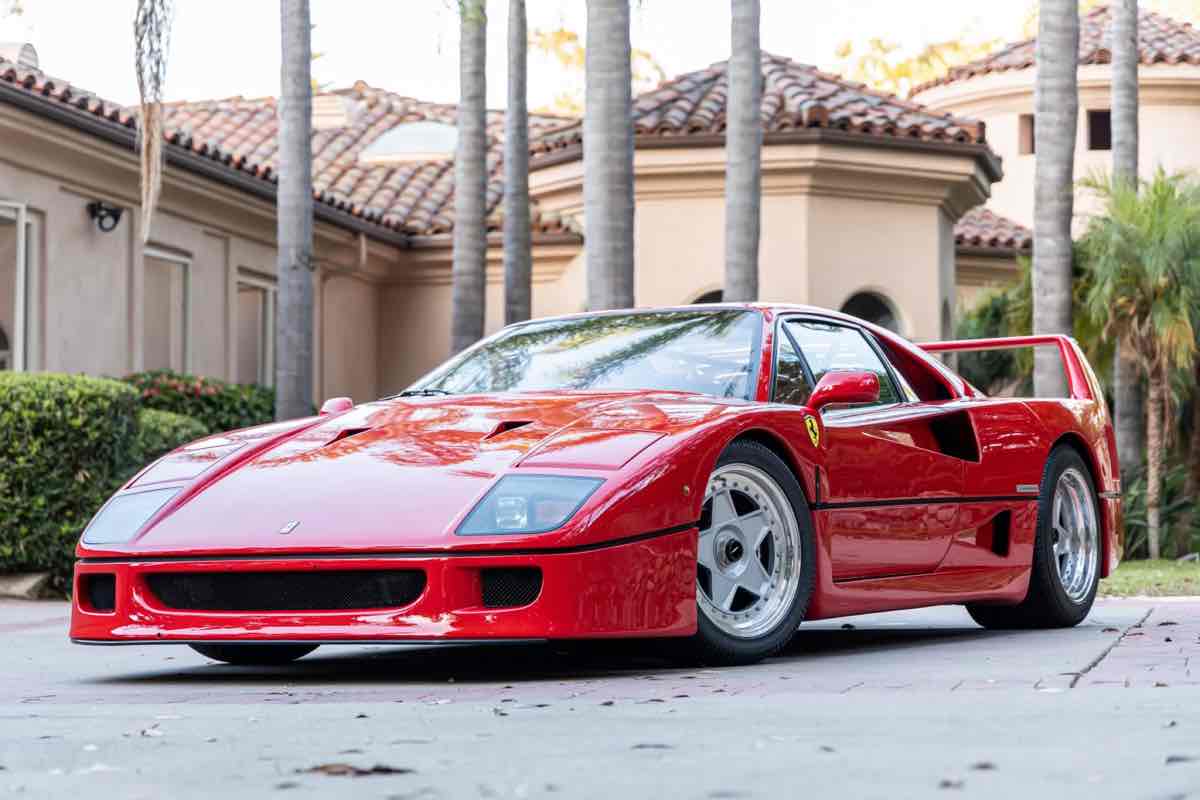
Few cars have aged quite like the Ferrari F40. Nearly four decades after its debut, it remains one of the most recognizable, desirable, and valuable supercars ever built. There is no hybrid assistance, no dual-clutch transmission, no traction control, and virtually nothing separating the driver from a twin-turbocharged V8 and the rear wheels. What the F40 does offer is roughly 478 horsepower, a five-speed manual transmission, an incredibly lightweight body, a 200-plus-mph top speed, and one of the most iconic shapes in automotive history. Today, exceptional examples command several million dollars — and although seeing an F40 on Bring a Trailer is a rare event, they do occasionally appear. Just don’t expect a bargain.
The Ferrari F40 Started With an Even Wilder Project
To understand the F40, you first have to go back to the Ferrari 288 GTO and the extraordinary GTO Evoluzione.
Ferrari developed the 288 GTO during an era when Group B regulations promised to create some of the most extreme racing machines on the planet. The GTO Evoluzione took the concept considerably further, combining an extremely lightweight structure with massive aerodynamic modifications and a twin-turbocharged V8. Group B ultimately disappeared before Ferrari could fully exploit the program, but the engineering work wasn’t wasted.
Instead, Ferrari realized it had the foundation for something extraordinary: a road-going supercar that would incorporate much of the philosophy and technology developed for competition.
The result was the F40.
Ferrari officially unveiled the car in Maranello on July 21, 1987. The name itself commemorated Ferrari’s 40th anniversary, but the F40 would ultimately become significant for another reason.
It was the final road-going Ferrari introduced during Enzo Ferrari’s lifetime and developed with his approval. Enzo Ferrari died in August 1988. That historical connection alone would eventually make the F40 special. But the car Ferrari created was even more remarkable.
Ferrari Initially Planned to Build Far Fewer F40s
Ferrari reportedly expected production to be limited to roughly 400 cars.
Demand changed everything. The reaction to the F40 was enormous, with hundreds of orders arriving almost immediately. Ferrari consequently continued production, and total output ultimately exceeded 1,300 cars.
That means the F40 isn’t necessarily the rarest Ferrari ever built. Yet rarity is only one component of collectibility.
The F40 occupies a unique position in Ferrari history that is almost impossible for another model to replicate.It marked the end of the Enzo Ferrari era while simultaneously representing one of the purest expressions of what a late-1980s supercar could be.
A Supercar That Wasn’t Interested in Luxury
Modern Ferrari buyers can expect extraordinary performance without necessarily sacrificing comfort. An F40 owner received something very different. Ferrari was obsessed with keeping the car lightweight, and virtually anything considered unnecessary was either simplified or removed altogether.
There was no power steering. There was no traction control.
There was no electronic stability control. There was no sophisticated electronically controlled suspension attempting to make the car comfortable on the highway and aggressive on a racetrack.
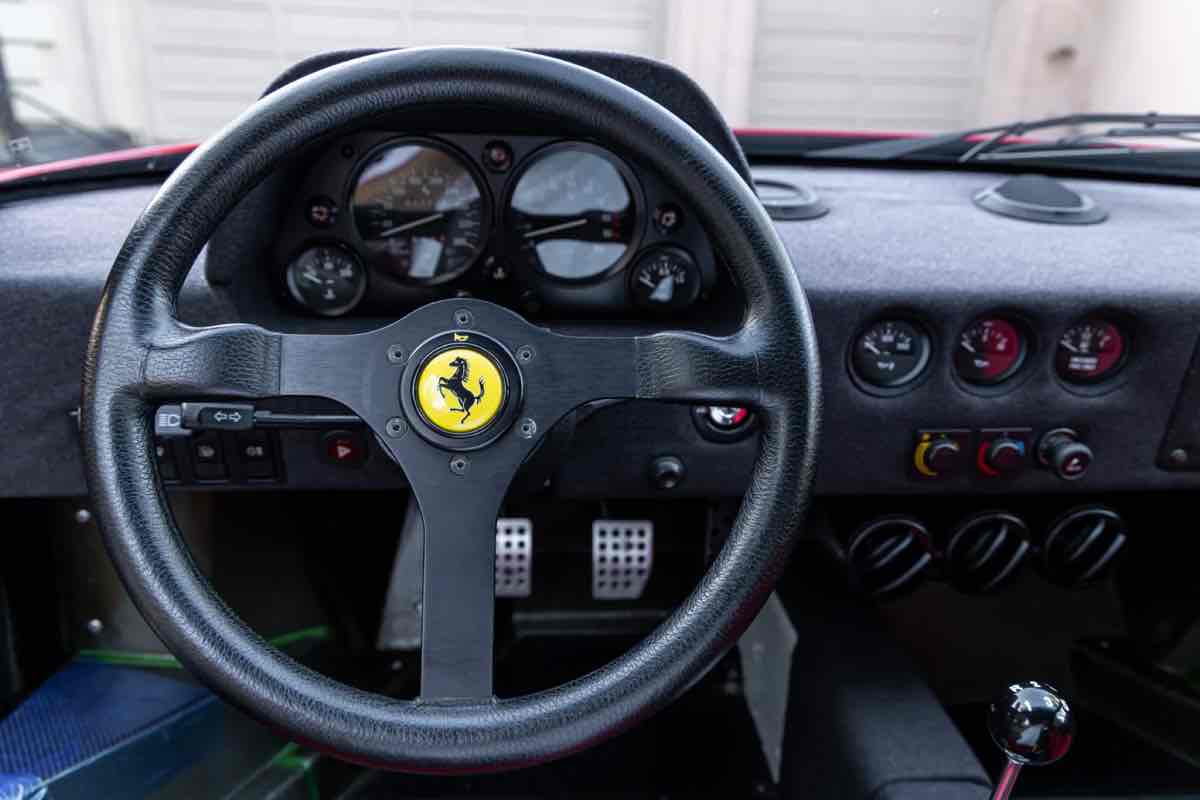
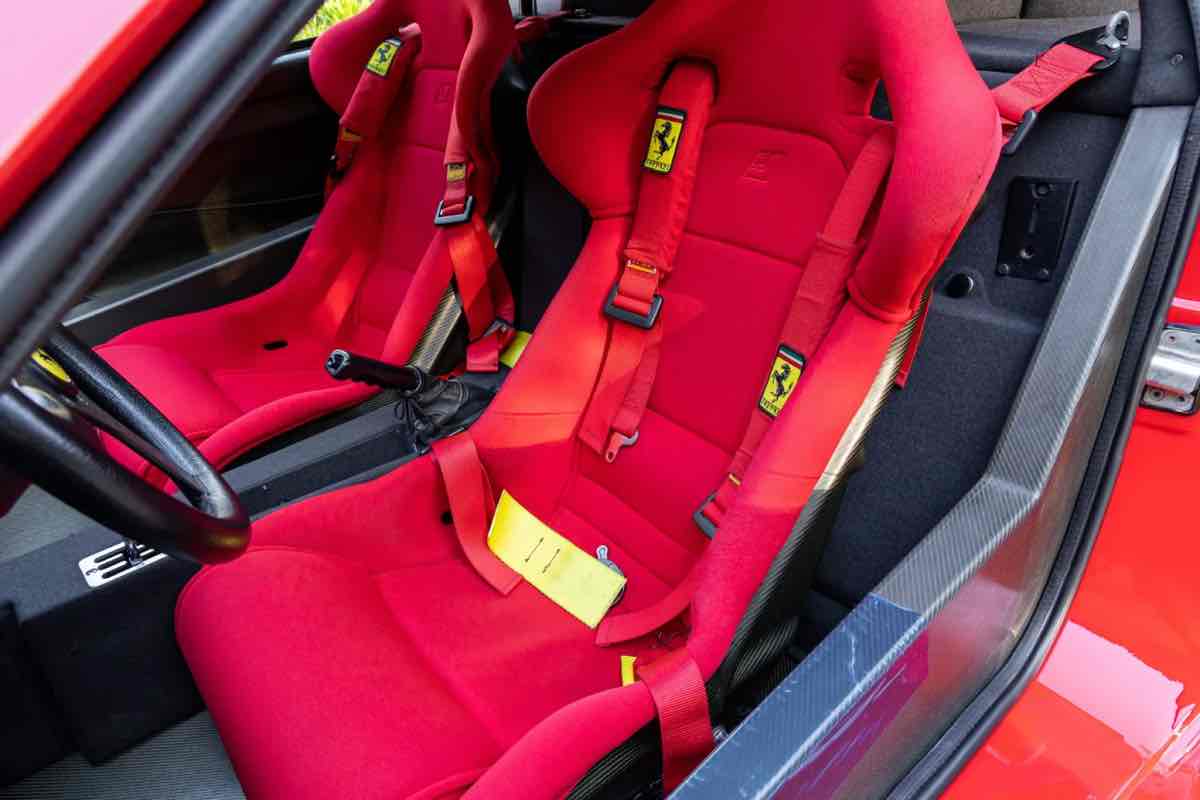
Even the interior was deliberately sparse. Depending on specification, the cabin featured lightweight bucket seats, minimal carpeting and trim, simple instrumentation, exposed composite materials, and lightweight door hardware. Ferrari famously used simple pull cords for the interior door releases on certain versions. The F40 wasn’t trying to be a luxury GT.
It was essentially Ferrari asking what would happen if race-car thinking were applied to a road-legal supercar with just enough equipment to make the concept usable.
Carbon Fiber and Kevlar Before They Became Supercar Buzzwords
The F40 was also technologically exotic for the late 1980s.
Its construction combined a tubular steel chassis with advanced composite materials, including carbon fiber and Kevlar. Today, carbon fiber is practically expected on an exotic car costing hundreds of thousands of dollars. In 1987, its extensive use in a production road car was far more remarkable.
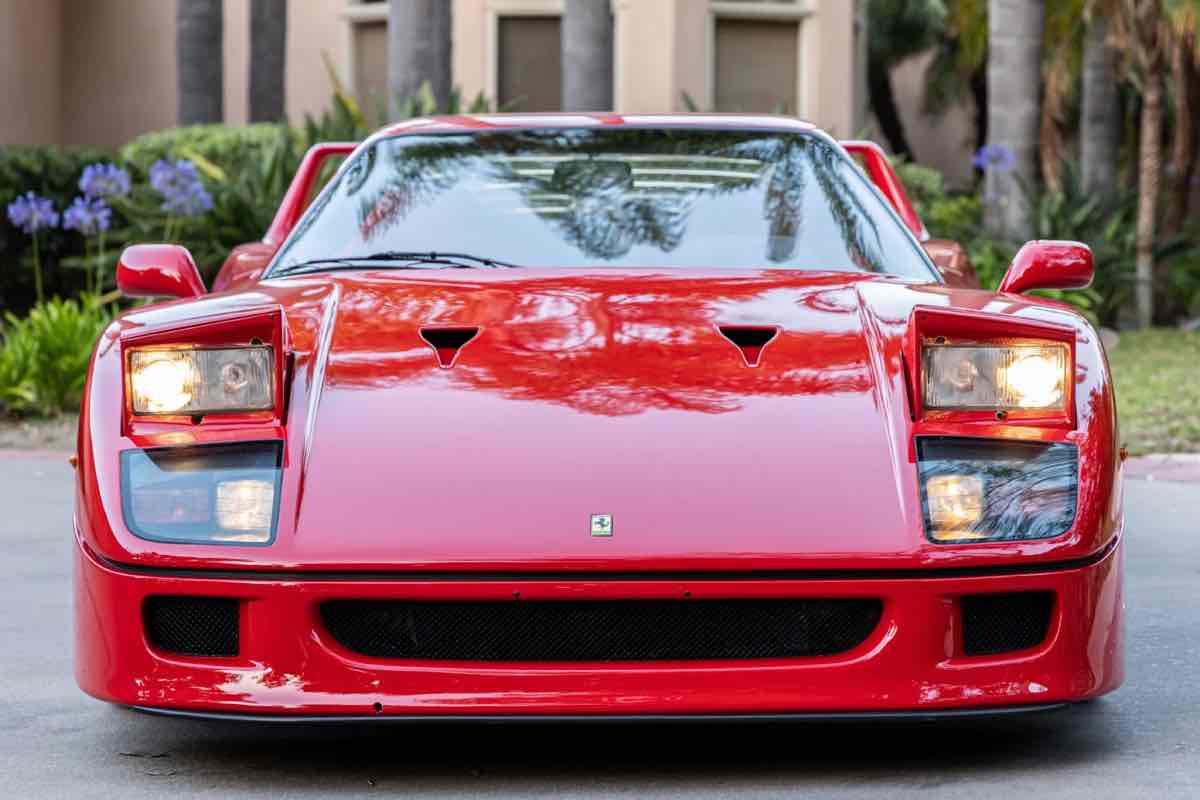
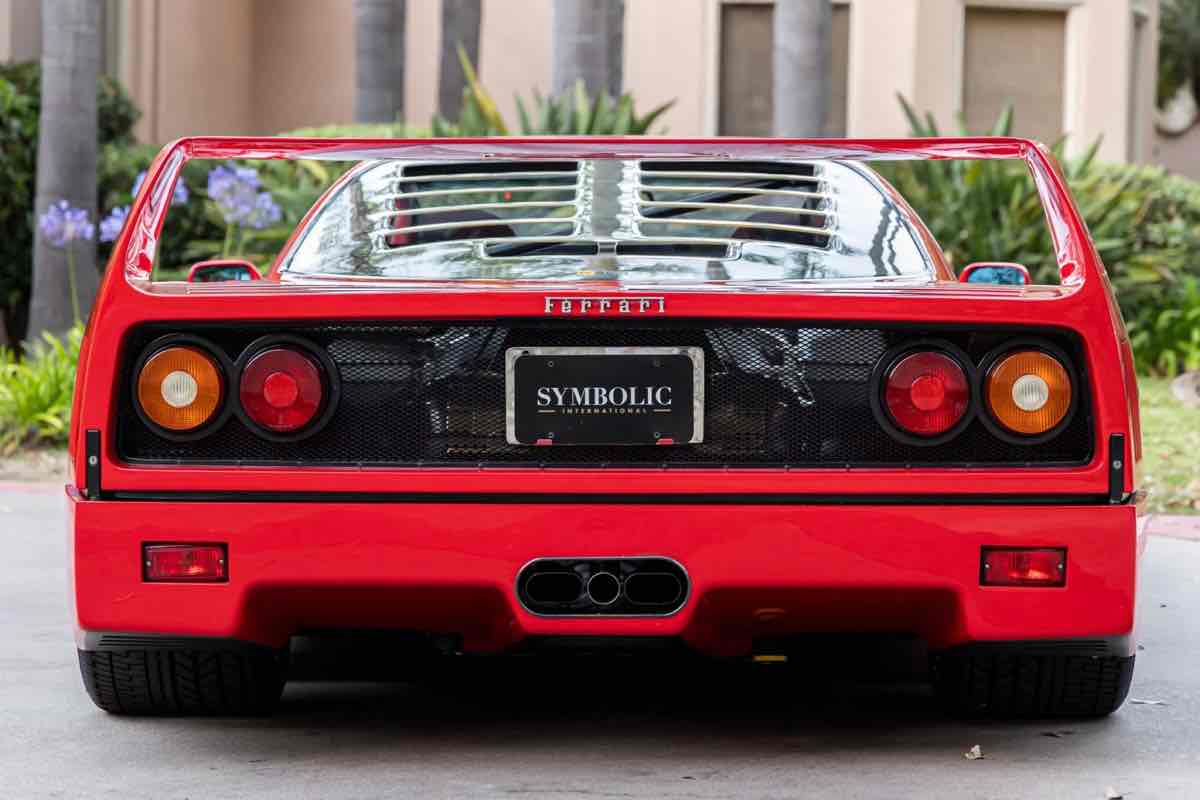
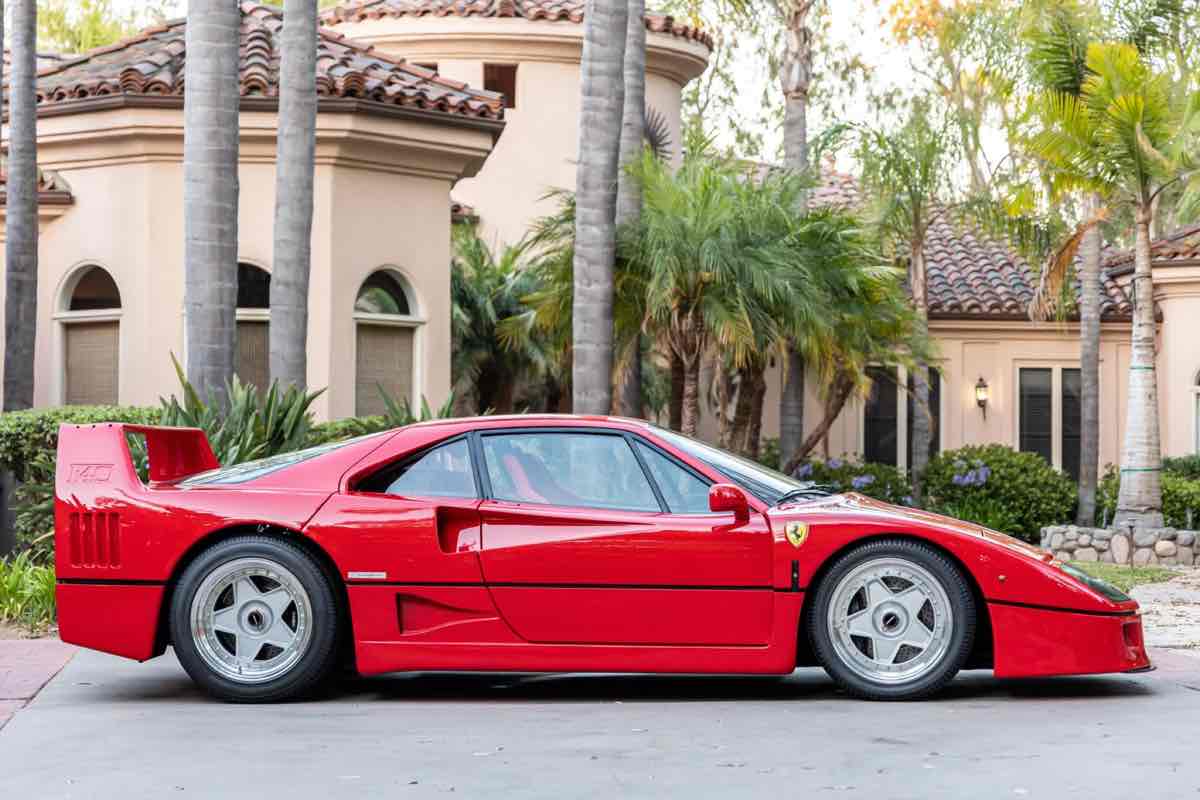
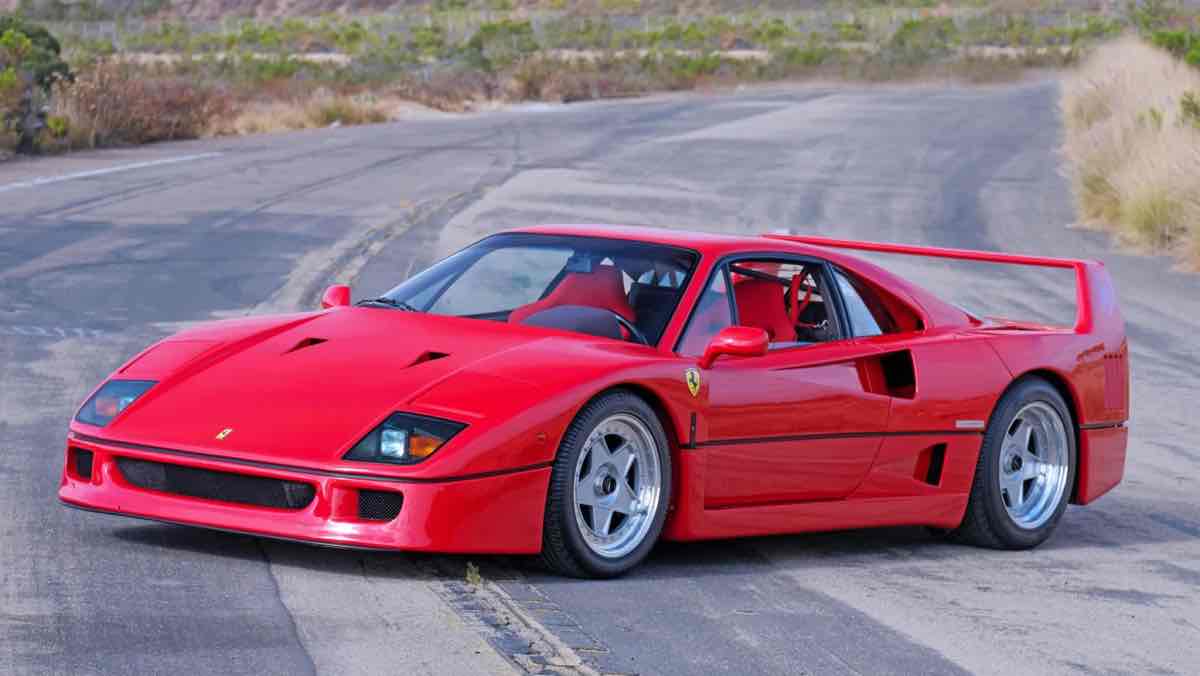
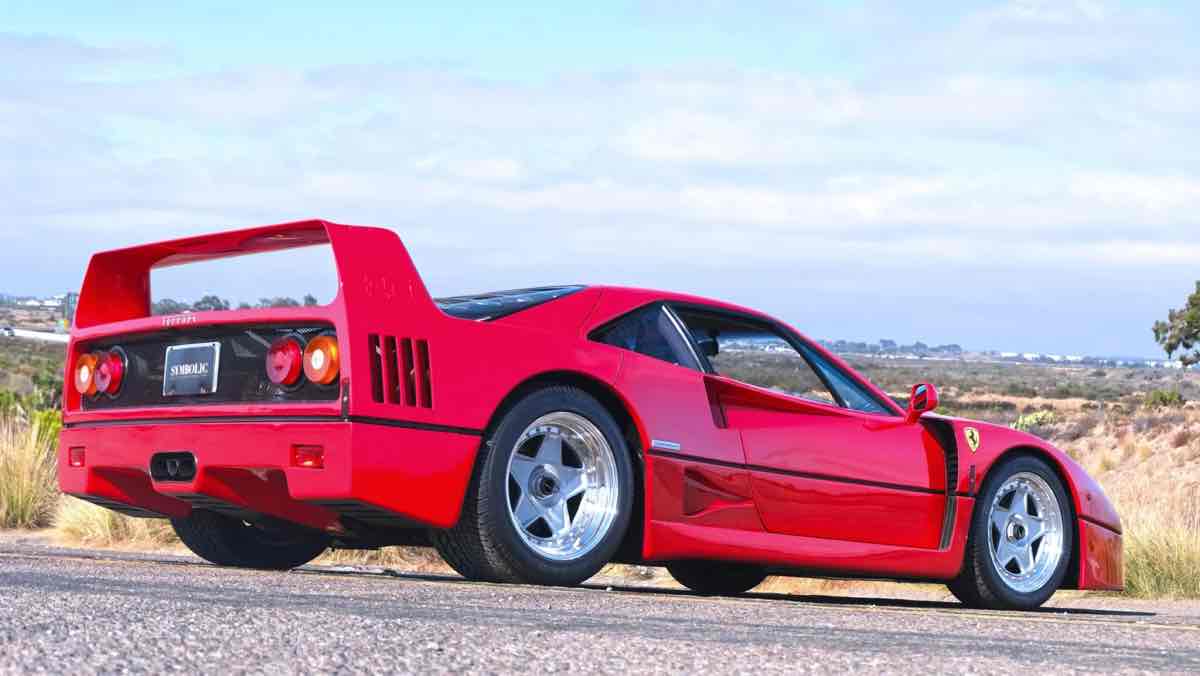
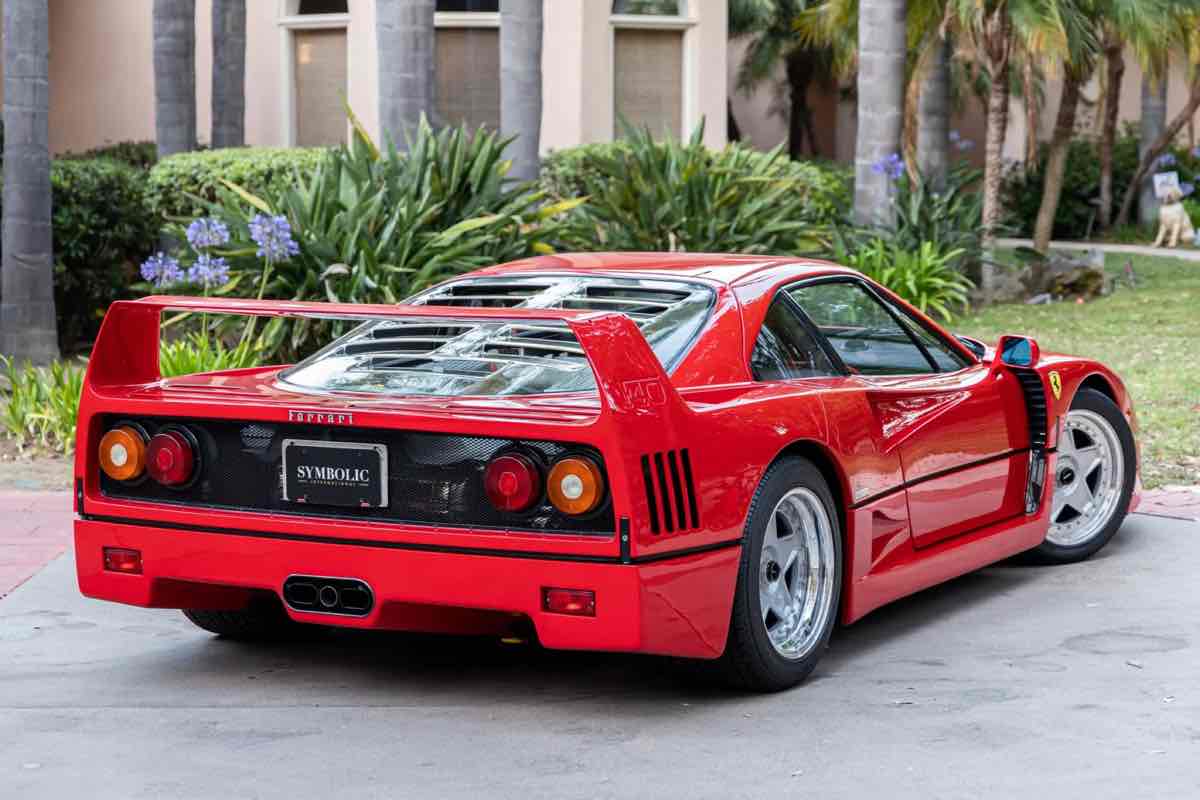
The bodywork was equally purposeful. Pininfarina’s design included an extremely low nose, NACA ducts, aggressive air intakes, a wide rear body and, of course, that enormous fixed rear wing.
It looked like a race car because its shape was dictated heavily by aerodynamic and cooling requirements. Yet one number perhaps illustrates the philosophy better than anything else.
European-specification F40s could weigh roughly 2,425 pounds depending on configuration. Put that into a modern perspective. Many of today’s high-performance cars weigh well over 3,500 pounds. Some electrified performance cars approach or exceed 4,500 pounds.
The F40 weighs roughly as much as a small modern economy car — while producing nearly 480 horsepower.
A 2.9-Liter Twin-Turbo V8 With 478 Horsepower
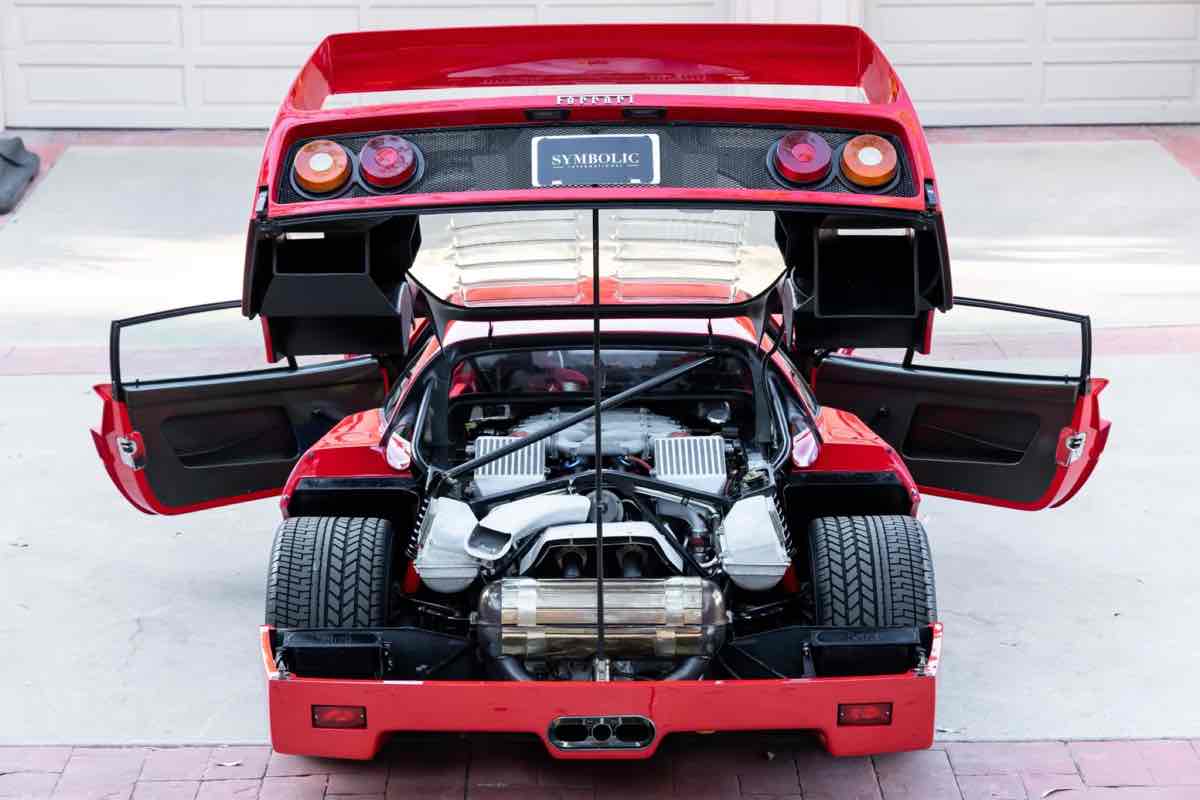
Behind the passenger compartment sits the centerpiece of the F40 experience. Ferrari’s 2,936-cc, 90-degree V8 uses two IHI turbochargers and twin intercoolers. European specification was rated at approximately 478 horsepower at 7,000 rpm, with roughly 425 lb-ft of torque.
That power is sent exclusively to the rear wheels through a five-speed manual transmission. There are no paddle shifters. There is no launch control. There is no computer deciding how much power each wheel should receive. The driver operates a clutch pedal, selects gears manually and controls what happens at the rear tires with the accelerator.
That simplicity is a major part of the F40’s appeal today.
Ferrari F40 Specifications
- Engine: 2.9-liter twin-turbocharged V8
- Displacement: 2,936 cc
- Turbochargers: Twin IHI units
- Intercoolers: Two
- Horsepower: Approximately 478 hp in European specification
- Torque: Approximately 425 lb-ft
- Transmission: Five-speed manual
- Drivetrain: Rear-wheel drive
- Engine layout: Longitudinal mid-engine
- European-spec weight: Approximately 2,425 pounds
- 0–62 mph: Approximately 4.1 seconds
- Top speed: Approximately 201 mph
- Wheels: 17-inch center-lock Speedline wheels
- Suspension: Independent double wishbones front and rear
- Brakes: Large ventilated and cross-drilled discs
Those performance figures might not sound outrageous by 2026 standards.
A modern electric performance sedan can accelerate to 60 mph significantly faster. But that comparison misses the point. The F40 weighs barely more than 2,400 pounds, produces nearly 480 horsepower and gives its driver almost no electronic safety net. Driving one quickly requires involvement.
The 200-MPH Barrier Was a Huge Deal
Ferrari claimed a top speed of approximately 201 mph, or 324 km/h. That number matters. Today, numerous supercars can exceed 200 mph. In the late 1980s, however, breaking through that barrier was extraordinary. The F40 became widely associated with the arrival of the 200-mph production supercar. That helped transform it from merely another high-performance Ferrari into a cultural phenomenon.
The F40 appeared on magazine covers, bedroom walls, scale models and posters around the world. For an entire generation of enthusiasts, the shape of an F40 became almost synonymous with the word “supercar.” And those children eventually grew up. Some of them also became wealthy enough to buy the car they once had hanging above their beds.
That matters enormously in today’s collector market.
The U.S.-Spec Ferrari F40 Was Different
For American collectors, there’s another important part of the story. The F40 officially came to the United States, but U.S.-market cars differed from their European counterparts due to federal safety and emissions requirements.
American-spec F40s gained additional equipment and structural changes that increased their weight. They can also be identified by various market-specific details. Only a relatively small portion of total F40 production was officially delivered to the United States, making genuine U.S.-market cars particularly interesting to American collectors.
However, European-market cars have also been imported into the U.S., especially as the model became old enough to qualify under federal import rules. That means buyers shopping for an F40 in America need to understand exactly which version they’re looking at. Documentation is critical.
Why Is the Ferrari F40 So Collectible?
There isn’t one simple answer. The F40 combines several attributes collectors value, and very few cars possess all of them simultaneously.
First is its connection with Enzo Ferrari. The F40 represents the final chapter of the company during its founder’s lifetime. That can never be recreated by a future Ferrari.
Second is the driving experience. The F40 comes from an era before supercars became dominated by sophisticated electronics. There is no dual-clutch transmission or computerized torque management between the driver and the mechanical experience.
Third is the design. An F40 doesn’t need a Ferrari badge to be recognized. Its silhouette has become one of the defining shapes in automotive history.
Fourth is nostalgia. The people who grew up dreaming about the F40 in the late 1980s and 1990s are now an important demographic within the collector-car market.
Finally, supply is permanently fixed. Ferrari can build a faster car tomorrow. It cannot build another original F40.
Condition and History Can Mean Millions of Dollars
Not every F40 is worth the same amount. Far from it. Mileage matters, but collectors also scrutinize originality, accident history, maintenance records, ownership history, factory specifications, paintwork, mechanical condition and documentation. Ferrari Classiche certification can also be significant. Then there are the individual components unique to these cars.
Fuel tanks, suspension components, turbocharger systems, composite body panels and other specialized parts require careful inspection and maintenance.
An F40 that has been properly preserved with extensive documentation can occupy an entirely different price category from an example with questionable history or extensive modifications.
The difference can potentially be measured in millions of dollars.
Ferrari F40 Prices Have Exploded
This is where the modern F40 story becomes remarkable. Values have climbed dramatically.
By 2026, public auction results for especially desirable examples were regularly entering territory that would have seemed extraordinary only a few years earlier. Several sales have exceeded $5 million, while exceptional cars have pushed considerably higher. This doesn’t mean every Ferrari F40 is suddenly an $8 million car.
Auction prices can be heavily influenced by mileage, specification, provenance, originality and the circumstances surrounding an individual sale. But it demonstrates something important. The F40 has moved beyond simply being an expensive classic Ferrari. It has become a blue-chip collector automobile.
Yes, You Can Occasionally Find a Ferrari F40 on Bring a Trailer
That brings us to one of the more fascinating places to watch the F40 market: Bring a Trailer. Bring a Trailer has evolved into one of America’s most important online enthusiast-car auction platforms, and its inventory can range from inexpensive project cars to seven-figure collector machines.
Every once in a while, that includes an F40. One particularly interesting example was a 1992 Ferrari F40 that appeared on the platform in 2022.
1992 Ferrari F40 auction on Bring a Trailer This wasn’t a typical U.S.-market F40.
The car had originally been delivered in Rome in July 1992 before reportedly entering a private museum collection in Japan in 1994. It remained there for decades before being imported into the United States in March 2022. At the time of the auction, the odometer showed approximately 17,000 kilometers, equivalent to roughly 11,000 miles. It also came with significant documentation, including a Ferrari Classiche Red Book. Prior maintenance included replacement aluminum fuel tanks and Koni coilovers, among other work. Then came the final number.
$2,440,444.
That’s what the F40 sold for on Bring a Trailer on August 5, 2022. More than $2.4 million for a used Ferrari sounds enormous. But looking at the F40 market only a few years later makes that sale particularly fascinating.
That $2.44 Million Price Looks Very Different Today
Collector-car values aren’t guaranteed to rise, and comparing two F40s is never as simple as comparing their auction prices. Nevertheless, the market has moved dramatically since that 2022 Bring a Trailer transaction.
By 2026, several F40 auction results had moved well beyond $3 million, with particularly desirable examples breaking through the $5 million level and exceptional cars going higher still. In other words, the Bring a Trailer F40 provides an excellent snapshot of just how quickly perceptions of value can change at the very top of the collector-car market.
A $2.44 million F40 sounded extraordinarily expensive in 2022. Several years later, that same number can look remarkably different.
Could an F40 Still Appear on Bring a Trailer?
Absolutely. But don’t expect to see one every week — or even every month. The number of owners willing to publicly auction an F40 online is naturally limited, and many examples change hands privately or through specialist dealers and traditional auction houses.
That’s precisely what makes seeing one appear on Bring a Trailer so interesting. Unlike walking into a Ferrari specialist and seeing an asking price, an online auction allows enthusiasts to watch the market react in real time.
You can see bidding develop. You can read questions from knowledgeable enthusiasts. You can inspect hundreds of photographs. You can review documentation. And eventually, you see exactly how much someone is willing to pay.
With an F40, that final number now tends to contain quite a few zeros.
The Ferrari F40 Represents Something Modern Supercars Can’t Recreate
Modern Ferraris are objectively superior automobiles in almost every measurable way.
They’re faster. They’re safer. They’re easier to drive. They’re more comfortable. They’re more efficient. Their transmissions shift almost instantaneously, their electronics can manage enormous horsepower, and their aerodynamic systems would have seemed like science fiction when the F40 was created.
But a new Ferrari can never become another F40. Ferrari cannot recreate 1987. It cannot produce another final supercar approved during Enzo Ferrari’s lifetime. And it cannot genuinely reproduce an era when a roughly 2,400-pound road car with a twin-turbo V8, five-speed manual transmission, rear-wheel drive and virtually no electronic driver aids was capable of more than 200 mph. That’s why the F40 matters. It’s more than a fast Ferrari. It’s a physical reminder of a period when the supercar was still slightly terrifying, deeply mechanical and completely uncompromising.
And as today’s multi-million-dollar auction results demonstrate, collectors understand exactly how difficult that experience is to replace.