



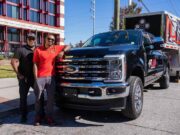










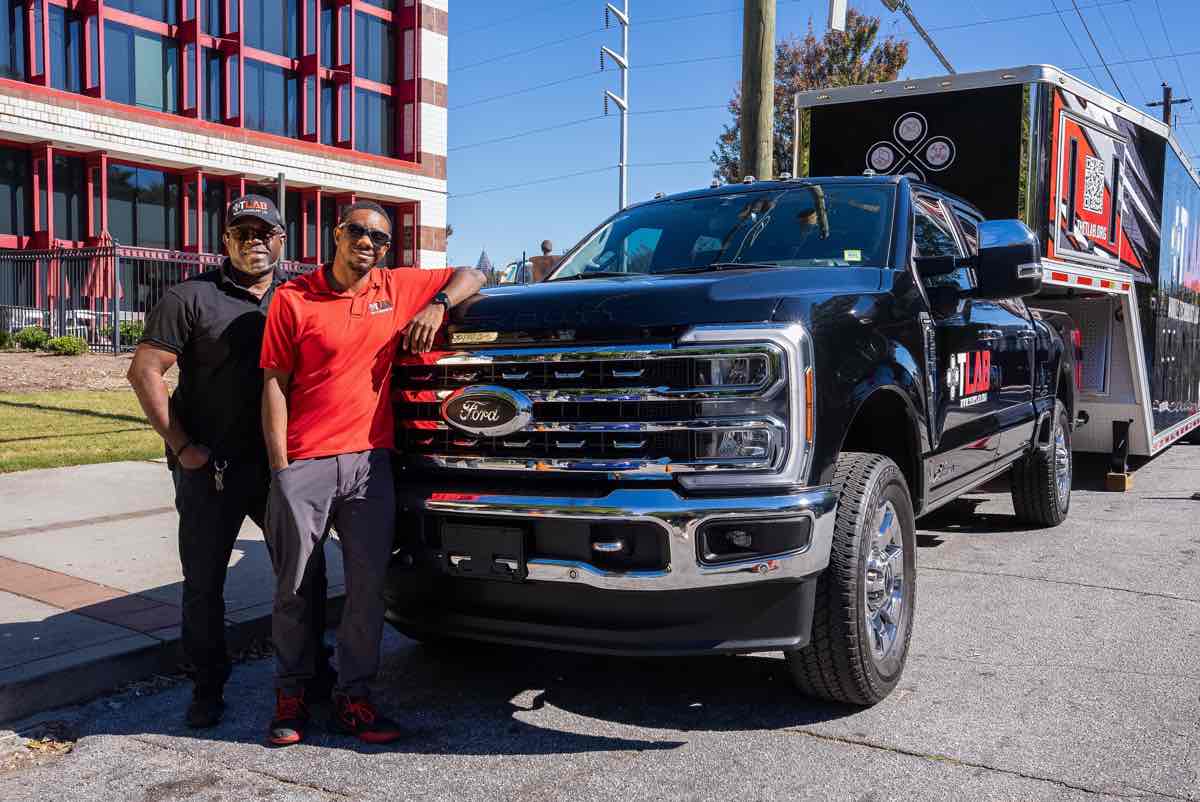
The Ford F-350 Super Duty is proving that heavy-duty pickup trucks can do much more than haul construction equipment or tackle demanding jobsites. In metro Atlanta, a father-and-son team is using a 2023 Ford F-350 Super Duty Lariat to transport a 40-foot mobile technology laboratory, bringing artificial intelligence education, coding, esports, and hands-on STEM learning directly to underserved communities. The ambitious project combines American truck capability with a mission to make modern technology education accessible to thousands of students and families.
A Ford Super Duty With a Mission Beyond Traditional Trucking
Heavy-duty pickup trucks have long been essential tools for American businesses, contractors, farmers, and commercial operators. Their towing capacity, durability, and versatility make them indispensable for transporting equipment and supporting demanding operations.
But in Atlanta, Georgia, one Ford Super Duty is playing a particularly meaningful role.
Robert Harden and his son Corey have developed TLAB, a mobile technology and innovation laboratory designed to bring advanced educational opportunities directly to neighborhoods where access to digital resources can be limited.
Rather than requiring students to travel to specialized technology centers, the Hardens bring the classroom to them.
Their mobile facility is housed inside a massive 40-foot gooseneck trailer, which is transported by a 2023 Ford F-350 Super Duty Lariat equipped with the Ultimate Package and Ford’s naturally aspirated 7.3-liter Godzilla V8 engine.
The combination creates a highly capable mobile educational platform that can visit schools, libraries, community centers, and other locations throughout metropolitan Atlanta.
And the truck is far more than a transportation accessory. It is an essential part of making the entire initiative possible.
Inside the 40-Foot Mobile Technology Laboratory
The TLAB trailer is essentially a fully functioning technology classroom on wheels.
Its interior contains 13 custom-built computer workstations, a dedicated server, artificial intelligence servers, and an extensive collection of electronic equipment.
The laboratory is equipped with its own generator, climate-control system, and dedicated cellular connectivity, allowing it to operate independently of conventional classroom infrastructure.
This self-contained configuration is particularly important when visiting communities where reliable internet access or advanced computer facilities may not be readily available.
Inside the trailer, up to 24 students can participate in educational activities simultaneously.
When an exterior tent is deployed, the overall capacity increases to 36 participants.
The equipment also supports esports competitions, technical workshops, and interactive demonstrations.
Corey Harden, an enthusiastic gamer with experience in photography and drone operations, personally assembled and configured the laboratory’s 13 workstations and dedicated server.
His technical background is especially interesting because much of his expertise developed through independent online learning.
That experience has become an important part of the project’s educational philosophy: demonstrating that technology skills can be acquired through curiosity, experimentation, and practical experience.
The 7.3-Liter Godzilla V8 Provides the Muscle
Transporting a sophisticated mobile laboratory requires considerably more capability than an ordinary passenger vehicle can provide.
The TLAB trailer measures 40 feet in length and has a gross vehicle weight rating of 12,500 pounds.
It also carries an extensive collection of sensitive electronic equipment, making stability, control, and dependable towing performance particularly important.
Robert Harden selected a 2023 Ford F-350 Super Duty Lariat with a single-rear-wheel configuration.
Under the hood sits Ford’s 7.3-liter Godzilla V8, paired with a 10-speed TorqShift automatic transmission.
The gasoline-powered V8 is known for its substantial low-end torque, relatively straightforward naturally aspirated design, and suitability for demanding commercial applications.
In the 2023 Super Duty lineup, the 7.3-liter V8 was rated at up to 430 horsepower and 485 lb-ft of torque.
For Robert, however, the decision was not simply about engine output.
Payload capability and the truck’s gross vehicle weight rating were the primary considerations.
His particular F-350 configuration provides more than 4,000 pounds of payload capacity, an important factor when dealing with the substantial pin weight imposed by a large gooseneck trailer.
The combination of a heavy-duty chassis, powerful gasoline engine, and specialized towing equipment makes the F-350 a practical solution for transporting the mobile laboratory.
Why Payload Capacity Matters Just as Much as Towing Power
When discussing heavy-duty pickups, maximum towing capacity often receives the most attention.
However, transporting a large gooseneck trailer involves several additional considerations.
Unlike a conventional bumper-pull trailer, a gooseneck trailer connects to a hitch mounted in the pickup bed, positioning a significant portion of the trailer’s weight over the truck’s rear axle.
This arrangement can improve stability and maneuverability, but it also places substantial demands on the vehicle’s payload capacity.
The weight transferred to the truck must remain within its applicable payload, axle, and gross vehicle weight limits.
That is why Robert prioritized the F-350’s payload rating and overall vehicle weight specifications when choosing his towing vehicle.
For a mobile technology laboratory carrying expensive and delicate equipment, proper weight management is essential.
The Super Duty’s heavy-duty construction provides the foundation needed to support the operation while allowing the Hardens to focus on delivering educational programs.
Ford’s Camera Technology Makes Urban Towing Easier
Pulling a 40-foot trailer along open highways is one challenge.
Navigating the same equipment through Atlanta’s residential neighborhoods, historic campuses, school entrances, and library parking lots presents an entirely different set of difficulties.
This is where the F-350’s advanced towing and driver-assistance technologies become particularly valuable.
Robert makes extensive use of the truck’s 360-degree camera system, which provides multiple perspectives around the vehicle.
The bed-view camera is especially helpful when aligning the truck with the trailer’s gooseneck coupler.
Once connected, the extended towing mirrors, side-view cameras, and Blind Spot Information System with Trailer Coverage help the driver monitor surrounding traffic and obstacles.
These features are particularly useful when negotiating tight turns or maneuvering around buildings and parked vehicles.
The trailer lighting check system also simplifies pre-trip inspections by allowing the driver to verify the trailer’s exterior lighting operation.
Combined with the 10-speed transmission and the V8’s low-rpm pulling capability, these technologies make the F-350 considerably more manageable during demanding urban towing operations.
Although driver-assistance systems cannot replace careful driving or proper trailer setup, they can reduce the workload associated with operating a large commercial-style combination.
From Gaming Entertainment to Advanced Technology Education
The TLAB project began in 2018 under the name TLAB Luxury Gaming.
What initially centered on gaming experiences gradually developed into a broader educational initiative.
Today, the laboratory uses gaming and esports as engaging entry points into subjects such as artificial intelligence, computer programming, digital literacy, and technology careers.
The approach recognizes that many students already have a strong interest in video games and digital entertainment.
By connecting those interests to practical technical skills, the program can introduce complex subjects in a more accessible and enjoyable way.
Through collaboration with educational organizations, including AI STEAM Lab, the initiative now provides learning opportunities for participants ranging from elementary school students to college-level learners.
Its educational activities cover science, technology, engineering, arts, and mathematics, commonly grouped under the STEAM designation.
Since its launch, the enterprise has reached more than 30,000 participants.
That figure demonstrates how a relatively small, family-led initiative can achieve substantial community reach when technology and mobility are combined effectively.
Artificial Intelligence Education Reaches Students and Families
One of the project’s increasingly important areas of focus is artificial intelligence literacy.
As AI tools become more common in education, business, and everyday life, understanding how to use them responsibly is becoming a valuable skill.
The TLAB initiative introduces students to AI prompting, digital problem-solving, and potential career opportunities involving emerging technologies.
Recent activities have included an AI literacy workshop serving 100 families during a library event.
Fourth-grade students have also received instruction in responsible AI prompting, while college students have participated in activities exploring technology-related career pathways.
These programs demonstrate that AI education does not necessarily require expensive permanent facilities.
A properly equipped mobile laboratory can deliver practical instruction directly to communities, helping reduce barriers related to transportation, infrastructure, and access to specialized equipment.
The project also highlights the importance of combining technical education with responsible technology use.
Rather than simply exposing students to new software, the goal is to help them understand how emerging tools can support learning, creativity, and professional development.
Esports Creates Another Pathway Into Technology Careers
Gaming remains a central element of TLAB’s educational strategy.
At a recent Future Hackathon event held at the Robert W. Woodruff Library, Corey Harden organized an eight-team Rocket League tournament.
The competition was designed for an anticipated livestream audience exceeding 16,000 viewers.
Events like this demonstrate how esports can provide more than entertainment.
Organizing and broadcasting a competitive gaming event involves multiple technical disciplines, including computer networking, audiovisual production, livestream management, event coordination, and digital communications.
Participants can gain exposure to professional skills that extend well beyond playing video games.
For students who may not initially be interested in conventional programming classes, esports can provide an appealing introduction to the broader technology industry.
And because the entire setup is mobile, these experiences can reach schools and neighborhoods without dedicated gaming or computer laboratories.
Three Generations Connected by Ford Trucks
The story also has a personal connection to Ford’s commercial vehicle heritage.
Robert Harden’s father spent more than 30 years driving commercial Ford trucks for Maislin Brothers.
Those vehicles helped support the family through decades of professional transportation work.
Now, another generation is relying on a Ford truck, but for a very different purpose.
Instead of moving conventional commercial cargo, Robert and Corey are transporting educational opportunities.
The connection reflects the versatility that has made heavy-duty trucks such an important part of American working life.
Ford’s Super Duty lineup continues to serve a wide range of commercial applications, from construction and agriculture to equipment transportation and specialized mobile businesses.
The TLAB project adds education and community development to that list.
It also illustrates how modern towing technology can expand the practical possibilities of heavy-duty pickup ownership.
2023 Ford F-350 Super Duty Lariat: TLAB Towing Specifications
The mobile laboratory uses a specific Super Duty configuration selected to meet the project’s transportation requirements.
| Specification | TLAB Vehicle |
|---|---|
| Vehicle | 2023 Ford F-350 Super Duty Lariat |
| Configuration | Single rear wheel |
| Equipment | Ultimate Package |
| Engine | 7.3-liter Godzilla V8 gasoline |
| Transmission | 10-speed TorqShift automatic |
| Engine output | 430 hp |
| Maximum torque | 485 lb-ft |
| Reported payload capacity | More than 4,000 lbs |
| Trailer type | Gooseneck |
| Trailer length | 40 feet |
| Trailer GVWR | 12,500 lbs |
| Camera technology | 360-degree and bed-view cameras |
| Towing assistance | BLIS with Trailer Coverage, trailer light check |
| Laboratory workstations | 13 |
| Interior student capacity | 24 |
| Expanded capacity | 36 with exterior tent |
| Connectivity | Dedicated cellular connection |
| Onboard equipment | Servers, AI computing systems, generator, climate control |
Payload capacity refers to the specific truck described in the project. Actual vehicle ratings vary by configuration, equipment, and applicable weight limits.
A Different Perspective on Heavy-Duty Truck Capability
The automotive industry often evaluates heavy-duty pickups through impressive numerical specifications.
Horsepower, torque, towing capacity, payload ratings, and advanced trailering technology remain essential factors when comparing vehicles such as the Ford F-350 Super Duty.
But the TLAB project offers another perspective.
It demonstrates how those capabilities can support meaningful activities that extend beyond traditional commercial transportation.
The same mechanical strength that allows a truck to move construction equipment or agricultural machinery can also help deliver educational resources to communities that might otherwise struggle to access them.
The F-350’s powerful V8 engine, heavy-duty chassis, specialized towing systems, and comprehensive camera technology all contribute to making the mobile laboratory practical.
Without a suitable tow vehicle, the initiative would face substantial logistical limitations.
With the Super Duty, the Hardens can move their classroom between locations and bring advanced digital experiences directly to students.
Ford Super Duty Helps Drive the Next Generation of Innovators
The story of Robert and Corey Harden is ultimately about much more than a pickup truck.
It is about using technology, mobility, and entrepreneurship to create opportunities.
Their mobile laboratory has already introduced tens of thousands of participants to gaming, artificial intelligence, coding, and other technology-related subjects.
The Ford F-350 Super Duty plays a crucial supporting role by providing the towing capability and maneuverability needed to move the sophisticated classroom around metropolitan Atlanta.
For Ford, the project offers a compelling real-world demonstration of what a modern heavy-duty truck can accomplish.
For the Hardens, it provides a dependable transportation platform that helps turn their educational vision into reality.
And for the students stepping inside the TLAB trailer, the most important part of the story may be the opportunities waiting beyond its doors.
The Ford Super Duty is hauling considerably more than computers and electronics.
It is helping transport the next generation of technological innovation.
SEO Focus Keyphrase: Ford F-350 Super Duty mobile technology lab
Suggested URL Slug: ford-f350-super-duty-mobile-technology-lab-atlanta
Tighten the repetitive middle sectionsLead with TLAB before truck details