























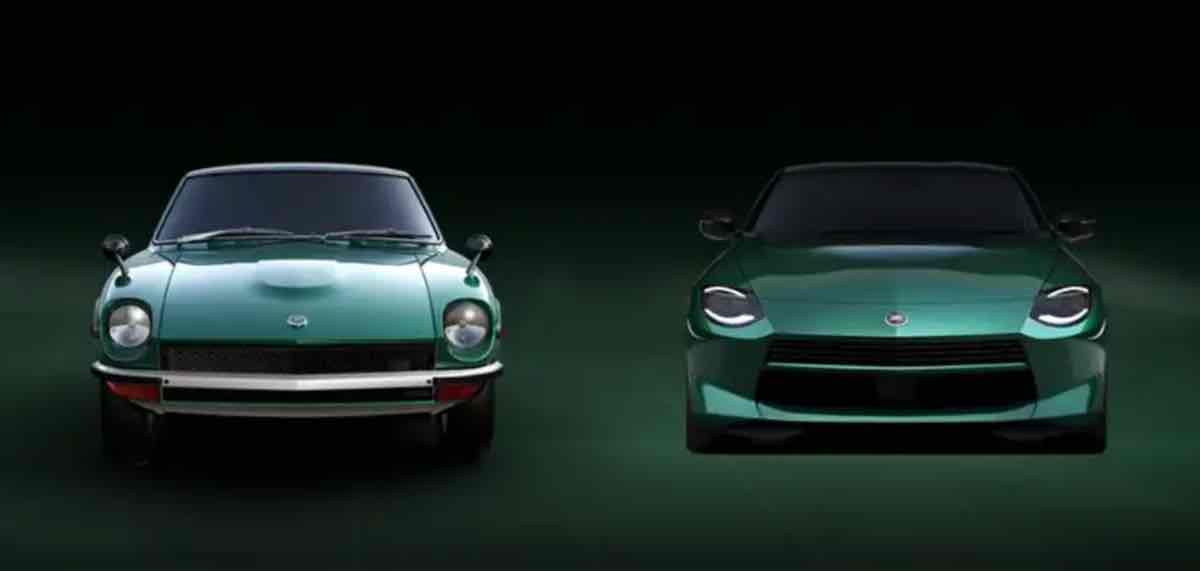
The Nissan Z has always carried its history proudly, but the updated 2027 model takes that connection to its predecessors even further. Nissan designers have incorporated five new heritage-inspired details into the latest Z, ranging from an S30-influenced front grille and Z31-inspired wheels to Shinkai Green paint, a classic tan interior and a digital startup sequence celebrating all seven generations of the legendary Japanese sports car.
The Nissan Z Continues to Evolve Without Forgetting Where It Came From
Few Japanese sports cars have a heritage as recognizable as the Nissan Z.
Beginning with the original Datsun 240Z more than half a century ago, the Z lineage has passed through dramatically different eras while maintaining the same basic philosophy: a stylish, driver-focused sports car offering serious performance without entering exotic-car territory.
The current-generation Z already makes extensive use of that history.
Its rear lighting treatment draws inspiration from the fourth-generation 300ZX, while a subtle “Since 1969” marking etched into the rear glass reminds owners exactly how far the lineage stretches back.
For the 2027 model year, Nissan has gone considerably further.
The changes aren’t simply about making the Z look retro. Instead, Nissan’s designers selected recognizable elements from previous generations and reinterpreted them for the modern car.
The result is five new details that longtime Z enthusiasts are likely to recognize immediately — while drivers unfamiliar with the car’s history can simply appreciate them as attractive additions to an already distinctive sports coupe.
1. The New Front Grille Looks Back to the Original S30
The most immediately obvious change is right at the front.
Nissan has redesigned the Z’s face with a new split-grille treatment, giving the sports car a noticeably different appearance compared with earlier versions of the current generation.
The inspiration comes directly from the original S30-generation Z, the family that introduced the Datsun 240Z to American drivers.
One of the challenges Nissan faced with the current Z was balancing styling with the cooling requirements of its twin-turbocharged engine. The original large grille opening was functional, but Nissan recognized an opportunity to make the updated design more closely resemble its ancestors without compromising cooling performance.
The solution was a horizontal element running through the opening.
The seemingly simple change dramatically alters the appearance of the front end, creating a visual relationship with the original 240Z while maintaining the airflow required by a modern high-performance sports car.
There’s another small but important change.
Instead of displaying the Nissan corporate badge at the front, the updated car wears a Z emblem.
That’s more than just a cosmetic substitution. Previous generations including the S30, S130, Z31 and Z32 prominently used Z identification, so returning the badge to the nose strengthens the connection between the modern car and its predecessors.
It also gives the Z a stronger identity of its own.
2. New 19-Inch RAYS Wheels Pay Tribute to the Z31 300ZX
Move down the side of the 2027 Nissan Z Performance and another piece of the model’s history becomes visible.
The Performance grade receives newly designed 19-inch RAYS alloy wheels, and Nissan didn’t simply create another contemporary multi-spoke design.
Instead, designers looked back to the Z31-generation 300ZX.
Produced during the 1980s, the Z31 represented a very different chapter in Z history. Its angular styling reflected the era, while its available machined wheels became one of the recognizable design details of the generation.
The new 19-inch RAYS wheels reinterpret that look with a modern ten-spoke design arranged in a star-like pattern.
It’s subtle enough that someone unfamiliar with the Z31 probably won’t immediately recognize the connection. Enthusiasts, however, should understand exactly where the inspiration originated.
The design serves a practical purpose as well.
Its relatively thin spokes leave the Z Performance’s large brake rotors and red brake calipers clearly visible, emphasizing the mechanical hardware behind the wheel.
The Performance model continues to use Bridgestone Potenza S007 high-performance tires, while the rear wheels are half an inch wider than those at the front to help maximize grip.
It’s a good example of Nissan’s approach to the entire 2027 update: heritage provides the inspiration, but the resulting component still has to work on a contemporary performance car.
3. Shinkai Green Revives a Classic Z Color Combination
One of the most attractive additions to the 2027 lineup may also be one of its most nostalgic.
Nissan is introducing Shinkai Green Pearl Metallic, an all-new exterior color available on both Z Sport and Z Performance models.
“Shinkai” translates to “deep sea” in Japanese, and the rich green finish was created as a modern interpretation of Grand Prix Green offered on the original S30-generation Z.
Developing it involved considerably more engineering than simply finding an old paint sample.
Green automotive paints can be particularly vulnerable to fading after prolonged exposure to sunlight. Nissan therefore developed the new finish using ultra-fine yellow and blue pigments that visually combine to produce the desired green appearance while offering better resistance to fading.
A subtle metallic flake was also incorporated into the paint.
That gives Shinkai Green additional visual depth and helps emphasize the Z’s sculpted body lines as lighting conditions change.
It feels appropriately classic without making the 2027 Z look like a replica of something built in the 1970s.
4. A Tan Interior Creates a Classic Sports-Car Combination
Shinkai Green becomes even more interesting when combined with another new option.
The 2027 Z Performance can now be ordered with a tan interior, again inspired by color combinations available during the S30 era.
Pairing a deep green exterior with a tan cabin is one of the most traditional sports-car combinations imaginable, and it works particularly well on a vehicle whose overall proportions already reference classic Z models.
The lighter upholstery also changes the character of the modern Z cabin.
Rather than making the entire interior tan, Nissan contrasts the color against black materials across the upper dashboard and doors. That allows the interior to retain its modern, performance-oriented appearance while introducing a warmer and more sophisticated atmosphere.
Customers won’t have to choose Shinkai Green to get it, either.
The tan interior can also be combined with Black Diamond Pearl, Bayside Blue Quad Coat, Pearl White TriCoat and Solid Red exterior colors.
Still, Shinkai Green over tan is likely to become the combination most closely associated with the updated model.
It gives the modern Z an almost timeless appearance and provides perhaps the strongest visual connection to the original sports car.
5. Every Generation of Z Appears When You Start the Car
The fifth heritage detail isn’t visible until the driver gets behind the wheel.
Sport and Performance versions of the 2027 Nissan Z receive a new animation within the standard fully digital instrument display.
Start the engine and previous generations of Nissan’s sports car appear during the startup sequence.
It’s a distinctly modern way of acknowledging the past.
Rather than reproducing another physical styling element, Nissan uses the Z’s digital technology to effectively run through the model’s family tree each time the car comes to life.
The animation references seven generations of Z, connecting today’s car with a history stretching all the way back to the original S30.
Z NISMO models retain their own unique startup animation.
It’s a small detail, but arguably one of the smartest additions to the 2027 car. Owners aren’t simply buying a sports coupe with an old badge attached to it; Nissan is actively reminding them that the modern Z is the latest chapter in a story that began in 1969.
The Current Z Was Already Packed With Historical References
These five additions aren’t being introduced to a design that previously ignored the past.
Quite the opposite.
The current Z was conceived from the beginning as a celebration of several generations rather than an interpretation of just one predecessor.
Its silhouette and overall proportions strongly recall early Z cars, while the rear lighting treatment is one of its clearest references to the Z32-generation 300ZX of the 1990s.
Even relatively hidden details such as the “Since 1969” marking in the rear glass reinforce that connection.
The 2027 changes simply make that relationship even stronger.
Importantly, Nissan hasn’t attempted to recreate the 240Z.
There’s a major difference between heritage-inspired design and outright retro styling. The 2027 Z remains unmistakably modern, but owners who understand the model’s history will continue discovering references to the cars that came before it.
The 2027 Z Isn’t Only About Styling
While Nissan’s five nostalgic touches provide an interesting story, the 2027 model-year changes go much deeper than design.
Z Performance models receive larger-diameter shock absorbers, intended to further improve the balance between ride quality and handling.
Nissan has also revised the fuel tank to help maintain consistent fuel delivery during aggressive high-g cornering.
But the headline mechanical change involves the Z NISMO.
For 2027, Nissan is finally giving enthusiasts something many have wanted since the current NISMO debuted: a manual transmission.
The high-performance Z NISMO can now be equipped with a specially developed six-speed manual gearbox featuring an upgraded clutch and revised shift-lever gearing designed to deliver shorter, more direct throws.
Nissan has also recalibrated the twin-turbocharged 3.0-liter V6’s throttle and ignition controls for the manual-equipped car, focusing on improved response and torque delivery.
The engine continues to produce 420 horsepower and 384 lb-ft of torque in NISMO specification.
The Z NISMO Gets Serious Performance Hardware
Nissan has made additional improvements to ensure the 2027 NISMO is about more than adding a clutch pedal.
The flagship model receives two-piece iron-and-aluminum brake rotors derived from technology used on the Nissan GT-R.
The new brake setup improves thermal performance while reducing weight, with the rotors contributing to an approximately 19-pound reduction.
Suspension and steering calibration have also been revised to complement the changes.
The result should be a more focused Z NISMO that better appeals to traditional sports-car enthusiasts — particularly those who considered the previous automatic-only configuration a deal breaker.
That development fits perfectly with the broader theme surrounding the 2027 Z.
Nissan isn’t merely decorating the car with references to its past. It is also bringing back one of the most fundamental elements of the traditional Z driving experience: the ability to shift gears yourself in the highest-performance version.
A Sports Car Built Around More Than 50 Years of History
Automakers frequently use heritage as a marketing tool, particularly when dealing with long-running performance nameplates.
But the Nissan Z occupies an unusual position.
Its history isn’t centered around one famous generation. Different enthusiasts have completely different reference points.
Some immediately think of the original Datsun 240Z. Others grew up with the turbocharged Z31 or the sophisticated twin-turbo Z32 300ZX. Another generation discovered Nissan’s sports-car formula through the 350Z and 370Z.
The current Z has to somehow acknowledge all of them.
That’s what makes Nissan’s approach to the 2027 model particularly effective.
The S30 contributes inspiration for the grille, exterior color and tan interior. The Z31 influences the new Performance wheels. The Z32 remains represented through the modern car’s taillights. And the startup animation ties all seven generations together.
None of those details fundamentally changes what the Z is.
Collectively, however, they make the car feel more connected to the lineage carrying its name.
The 2027 Nissan Z Shows How Heritage Design Should Work
The best heritage-inspired cars don’t simply copy their predecessors.
They identify the elements that made earlier models memorable and reinterpret them in a way that feels appropriate decades later.
That’s exactly what Nissan is attempting with the 2027 Z.
The redesigned front end arguably improves the appearance of the current car while simultaneously strengthening its relationship with the original 240Z. The Z31-inspired RAYS wheels provide another historical connection without appearing dated. Shinkai Green and the available tan interior deliver a classic sports-car combination, while the startup animation gives Nissan an opportunity to celebrate every generation without adding another physical retro-design element.
At the same time, meaningful mechanical changes — especially the manual-transmission Z NISMO — ensure that 2027 isn’t simply a cosmetic model-year update.
More than five decades after the first Z arrived, Nissan’s sports car continues to evolve.
And this time, moving forward means looking a little more closely at where it came from.