

























The Ford Bronco has always been marketed as a vehicle built for adventure, but for professional arborist and timber faller Katelyn Johnson, off-road capability isn’t about weekend recreation. It’s part of the job. Working across the rugged forests of Northern California, Johnson relies on her Bronco to reach remote logging sites, wildfire zones and emergency tree-removal jobs. That makes her an unusually appropriate person to put the new Ford Bronco Filson through its paces — a special model combining Bronco’s serious off-road hardware with Filson-inspired design, storage solutions and an unmistakably outdoors-focused personality.
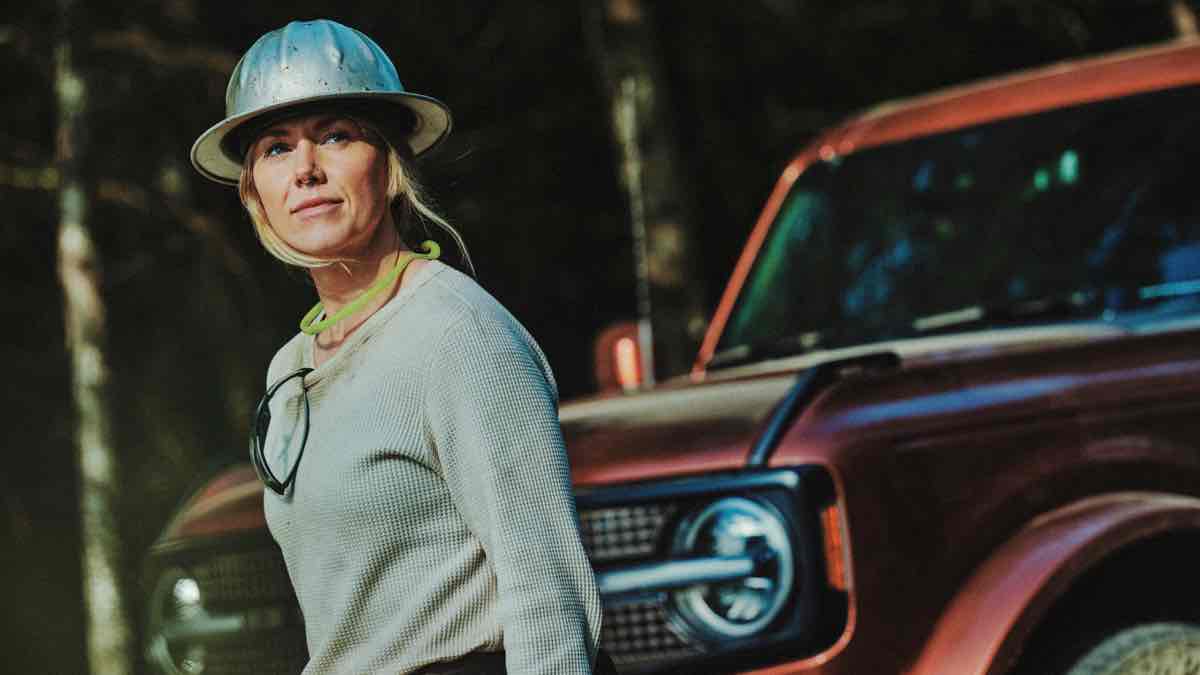
Katelyn Johnson Starts Working Before the Sun Comes Up
For many Bronco owners, driving into the wilderness is something reserved for weekends. For Katelyn Johnson, it can happen before most people have even poured their first cup of coffee.
Johnson lives near Lake Tahoe, California, and her workdays can begin at around 4 a.m. She drives into the mountains before sunrise, reaches the cutting site and waits for enough daylight to safely begin working.
Then the chainsaw comes out.
Johnson is both a timber faller and a certified arborist, two jobs that require an unusual combination of physical strength, technical knowledge, precision and constant awareness of the surrounding environment.
Her work can range from removing or pruning trees around residential properties to logging, forest thinning and working around active wildfire areas.
In the latter environment, she may be responsible for dealing with burned, damaged and unstable trees that pose serious hazards.
And getting to those locations can be a challenge in itself.
Her Bronco Isn’t a Lifestyle Accessory — It’s a Work Tool
Johnson describes her vehicle as her lifeline to work, and the roads she encounters help explain why.
Remote forestry operations rarely take place beside smooth paved highways. Access can involve muddy logging roads torn apart by heavy machinery, neglected fire roads covered by vegetation, steep mountain terrain and substantial snowfall.
That is exactly the type of environment the modern Ford Bronco was engineered to tackle.
Johnson began using a Bronco in early 2025, choosing a Bronco Badlands equipped with the optional Sasquatch Package.
The combination gives her considerably more capability than a conventional crossover when conditions deteriorate.
During difficult winter conditions, Johnson can leave the Bronco in four-wheel drive and use its G.O.A.T. Modes terrain-management system to adapt the vehicle to changing surfaces.
On ice and other low-traction surfaces, Slippery mode adjusts several vehicle systems, including throttle response, traction control and four-wheel-drive operation.
For someone whose ability to reach a job site can depend on whether a vehicle can make it through several feet of snow, those features aren’t simply toys to experiment with on an off-road trail.
They can determine whether she gets to work.
The Bronco Has Enough Space for a Professional Arborist’s Gear
At first glance, a pickup truck might appear to be the obvious choice for forestry work.
Johnson’s experience suggests otherwise.
Despite the demanding nature of her job, she doesn’t necessarily need to transport enormous quantities of equipment every day.
Chainsaws, wedges, axes, fuel and smaller pieces of specialist equipment make up much of her typical loadout. Johnson has adapted her Bronco around those requirements, allowing the SUV to carry the tools she needs while retaining the enclosed cargo space and off-road characteristics she values.
And that is where the new Bronco Filson becomes particularly interesting.
Ford and Filson Have History Together
The Bronco Filson isn’t simply a conventional Bronco wearing a few outdoor-themed badges.
The relationship between Ford and outdoor clothing and equipment company Filson stretches back years.
Ford and Filson collaborated on a Bronco concept in 2020 built around wildland firefighting — an appropriate theme considering the types of environments in which Johnson now works.
But the connection between the two companies reaches considerably further into American history.
Both Ford and Filson supplied products used by U.S. Forest Service workers during the 1960s.
Filson itself dates back to 1897, when the company supplied clothing and equipment to prospectors heading toward the Klondike Gold Rush. Over more than a century, the brand developed a reputation for durable outdoor products intended to survive demanding working conditions.
That philosophy fits remarkably naturally with Bronco.
Six years after Ford and Filson’s 2020 concept, the collaboration has evolved into a production vehicle.
The Bronco Filson Gets Serious Off-Road Hardware
Ford recently gave Johnson an opportunity to experience the Bronco Filson in precisely the type of environment where the vehicle is supposed to make sense.
Some of its equipment was immediately familiar.
Like Johnson’s personal Bronco Badlands, the Filson uses the Sasquatch Package and its imposing 35-inch tires.
But the Filson goes considerably further.
The suspension receives FOX remote-reservoir shocks, providing hardware intended to cope with serious off-road driving and demanding terrain.
More significantly, Ford has given the Bronco Filson considerably more power.
Instead of simply using one of the Bronco’s regular powertrains, the Filson borrows the 3.0-liter twin-turbocharged EcoBoost V-6 from the Bronco Raptor.
That immediately changes the character of the vehicle.
The Bronco Filson may draw visual inspiration from classic outdoor equipment, but underneath the heritage-influenced appearance is some extremely serious modern off-road hardware.
Field Green Metallic Looks Right at Home in the Forest
Johnson was particularly impressed by the Bronco Filson’s distinctive exterior color.
Ford calls it Field Green Metallic, and it might be difficult to imagine a more appropriate environment for the color than the forests in which Johnson works.
The understated green finish reinforces the connection between the Bronco and Filson without making the vehicle look like an exaggerated themed special edition.
That’s important.
The strongest brand collaborations usually work when the resulting product looks like something that could exist naturally rather than simply serving as a rolling advertisement.
Bronco and Filson already share similar design philosophies: rugged materials, functional construction and an emphasis on outdoor use.
The Field Green Metallic finish helps bring those identities together.
The Cleverest Details Are Inside
For Johnson, however, one of the Bronco Filson’s most useful features isn’t the engine, suspension or paint.
It’s storage.
Filson-inspired removable storage bags are integrated into the doors and the triangular areas of the rear sport bar.
The bags are constructed from materials designed to resist water and dirt — an obvious advantage inside a vehicle that could regularly be filled with muddy equipment.
Ford has also incorporated magnetic closures rather than traditional snap buttons.
That means the compartments can be opened and closed one-handed.
It sounds like a relatively minor detail until you consider the environment in which someone like Johnson operates.
A professional arborist can carry chains, replacement chainsaw components and numerous small tools and accessories. Those items can easily disappear into a large cargo compartment.
Dedicated storage allows smaller pieces of equipment to remain organized and readily accessible.
Even better, the bags themselves can be removed from the Bronco.
Instead of taking individual tools out of a storage compartment, the owner can simply remove the entire bag and carry it to the job site.
It’s exactly the kind of practical detail that makes considerably more sense after watching how professionals actually use their vehicles.
Bronco Filson Combines Two Similar Philosophies
There is an obvious marketing component whenever two recognizable brands collaborate on a special-edition vehicle.
But Ford and Filson have an unusually natural connection.
Filson built its reputation producing rugged clothing and equipment designed for people working outdoors in difficult environments.
Bronco has built much of its identity around getting drivers into those same environments.
Johnson sees the connection clearly.
The durability and functionality associated with Filson clothing translate surprisingly well to the philosophy behind the Bronco: equipment designed to continue working when conditions become unpleasant.
For a timber faller, reliability isn’t an abstract concept.
Johnson’s profession requires placing enormous trust in equipment.
Tree rigging, ropes, chainsaws and other tools may be responsible for controlling massive pieces of timber. A failure at the wrong moment could have serious consequences.
Vehicle recovery involves a similar principle. When a vehicle is stuck in mud, snow or difficult terrain, recovery equipment has to withstand enormous loads.
In both cases, the equipment needs to work as intended.
Johnson’s Journey Started on an Ohio Farm
Johnson didn’t grow up in Northern California expecting to become a professional timber faller.
She was raised in a small town in western Ohio, spending time on her grandparents’ farm and helping care for animals.
That outdoor upbringing eventually led her to study wildfire management at Ohio State.
But her career took an unexpected turn.
Unable to immediately find the forestry job she originally envisioned, Johnson discovered a local arborist company looking for employees.
She applied despite having little idea what the job would actually involve.
The work clicked.
She became involved in climbing and spent several years performing residential tree work around Columbus, Ohio.
Eventually, however, she wanted something bigger — literally.
Johnson headed west in pursuit of the enormous timber found in California and other parts of the western United States.
Today she operates her own company, Sure Shot Forestry, while documenting her profession for hundreds of thousands of followers online.
Tree Falling Requires Constant Concentration
Watching a massive tree fall can look spectacular, but the most important part of Johnson’s work happens before the tree begins moving.
Professional timber falling requires continuously evaluating what could happen next.
The tree itself is only one potential danger.
Dead or damaged branches can break loose overhead. Nearby trees can interact with the falling trunk. Terrain can affect escape routes. Wind, tree condition and countless other variables can alter the situation.
Johnson has spent more than a decade in the industry while avoiding serious injury.
That isn’t simply luck.
It’s the result of constantly thinking several steps ahead.
And the same mentality explains why reliable transportation matters.
A vehicle used in remote forestry work needs to be predictable and capable enough that reaching the site doesn’t become another unnecessary risk.
Forest Management Is Part of the Bigger Story
Johnson also uses her public platform to explain why professional forestry work matters.
Removing trees can be controversial, particularly when images or videos are viewed without context.
But forest management isn’t simply about cutting down trees.
In some environments, thinning can reduce competition between trees, improve the health and growth of the remaining forest and help manage wildfire risk.
California’s enormous wildfire problem makes that conversation particularly relevant.
Johnson’s objective is to help people better understand the relationship between tree management, healthy forests, wildfire mitigation and the communities located alongside them.
Residential arboriculture follows the same basic principle on a smaller scale.
Properly pruning or removing a hazardous tree can help prevent damage to homes and other structures.
For Johnson, responsible tree work ultimately comes down to finding safer ways for people and forests to coexist.
Ford’s Bronco Wild Fund Adds Another Connection
There’s another environmental element connecting Johnson’s work with Bronco.
Ford supports outdoor conservation through the Bronco Wild Fund, which works with organizations including the National Forest Foundation.
Through that collaboration, more than 2.3 million trees have been planted across 42 reforestation sites.
Ford’s approach effectively links Bronco sales with conservation and restoration projects, reinforcing the idea that enjoying remote landscapes and protecting them don’t have to be opposing concepts.
That message fits particularly well alongside Johnson’s work.
Forestry can involve removing trees, but responsible forest management is ultimately about maintaining healthier, safer and more sustainable landscapes.
The Bronco Filson Makes More Sense Covered in Mud
Special-edition vehicles can sometimes feel as though they were designed primarily to sit under showroom lights.
The Bronco Filson feels different.
Its combination of 35-inch tires, FOX remote-reservoir shocks, Bronco Raptor-sourced twin-turbo V-6 power, practical removable storage and durable materials suggests a vehicle intended to actually be used.
Katelyn Johnson provides a particularly convincing demonstration of why that matters.
Her Bronco isn’t transportation to an outdoor lifestyle.
It’s transportation through that lifestyle.
Mud, deep snow, overgrown fire roads, chainsaws, ropes and remote forests aren’t part of a carefully staged weekend adventure. They’re normal components of her working day.
And that might be the best possible environment for understanding what Ford and Filson are trying to accomplish.
The Bronco Filson combines the heritage of two American brands associated with the outdoors, but its most compelling features aren’t nostalgic.
They’re practical.
When your office happens to be several miles down a muddy logging road in the Sierra Nevada, that’s exactly what matters.