






























The Honda Civic Type R is getting a meaningful refresh for 2027, combining sharper driving dynamics and improved cooling with a more premium cabin and significantly more standard technology. Honda’s legendary 315-horsepower hot hatch retains its turbocharged engine and exclusively manual-transmission formula, but adds revised suspension tuning, quicker rev matching, improved brake feel, heated front seats, Google built-in with Gemini, upgraded Honda Sensing technology and a new Meteorite Gray Metallic exterior color.
Honda Refines the Civic Type R for 2027
Thirty years after the original Civic Type R made its debut in Japan, Honda isn’t reinventing its high-performance hatchback. Instead, it is carefully improving the areas that matter most, with changes to aerodynamics, cooling, suspension, braking, interior comfort, connectivity and safety technology.
Crucially, Honda hasn’t abandoned the formula that makes the Type R such an unusual car in today’s increasingly electrified and automated performance market. Under the hood remains the turbocharged 2.0-liter K20C four-cylinder engine producing 315 horsepower, while a six-speed manual transmission remains the only gearbox available. For 2027, Honda has focused on making the entire package sharper, more comfortable and more technologically advanced without compromising its driver-focused character.
A More Aggressive Front End Has a Functional Purpose
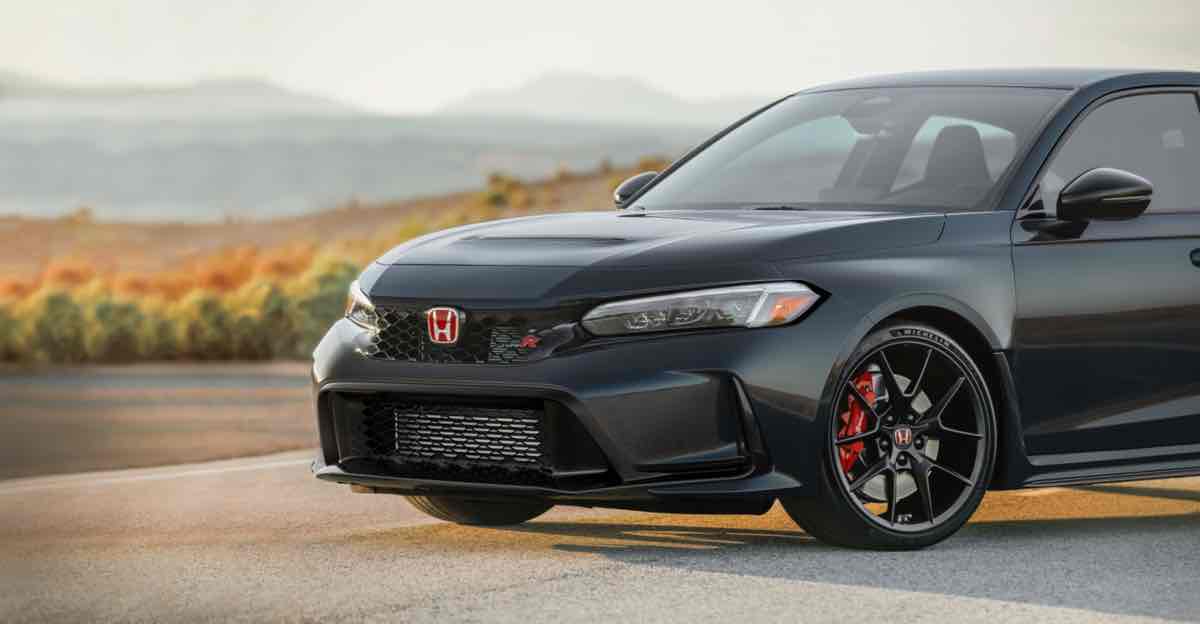
The most obvious exterior change is found at the front, where Honda has redesigned the Civic Type R’s fascia to provide a more aggressive appearance while simultaneously improving performance. A larger grille opening increases airflow, while Honda engineers worked to reduce turbulence and increase airflow velocity through the front of the car.
The result is improved engine cooling, an important advantage during prolonged high-performance driving and track use. There’s also a deeper front splitter that increases aerodynamic downforce, helping the front end remain more firmly planted at higher speeds. It’s a classic Type R approach: visual aggression backed up by functional engineering rather than styling for styling’s sake.
Honda Has Retuned the +R Suspension Mode
Some of the most important 2027 improvements won’t necessarily be visible from outside the car. Honda has optimized the suspension damping calibration in +R mode, the Civic Type R’s most aggressive performance setting, with the goal of improving the car’s ability to maintain contact with the road while reducing unwanted bouncing and impact harshness.
That should translate into improved stability and greater confidence when cornering hard, particularly over less-than-perfect pavement. The current-generation Civic Type R already combines exceptional body control with surprisingly usable road manners, so refining +R mode could make its most aggressive chassis setting more useful outside perfectly smooth racetracks as well.
Quicker Rev Matching Should Make Downshifts Even Better
The six-speed manual transmission remains central to the Civic Type R experience, and Honda has improved its Rev Match system for 2027 to deliver faster engine response during downshifts. Automatic rev matching electronically raises engine speed as the driver selects a lower gear, effectively reproducing the throttle-blipping technique traditionally performed manually during heel-and-toe downshifts.
The quicker response should make aggressive downshifts smoother and more immediate. More importantly for enthusiasts, Honda has resisted any temptation to introduce an automatic alternative. The 2027 Civic Type R remains exclusively available with a manual transmission, preserving one of the characteristics that most clearly separates it from many modern performance cars.
Brake Pedal Feel Gets More Direct
Honda has also made an unusually specific mechanical change to improve brake feel. A new yoke spring has been added to the brake pedal assembly to reduce play within the linkage, creating a more direct connection between the driver’s foot and the braking system.
For an ordinary commuter car, such a small difference might go largely unnoticed. In a vehicle designed around precision and driver feedback, however, pedal consistency and initial brake response can make a meaningful difference. Particularly on track, predictable brake feel allows drivers to judge braking points and pressure more accurately.
The 315-HP Turbocharged Engine Remains
Honda hasn’t increased output for 2027, but that’s hardly a problem. The Civic Type R continues to produce 315 horsepower from its turbocharged 2.0-liter four-cylinder K20C engine, retaining its position as the most powerful Honda production vehicle ever sold in the United States.
Power continues to reach the front wheels through the Type R’s six-speed manual transmission. Rather than chasing a higher horsepower figure primarily for the specification sheet, Honda has concentrated this refresh on cooling, chassis response, braking and driver interaction.
The engine itself receives a redesigned cover inspired by early-generation Type R models sold in Japan, providing a subtle visual tribute as the nameplate celebrates three decades of history. The Type R’s K20C engine continues to be manufactured at Honda’s Anna Engine Plant in Ohio using domestic and globally sourced parts.
2027 Marks 30 Years of Civic Type R
The timing of the update is particularly significant. The Civic Type R celebrates its 30th anniversary globally in 2027, following the debut of the original EK9-generation model in Japan as a 1997 model. It also marks the 10th anniversary of the Civic Type R in North America.
American enthusiasts had to wait considerably longer than Japanese and European buyers to officially get the Type R, but it has since become one of Honda’s defining performance models in the U.S. The 2027 model continues that lineage without diluting the characteristics that established its reputation.
Heated Type R Seats Finally Arrive
One of the most welcome everyday improvements has nothing to do with lap times. For the first time, the Civic Type R receives heated front seats, with both driver and front passenger benefiting from three-level heating while retaining the Type R’s distinctive red racing-inspired sport seats.
The seat upholstery itself has also been updated. Honda continues to use its high-friction red suede-like material, which helps prevent occupants from sliding around during high-G cornering, but the 2027 seats receive a redesigned perforation pattern featuring distinctive black striping. The perforated areas also improve breathability in high-contact zones, helping reduce fatigue during longer drives.
For a performance car that many owners use as their daily driver, heated seats may ultimately prove to be one of the most appreciated changes in the entire update.
Ultrasuede Gives the Dashboard a More Premium Feel
The Type R cabin is also getting a noticeable materials upgrade. Premium Ultrasuede now covers sections of the instrument panel and upper front door panels, giving the interior a more purposeful, motorsport-inspired appearance while also helping reduce glare and reflections on the windshield.
Honda has redesigned the dashboard trim with a diamond-pattern mesh panel surrounded by black trim. The climate-control and air-vent knobs are now black, while the familiar aluminum manual-transmission shift knob receives a darker gray finish. That darker treatment is repeated on the center-console trim and interior door handles, while silver trim has been added to the front door panels.
Taken together, the changes should make the Type R cabin feel more special and premium without compromising the functional simplicity that suits the car.
Google Gemini Comes to the Civic Type R
Technology receives one of the biggest upgrades for 2027. The Civic Type R now comes standard with Google built-in, integrating Google Maps, Google Play and other Google services directly into the vehicle. More significantly, the system includes Google Gemini, bringing Google’s conversational AI technology into Honda’s high-performance hatchback.
Gemini replaces the more traditional Google Assistant experience with conversational AI capable of maintaining context across multiple interactions. For drivers, that should allow more natural voice-based interaction without needing to repeatedly formulate rigid individual commands.
The concept is particularly appropriate in a manual-transmission performance car, where keeping both hands available for driving is especially valuable. Alexa built-in is also standard, while Honda has added two USB-C ports in the center console above the standard wireless smartphone charging pad.
More Everyday Comfort Without Diluting the Type R
The list of relatively small but useful everyday improvements continues with a new auto-dimming rearview mirror, which automatically reduces glare from headlights behind the car during nighttime driving.
None of these comfort upgrades fundamentally changes what the Civic Type R is. Instead, they address some of the compromises owners previously had to accept when choosing Honda’s most focused performance model as an everyday vehicle. That balance between track capability and daily usability has always been one of the Type R’s strongest qualities, and the 2027 update pushes it further in that direction.
Honda Sensing Gets Smarter for 2027
Honda has also upgraded the Civic Type R’s standard Honda Sensing suite of driver-assistance and safety technologies. The Collision Mitigation Braking System with Pedestrian Detection gains improved detection capabilities for motorcycles and bicycles, while Adaptive Cruise Control has been revised to provide improved acceleration and braking responses.
Lane Keeping Assist receives enhanced compensation for road camber and other disturbances, with the objective of delivering smoother and more natural operation. For the first time, the Civic Type R also receives Post-Collision Braking, which can automatically apply the brakes following an initial collision to help reduce the possibility or severity of a subsequent impact.
Standard Honda Sensing equipment continues to include Collision Mitigation Braking, Adaptive Cruise Control, Lane Keeping Assist, Forward Collision Warning, Road Departure Mitigation, Lane Departure Warning, Blind Spot Information, Cross Traffic Monitor, Driver Attention Monitor, Traffic Sign Recognition and automatic high-beam headlights. Even the horn has been upgraded to a dual-tone unit for 2027.
Meteorite Gray Metallic Joins the Color Palette
Honda is introducing one new exterior finish for the 2027 model year: Meteorite Gray Metallic. The darker, relatively understated color provides an interesting contrast to the Type R’s aggressive aerodynamic treatment and prominent rear wing.
Three familiar colors remain available: Boost Blue Pearl, Sonic Gray Pearl and the iconic Championship White. Championship White continues to carry particularly strong significance for Honda enthusiasts because of its longstanding connection to the company’s motorsports and Type R heritage.
The Type R Still Makes 315 Horsepower — And That’s Enough
There will inevitably be enthusiasts who look at the 2027 update and immediately notice that horsepower hasn’t increased. But the changes illustrate a different philosophy: rather than chasing an increasingly intense numbers battle, Honda has concentrated on making the existing car more responsive, more consistent and easier to live with.
Improved cooling helps maintain performance under demanding conditions, while additional front downforce improves aerodynamic stability. Revised +R damping enhances chassis behavior, the faster Rev Match system improves downshifts and the revised brake pedal provides more direct feedback.
None of those changes creates a dramatically larger headline number for the specification sheet, but together they have the potential to make the Type R a more polished and satisfying driver’s car.
2027 Honda Civic Type R Pricing
The updated 2027 Honda Civic Type R carries a starting MSRP of $48,695. Honda lists the total suggested retail price, including destination-related charges, at $49,990.
EPA fuel economy ratings remain surprisingly reasonable considering the performance available, at 22 mpg city, 28 mpg highway and 24 mpg combined. The refreshed Type R begins arriving at U.S. Honda dealerships in October 2026.
The Type R Formula Remains Refreshingly Old-School
The automotive landscape surrounding the Civic Type R has changed dramatically. Performance vehicles are increasingly electrified, automatic transmissions dominate the market, and even enthusiast-oriented models increasingly rely on sophisticated software to isolate drivers from the mechanical process underneath.
The Civic Type R takes a different path. Yes, it now has Google Gemini, adaptive cruise control and an extensive suite of electronic safety systems, but the fundamental driving experience remains remarkably traditional. There’s a turbocharged internal-combustion engine up front, three pedals under the dashboard and a manual gear lever between the seats.
The driver still has to choose every gear, and the engineering changes Honda has made for 2027 — suspension damping, brake-pedal response, rev matching, cooling and aerodynamic downforce — demonstrate where the priorities remain.
Honda Has Improved the Type R Without Reinventing It
A major redesign wasn’t necessary. The current Civic Type R already established an unusually successful balance between track-ready performance, everyday practicality and mechanical involvement, so the 2027 refresh instead concentrates on removing some of its remaining compromises.
Heated seats make cold mornings easier, Ultrasuede makes the cabin feel more special, and Google built-in with Gemini modernizes the infotainment experience. Improved Honda Sensing technology strengthens everyday usability, while revised damping, better brake feel, quicker rev matching, improved cooling and increased front downforce enhance the performance side of the equation.
Thirty years after the first Civic Type R appeared, Honda’s philosophy remains remarkably recognizable: make it fast, make it precise, make it usable — and above all, keep the driver involved.