






















Volkswagen sold 78,179 vehicles in the United States during the third quarter of 2026, down 10.9% from the same period a year earlier. The overall decline masked sharply different results across the lineup: Tiguan sales climbed 27.4%, while the Jetta gained 24.9%. Those increases helped offset weaker Atlas sales and substantial declines for the electric ID.4 and ID. Buzz.
The results, released on October 12, show a Volkswagen business increasingly supported by two familiar nameplates. The Tiguan was comfortably the brand’s best-selling vehicle for the quarter, while the Jetta provided a significant boost to passenger-car volume. However, their combined growth was insufficient to bring total sales back to the 87,705 vehicles recorded in the third quarter of 2025.
Tiguan Leads Volkswagen’s U.S. Lineup
Volkswagen delivered 28,091 Tiguans during the quarter, compared with 22,050 a year earlier. That increase of 6,041 vehicles made the compact SUV the largest source of additional sales in the lineup. It also accounted for approximately 36% of Volkswagen’s total U.S. volume during the period, underlining its importance to the brand’s quarterly performance.
The Taos held relatively steady, with sales increasing from 9,741 to 9,780 vehicles, a gain of 0.4%. Although that growth was modest, the smaller SUV avoided the declines affecting several other Volkswagen models. Together, the Tiguan and Taos delivered 37,871 sales, providing a substantial foundation for the company’s U.S. business.
Results were weaker for the larger Atlas models. Atlas sales fell 19.5% to 15,375 vehicles, while the Atlas Cross Sport declined 9.5% to 6,889. Combined, the two nameplates recorded 22,264 sales, compared with 26,714 in the third quarter of 2025.
Jetta Growth Lifts Passenger-Car Sales
The Jetta was another bright spot, recording 14,092 sales compared with 11,287 a year earlier. Its 24.9% increase added 2,805 vehicles to Volkswagen’s quarterly total and helped the passenger-car category grow despite lower sales of both performance hatchbacks.
Golf GTI sales slipped 5.3%, from 1,931 to 1,829 vehicles. The Golf R experienced a larger percentage decline, falling 32.6% from 1,041 to 702 vehicles. Even with those reductions, Volkswagen’s total passenger-car sales rose 16.6% to 16,623 units.
That result gives the quarter an interesting balance. While SUVs continued to generate most of Volkswagen’s U.S. volume, passenger cars delivered the stronger year-over-year performance. The Jetta’s contribution was particularly significant because its increase more than compensated for the combined decline in GTI and Golf R sales.
ID.4 and ID. Buzz Record Steep Declines
The largest percentage declines came from Volkswagen’s electric models. ID.4 sales fell from 12,470 vehicles in the third quarter of 2025 to 989 in the same period of 2026, a decrease of 92.1%. ID. Buzz sales dropped 82.5%, from 2,469 to 432 vehicles.
Combined, the two electric nameplates recorded 1,421 sales, compared with 14,939 a year earlier. Their reduction of 13,518 vehicles exceeded Volkswagen’s overall quarterly decline of 9,526 vehicles, showing how strongly their results affected the brand’s total.
The sales release does not explain the reasons behind those changes. The figures therefore establish the scale of the decline without determining how much resulted from availability, purchase timing, demand, or other factors.
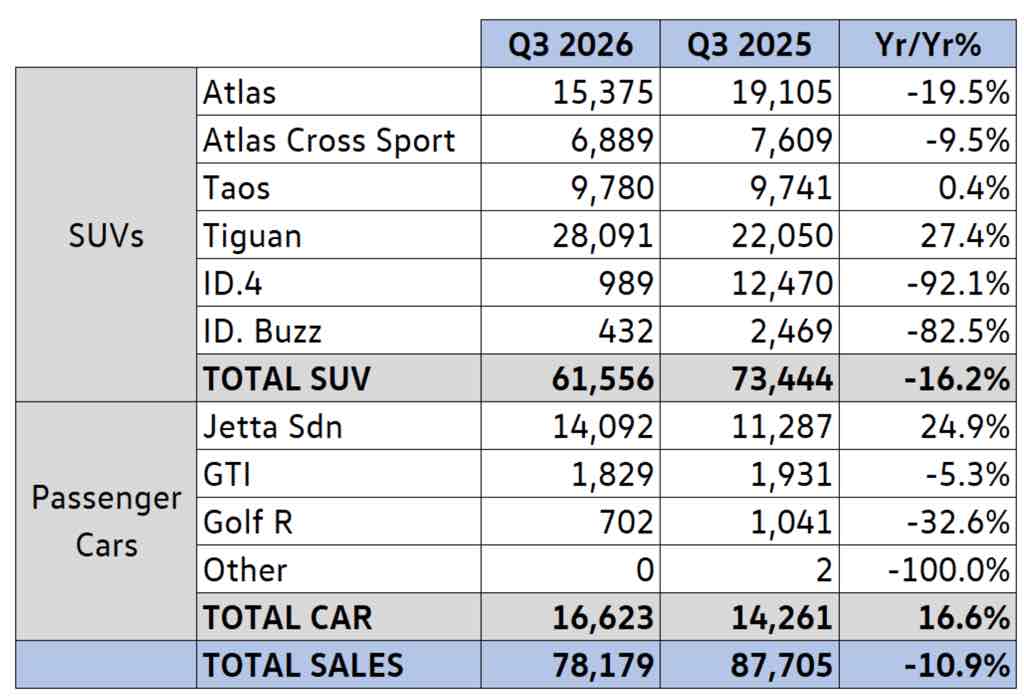
Volkswagen Q3 2026 U.S. Sales by Model
| Model or category | Q3 2026 | Q3 2025 | Year-over-year change |
|---|---|---|---|
| Atlas | 15,375 | 19,105 | -19.5% |
| Atlas Cross Sport | 6,889 | 7,609 | -9.5% |
| Taos | 9,780 | 9,741 | +0.4% |
| Tiguan | 28,091 | 22,050 | +27.4% |
| ID.4 | 989 | 12,470 | -92.1% |
| ID. Buzz | 432 | 2,469 | -82.5% |
| SUV category total | 61,556 | 73,444 | -16.2% |
| Jetta | 14,092 | 11,287 | +24.9% |
| Golf GTI | 1,829 | 1,931 | -5.3% |
| Golf R | 702 | 1,041 | -32.6% |
| Other | 0 | 2 | -100.0% |
| Passenger-car total | 16,623 | 14,261 | +16.6% |
| Total Volkswagen sales | 78,179 | 87,705 | -10.9% |
Volkswagen includes the ID. Buzz in the SUV category used in its sales report.
Two Growing Models Carry More of the Business
The Tiguan and Jetta together generated 42,183 sales during the quarter, representing approximately 54% of Volkswagen’s U.S. total. Their combined volume increased by 8,846 vehicles compared with the third quarter of 2025, cushioning the impact of declines elsewhere in the range.
The results highlight the importance of those two models while also showing the limits of their growth. Stronger Tiguan and Jetta sales supported the business, but Volkswagen still finished the quarter with lower overall volume as its electric models and larger SUVs lost ground. The next quarterly report will show whether those differences across the lineup begin to narrow.