




























The 2027 Jeep Cherokee Trailhawk brings genuine off-road capability back to the Cherokee nameplate, combining a 210-horsepower turbocharged hybrid powertrain with Jeep Active Drive II, a class-exclusive two-speed power transfer unit, an electronic locking rear axle, 9 inches of ground clearance, and a 24-inch water-fording capability. With an estimated 31 MPG combined and a starting price of $44,625, Jeep is positioning the new Trailhawk as an SUV that doesn’t force buyers to choose between everyday efficiency and serious trail performance.
A Trailhawk Designed to Earn Its Badge
The arrival of the 2027 Cherokee Trailhawk adds an important dimension to the reborn Jeep Cherokee lineup. Rather than simply applying tougher styling and familiar Trailhawk badges to a conventional crossover, Jeep has engineered this version around genuine off-road capability, combining specialized suspension hardware, additional ground clearance, underbody protection, all-terrain tires and a considerably more sophisticated four-wheel-drive system. At the same time, the Trailhawk retains the efficiency advantages of the Cherokee’s new hybrid powertrain, with Jeep estimating fuel economy at approximately 31 MPG combined. That creates an unusual proposition: an SUV designed to operate efficiently as an everyday family vehicle while still possessing the mechanical hardware required for serious off-road use.
Jeep has treated the Trailhawk badge seriously for well over a decade, and Cherokee itself was among the first models to receive the designation. For this new generation, engineers subjected the SUV to extensive validation in some of the most demanding off-road environments in the American Southwest. Testing at Sand Hollow focused on slickrock and sand performance while also putting the underbody and sensitive components through demanding conditions. In Moab, engineers concentrated on suspension articulation, ground clearance, traction and the vehicle’s ability to negotiate obstacles that go well beyond anything most owners will encounter during everyday driving.
“Jeep Cherokee Trailhawk is the real deal, and earned its Trail Rated badge through a gauntlet of testing scenarios,” Jeep brand CEO Branden Coté said. “This SUV blends authentic 4×4 off-road capability that the Trailhawk badge represents, and with hybrid efficiency that is so important to customers in this segment.”
The resulting specifications reinforce that message. The 2027 Cherokee Trailhawk offers a standard 28.8-degree approach angle, 31.8-degree departure angle and 21.9-degree breakover angle, aided by Trailhawk-specific front and rear fascias designed not only to look more aggressive but also to improve clearance around obstacles. Ground clearance increases to 9 inches, thanks partly to a one-inch suspension lift, while unique spring and damper tuning improves flexibility and control over uneven terrain. Jeep says these modifications result in a 45-point Ramp Travel Index improvement compared with other Cherokee models, providing greater suspension articulation when individual wheels are forced to travel across dramatically different elevations.
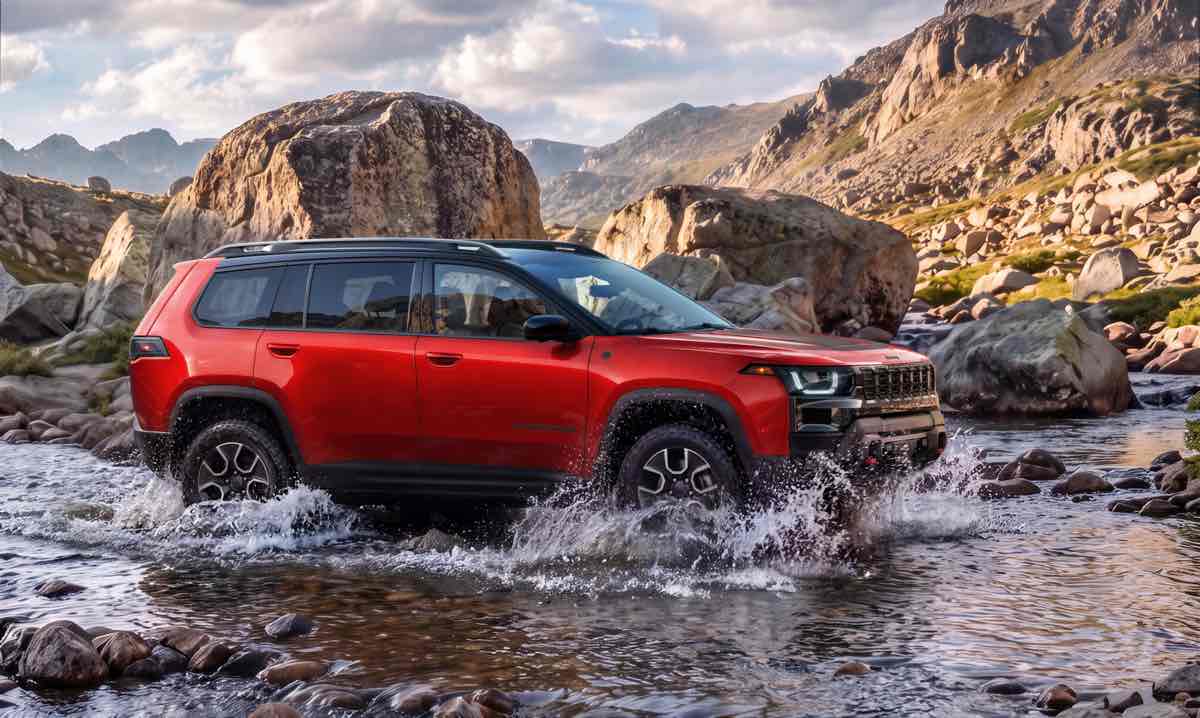
Water crossings are another area where Jeep has pushed the Trailhawk beyond the conventional crossover formula. The company says the new Cherokee Trailhawk is the only SUV in its class to offer a 24-inch water-fording rating, giving it a meaningful advantage for owners who genuinely intend to take their vehicle beyond maintained roads.
Real Low-Range 4×4 Hardware Separates the Trailhawk From Ordinary Crossovers
The most important Trailhawk upgrades are underneath the body. At the center of the system is Jeep Active Drive II 4×4 with Lock Mode, complemented by an Electronic Locking Rear Axle and a standard, class-exclusive two-speed power transfer unit. The system provides a 2.92 low-range ratio and 37.5:1 crawl ratio, allowing the Cherokee to negotiate steep, rocky and loose terrain at controlled speeds while maintaining effective torque delivery.
That distinction matters because many modern SUVs marketed around outdoor lifestyles rely primarily on conventional all-wheel-drive systems. The Cherokee Trailhawk’s low-range capability allows the drivetrain itself to help regulate speed during difficult climbs and descents, reducing the need for the driver to constantly manage the vehicle using the brakes. Combined with the locking rear axle, it should also provide significantly better traction when individual wheels encounter slippery or loose surfaces.
Jeep’s Selec-Terrain system is standard and provides five settings: Auto, Sport, Snow, Sand/Mud and Rock. Each adjusts the vehicle’s drivetrain and traction-control behavior for different conditions, with Rock mode particularly relevant when the Trailhawk’s low-range hardware is being used on demanding terrain. Jeep has also added substantial underbody protection, including steel skid plates protecting the front axle, wiring and fuel tank. Because the Cherokee uses a hybrid drivetrain, engineers have also installed a dedicated protection plate for the hybrid battery — an especially important consideration on rocky trails where underbody contact can become unavoidable.
The suspension and drivetrain upgrades are complemented by appropriately chosen wheels and tires. Rather than following the industry trend toward oversized wheels and thin road-oriented tires, Jeep equips the Trailhawk with two available 17-inch wheel designs wrapped in 245/65R17 Nexen Roadian ATX all-terrain tires. The relatively generous tire sidewalls should provide better protection and compliance over rocks and rough surfaces while also contributing to traction away from pavement.
Rugged Design With Functional Trailhawk Details
The exterior design reflects the Cherokee’s broader return to a more upright, squared-off Jeep aesthetic, but the Trailhawk receives several important modifications of its own. The unique front fascia incorporates a gloss-black upper section, while both the front and rear bodywork have been reshaped to help achieve the model’s improved approach and departure angles. As a result, the visual changes serve a functional purpose rather than simply differentiating the Trailhawk from less capable Cherokee trims.
Bright red tow hooks are installed at both ends of the vehicle, continuing one of the most recognizable Trailhawk design traditions while providing genuine recovery points for difficult situations. An anti-glare Trailhawk hood graphic adds another distinctive element, complemented by Trailhawk badging at the rear. Together with the raised suspension, all-terrain tires and unique wheels, the changes give the model a more purposeful appearance without attempting to transform the Cherokee into something it isn’t.
The interior receives its own distinctive identity. Jeep introduces Mantis Green upholstery with red accent stitching and an embossed logo, giving the cabin a noticeably different atmosphere from the rest of the Cherokee range. A unique Black Spun Aluminum finish is applied to the rotary shifter, while a Radical Red bezel surrounds the transmission dial. The latter is a deliberate connection to some of Jeep’s most capable models, including the Wrangler Rubicon.
Importantly, the Trailhawk hasn’t been stripped of comfort features in pursuit of off-road ability. Every new Cherokee already includes a 10.25-inch digital instrument cluster and 12.3-inch infotainment display, and the Trailhawk incorporates much of the equipment associated with the more comfort-oriented Overland trim. Standard features include LED headlights and taillights, fog lamps, heated power front seats, a heated steering wheel, a foot-activated power liftgate and memory functionality for the seats and mirrors.
210-HP Hybrid Powertrain Brings a Different Kind of Trailhawk
Perhaps the most interesting aspect of the new Cherokee Trailhawk is the contrast between its traditional Jeep off-road engineering and its modern electrified powertrain. Instead of relying on a large-displacement engine, Jeep uses a 1.6-liter turbocharged hybrid system producing 210 horsepower, allowing the Trailhawk to retain the efficiency expected from the new Cherokee while carrying substantially more specialized off-road equipment.
Jeep estimates 31 MPG combined, a figure that could become one of the Trailhawk’s strongest selling points. Dedicated off-road vehicles have traditionally required buyers to accept considerably higher fuel consumption in exchange for mechanical capability, while efficient hybrid crossovers often lack low-range gearing, locking differentials, substantial ground clearance and serious underbody protection. The Cherokee Trailhawk is intended to bridge that gap, giving owners a vehicle that can spend most of its life commuting, traveling and handling family duties without making its off-road capability merely theoretical.
This dual-purpose approach extends to towing. When properly equipped with the available Trailering Package, the Cherokee offers a maximum towing capacity of 3,500 pounds, which Jeep describes as unsurpassed in its segment. Two additional option packages allow buyers to push the Trailhawk further toward luxury and technology. The Sun and Sound Package combines a dual-pane sunroof with a premium Alpine audio system, while the Advanced Pro Tech Group adds ventilated front seats, heated rear seats, front and rear camera washers and a 360-degree camera system. The camera washers are an especially logical feature on an off-road-oriented vehicle, where mud and dust can quickly make exterior cameras useless.
The 2027 Cherokee Trailhawk Looks Like the Real Thing
On paper, Jeep appears to have avoided one of the biggest problems affecting the modern SUV market: using an established off-road name primarily as a styling package. The one-inch lift, 9 inches of ground clearance and all-terrain tires are valuable upgrades, but it is the mechanical specification underneath them that makes the 2027 Cherokee Trailhawk particularly interesting. A class-exclusive two-speed power transfer unit, 2.92 low-range ratio, 37.5:1 crawl ratio, Electronic Locking Rear Axle, steel skid plates and dedicated hybrid-battery protection represent meaningful engineering changes rather than cosmetic differentiation.
At the same time, Jeep isn’t attempting to turn the Cherokee into another Wrangler. The two vehicles serve fundamentally different purposes, and the Trailhawk’s hybrid drivetrain, extensive standard comfort equipment and projected 31 MPG combined fuel economy make its everyday priorities clear. Instead, the Cherokee Trailhawk occupies the considerable space between efficient road-oriented hybrid crossovers and traditional dedicated off-road vehicles.
That positioning could make it one of the more interesting models in the new Cherokee range. Buyers get much of the practicality, technology and efficiency expected from a modern hybrid SUV, but they also receive hardware capable of doing considerably more than navigating a snowy driveway or an occasional gravel road.
The 2027 Jeep Cherokee Trailhawk starts at $44,625, including a $1,995 destination charge. Orders are open now, with production scheduled to begin later in 2026 at Stellantis’ Toluca Assembly Complex.
For buyers who actually intend to use the capabilities represented by the Trailhawk badge, the specification sheet is promising. More importantly, Jeep appears to understand that the badge still carries expectations. The new Cherokee Trailhawk isn’t merely designed to look adventurous in a parking lot; it has been engineered to leave the pavement behind, tackle genuinely difficult terrain and then return to everyday life with an estimated 31 MPG.