


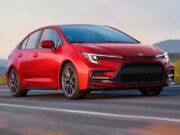










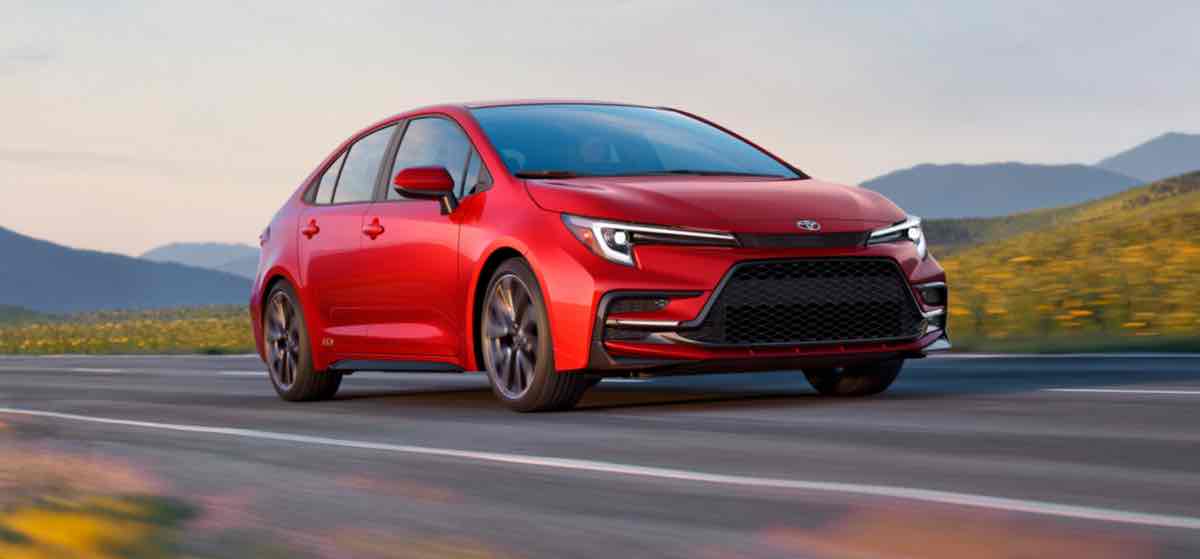
The Toyota Corolla enters the 2027 model year with a milestone few automotive nameplates ever reach: its 60th anniversary. The 2027 Toyota Corolla Hybrid combines that remarkable legacy with Toyota’s fifth-generation hybrid technology, up to an estimated 50 MPG combined, available Electronic On-Demand All-Wheel Drive and a special 60th Anniversary Edition limited to just 2,500 units. It may not reinvent the Corolla formula, but it continues to refine one of America’s most sensible electrified compact sedans.
The Toyota Corolla Turns 60
Few cars have remained relevant for six decades, but the Corolla has managed to evolve continuously without abandoning the qualities that made it successful in the first place.
For 2027, Toyota is celebrating 60 years of the Corolla while simultaneously demonstrating just how dramatically the compact car has evolved since its early days.
The modern Corolla Hybrid is a particularly good example.
What was once an extremely simple, inexpensive compact has become a technologically sophisticated hybrid sedan capable of delivering impressive fuel economy, available all-wheel drive, modern driver-assistance technology and a surprisingly comprehensive list of comfort and connectivity features.
Yet the basic mission remains familiar: provide practical, efficient and accessible everyday transportation.
The 2027 Corolla Hybrid lineup continues to be offered in LE, SE and XLE grades, allowing buyers to choose between value, sportier styling and a more upscale specification.
For the anniversary year, however, there is another particularly interesting addition.
The 60th Anniversary Special Edition Is Limited to 2,500 Cars
Toyota is marking six decades of Corolla production with a dedicated 60th Anniversary Special Edition.
Only 2,500 examples are planned, making it considerably more exclusive than the regular Corolla Hybrid lineup.
Rather than basing the anniversary model on the luxury-oriented XLE, Toyota chose the more athletic SE Hybrid as its starting point.
That decision gives the commemorative Corolla a sportier character while maintaining the efficiency expected from the hybrid powertrain.
One of its most recognizable exterior features is a set of exclusive 18-inch machined alloy wheels with black-painted accents. Special badging further distinguishes the limited-production model from an ordinary Corolla Hybrid SE.
The result isn’t intended to transform the Corolla into a performance sedan. Instead, Toyota has created a visually distinctive version of the Hybrid that acknowledges the nameplate’s history without abandoning the characteristics that make the current car attractive.
Fifth-Generation Toyota Hybrid System Remains at the Heart of the Corolla
Under the hood, the 2027 Corolla Hybrid uses Toyota’s fifth-generation Toyota Hybrid System, or THS 5.
The system combines a 1.8-liter four-cylinder gasoline engine with electric motor assistance and an electronically controlled continuously variable transmission, or ECVT.
Combined system output is 138 horsepower.
On paper, that figure might appear relatively modest in an era when even mainstream compact cars increasingly offer turbocharged engines with considerably more power.
But outright acceleration isn’t the Corolla Hybrid’s primary objective.
Toyota has instead optimized the powertrain around efficiency, smoothness and everyday usability.
Electric assistance helps provide immediate response at lower speeds, while the hybrid system constantly manages the relationship between gasoline and electric power without requiring the driver to change how the vehicle is operated.
There is no need to plug the Corolla Hybrid into an external charger.
Energy recovered during braking and deceleration is stored in the hybrid battery and reused automatically, allowing the vehicle to spend portions of everyday driving with the gasoline engine operating less frequently.
For drivers who want electrification without changing their fueling habits, that remains one of the conventional hybrid’s biggest advantages.
Up to 50 MPG Combined Makes the Corolla Hybrid Extremely Efficient
Fuel economy remains one of the strongest arguments for choosing the Corolla Hybrid.
Toyota estimates that the Corolla Hybrid LE with front-wheel drive can achieve 53 MPG city, 46 MPG highway and 50 MPG combined.
The XLE can also achieve a manufacturer-estimated 50 MPG combined.
Those numbers make the Corolla Hybrid particularly compelling for drivers who spend substantial amounts of time in urban and suburban traffic.
Unlike a conventional gasoline vehicle, where stop-and-go driving can dramatically increase fuel consumption, a hybrid can take advantage of regenerative braking and electric assistance.
That explains why the Corolla Hybrid’s estimated city economy can actually exceed its highway rating.
For commuters covering thousands of miles each year, the difference in fuel consumption compared with a conventional gasoline compact can become significant over the lifetime of the vehicle.
And because it remains a conventional self-charging hybrid rather than a plug-in hybrid or EV, long-distance travel requires no additional planning beyond stopping at a regular gas station.
Available Electronic On-Demand AWD Adds Another Dimension
Efficiency isn’t the only attraction.
Toyota also offers the Corolla Hybrid with Electronic On-Demand All-Wheel Drive, giving buyers an option rarely associated with highly economical compact hybrid sedans.
Instead of using a traditional mechanical driveshaft connecting the gasoline engine to the rear axle, Toyota’s system can use electric power to assist the rear wheels when additional traction is required.
That arrangement provides several advantages.
It allows the vehicle to retain much of the packaging and efficiency benefit of a front-wheel-drive hybrid while providing additional traction when road conditions deteriorate.
For drivers living in areas with snow, ice or frequent heavy rain, available AWD could be one of the Corolla Hybrid’s most important features.
It also broadens the Corolla’s appeal in regions where buyers might otherwise automatically choose an AWD crossover.
The Corolla Hybrid SE Brings a Sportier Personality
Buyers wanting a more aggressive-looking Corolla don’t necessarily need to sacrifice hybrid efficiency.
The SE Hybrid provides a more athletic interpretation of the compact sedan, with styling and equipment intended to distinguish it from the efficiency-focused LE.
Larger wheels and sportier exterior details give the SE considerably more visual presence, which also explains why Toyota selected this grade as the foundation for the 60th Anniversary Special Edition.
The availability of AWD adds another interesting element.
A Corolla Hybrid SE AWD isn’t a hot sedan in the traditional sense, but it combines sporty styling, electrification and four-wheel traction in a package that remains designed primarily around affordable everyday transportation.
That’s a relatively unusual combination in the compact-car segment.
XLE Takes the Corolla Hybrid in a More Premium Direction
At the other end of the range sits the Corolla Hybrid XLE.
Where the SE emphasizes a sportier appearance, the XLE focuses more heavily on comfort and premium equipment.
This gives the Corolla Hybrid lineup a useful degree of flexibility.
The LE remains the logical choice for drivers primarily interested in maximum efficiency and value, while the SE adds more visual attitude.
The XLE is aimed at customers who like the Corolla Hybrid’s compact dimensions and fuel economy but don’t necessarily want an entry-level cabin or specification.
That breadth is important because compact sedans increasingly need to compete not only against one another but also against small crossovers.
Toyota’s strategy allows the Corolla Hybrid to cover several different customer profiles without requiring multiple fundamentally different powertrains.
A Hybrid Sedan Still Makes Plenty of Sense in America
The American market has shifted dramatically toward SUVs and crossovers, but compact sedans continue to offer several inherent advantages.
They are generally lighter and more aerodynamic than similarly priced crossovers, helping reduce energy consumption.
Their lower center of gravity can also provide more natural handling characteristics, while smaller exterior dimensions make them easier to maneuver and park.
Combine those advantages with an efficient hybrid system and the formula becomes particularly compelling.
The Corolla Hybrid doesn’t attempt to mimic an SUV. Instead, it focuses on being an efficient compact sedan and offers AWD to buyers who need additional traction.
For many commuters, that’s arguably a more rational combination than moving to a larger, heavier vehicle simply to obtain four driven wheels.
138 Horsepower Is About Efficiency, Not Performance
With 138 net combined horsepower, nobody is likely to confuse the 2027 Corolla Hybrid with a GR Corolla.
Nor should they.
Toyota’s hybrid sedan is designed around a very different philosophy.
The objective is to deliver predictable response, low fuel consumption and smooth operation rather than dramatic straight-line acceleration.
That distinction matters because horsepower figures alone don’t tell the entire story of a hybrid drivetrain.
Electric motors can provide immediate torque, particularly when pulling away from a stop, while the ECVT allows the hybrid system to continuously select an efficient operating condition.
As a result, everyday urban performance can feel more responsive than the relatively modest horsepower number might suggest.
Drivers wanting serious performance have other choices within the broader Corolla family.
The Hybrid’s job is to minimize trips to the gas station while remaining perfectly usable as everyday transportation.
Corolla’s Greatest Strength May Still Be Its Simplicity
The automotive industry is moving rapidly toward increasingly complicated forms of electrification.
Battery-electric vehicles can provide excellent efficiency and performance, but they also require access to charging infrastructure.
Plug-in hybrids offer electric commuting with gasoline backup, but owners need to charge regularly to realize their full efficiency potential.
The conventional Corolla Hybrid sits between traditional gasoline cars and those more infrastructure-dependent alternatives.
You drive it like a normal car.
You refuel it like a normal car.
The hybrid system handles everything else automatically.
For drivers who want lower fuel consumption but aren’t ready — or simply don’t need — to plug in their vehicle every night, that simplicity remains extremely attractive.
The 2027 Corolla Hybrid Sticks to a Proven Formula
Toyota hasn’t attempted to reinvent the Corolla Hybrid for 2027.
Instead, it continues developing a formula that already makes considerable sense.
The fifth-generation hybrid system provides 138 combined horsepower, while the most efficient front-wheel-drive versions can achieve a manufacturer-estimated 50 MPG combined.
Available Electronic On-Demand AWD makes the Corolla Hybrid viable for a wider range of climates, while LE, SE and XLE grades allow buyers to prioritize affordability, styling or comfort.
The 60th Anniversary Special Edition adds something less rational but perhaps equally important: character.
After six decades, the Corolla has earned the right to celebrate its history.
And there’s something appropriate about Toyota marking that anniversary not with an extravagant high-performance machine, but with a highly efficient, practical and accessible compact sedan.
That is, after all, remarkably close to the philosophy that made the Corolla successful in the first place.
The technology has changed enormously. The basic idea hasn’t.