




























Few cars have ever achieved the cultural status of the Lamborghini Countach. For an entire generation, it wasn’t simply an exotic Italian supercar — it was the car on the bedroom wall, the machine that seemed almost too outrageous to exist in the real world. And among the many versions produced during its remarkably long life, the Lamborghini Countach 5000 Quattrovalvole stands out as one of the most spectacular: a 5.2-liter V12-powered evolution with unmistakable 1980s styling, breathtaking performance and enough visual drama to make even today’s supercars look restrained.
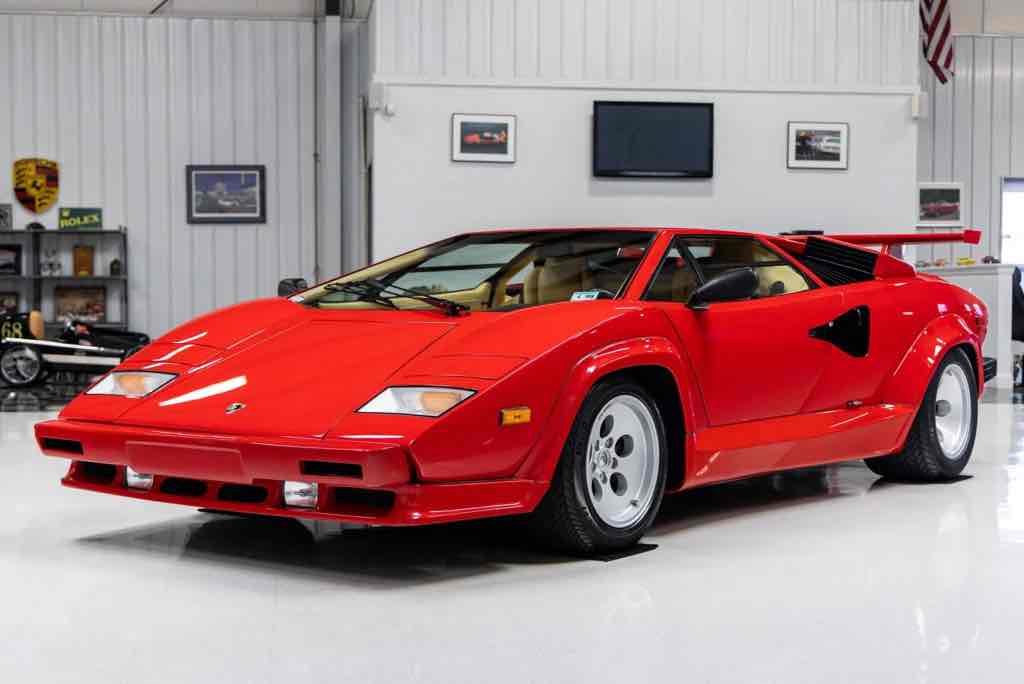
The Lamborghini That Became a Bedroom-Wall Legend
Long before social media, YouTube and endless online configurators gave enthusiasts instant access to the world’s most exotic machinery, there were posters.
And few cars were better suited to the format than the Lamborghini Countach.
Its impossibly low body, wedge-shaped profile, enormous rear tires and upward-opening scissor doors looked like something transported directly from a science-fiction movie. The Countach became one of the defining automotive images of the 1970s and especially the 1980s.
Yet the car’s story began considerably earlier.
Lamborghini revealed the Countach LP500 prototype at the 1971 Geneva Motor Show. Marcello Gandini, working at Bertone, was responsible for the radical design.
Production eventually began in 1974, and the Countach would remain part of Lamborghini’s lineup until 1990.
Over those years, it evolved substantially. Engines became larger, tires became wider, bodywork grew more aggressive and performance steadily increased.
By the middle of the 1980s, Lamborghini was ready to create one of the ultimate expressions of the original Countach formula.
The result was the Countach 5000 Quattrovalvole, better known simply as the 5000 QV.
Quattrovalvole Meant Four Valves Per Cylinder
Introduced in 1985, the Countach 5000 QV represented a significant mechanical step forward.
Its name explained one of the most important changes.
“Quattrovalvole” means “four valves” in Italian, referring to the new four-valve-per-cylinder cylinder heads fitted to Lamborghini’s legendary V12.
With 12 cylinders, that meant the Countach now had a total of 48 valves.
Displacement increased to 5,167 cc, or approximately 5.2 liters, allowing Lamborghini to extract substantially more performance from its naturally aspirated V12.
European-specification cars used six Weber downdraft carburetors and produced approximately 455 PS, equivalent to roughly 449 SAE horsepower.
That was an extraordinary number in 1985.
This was an era when even many genuinely fast sports cars struggled to produce half that amount of power.
And the Countach delivered it without turbochargers, superchargers, electric motors or sophisticated electronic assistance.
Just a large naturally aspirated Italian V12 sitting immediately behind the occupants.
The American Countach 5000 QV Was Different
For U.S. enthusiasts, however, there is an important distinction.
American-market Countach 5000 QVs did not use the same six-Weber carburetor arrangement as their European counterparts.
Instead, U.S.-specification cars received Bosch K-Jetronic fuel injection, primarily to satisfy American emissions requirements.
The change reduced output compared with the European “Downdraft” cars, with commonly quoted figures putting the fuel-injected version at roughly 414–420 horsepower, depending on specification and measurement.
American cars were visually different as well.
Federal regulations resulted in distinctive bumper arrangements that altered the Countach’s famously clean nose. To modern eyes, the U.S. bumpers may appear somewhat awkward compared with the European design, but today they are an unmistakable part of the history of federalized Countach models.
And rarity makes the fuel-injected QV particularly fascinating.
Only a relatively small number of the 5000 QVs were produced with fuel injection, making surviving original examples highly desirable among collectors.
The V12 Was the Star of the Show
The Countach’s styling may have attracted people from across the parking lot, but the engine provided the mechanical theater.
Mounted longitudinally behind the passenger compartment, the 5.2-liter V12 was one of the most exotic production engines of its era.
In European specification, peak output arrived at around 7,000 rpm.
There was no dual-clutch transmission handling shifts in milliseconds. No launch control optimized the getaway. No computer constantly adjusted the chassis to protect the driver from excessive enthusiasm.
Instead, the Countach used a five-speed manual transmission and sent its power exclusively to the rear wheels.
Driving one properly demanded involvement.
The clutch was heavy. The steering was unassisted. The gated manual transmission required deliberate inputs. Visibility — particularly toward the rear — was notoriously poor.
This was a supercar that expected its driver to participate.
Performance That Was Extraordinary for the Mid-1980s
Depending on specification and testing methodology, the Countach 5000 QV could accelerate from 0–60 mph in roughly the mid-four-second range, while 0–62 mph was generally achievable in approximately five seconds.
Its claimed top speed approached 185 mph, with some period claims varying depending on configuration and whether the enormous optional rear wing was fitted.
Those numbers require historical context.
Today, a high-performance electric sedan can accelerate to 60 mph faster than many classic supercars. But comparing numbers alone misses what made the Countach extraordinary.
In the mid-1980s, a road car approaching 300 km/h — roughly 186 mph — belonged to an exceptionally exclusive category.
And the Lamborghini delivered that performance while looking unlike almost anything else on the road.
Marcello Gandini Created One of the Most Recognizable Shapes Ever
Performance alone doesn’t explain why the Countach became such an icon.
Its design does.
Marcello Gandini’s wedge-shaped body abandoned most traditional sports-car styling conventions. The windshield was dramatically raked, the nose sat incredibly low and the entire vehicle appeared to have been designed around straight lines, sharp angles and geometric forms.
Then there were the doors.
The Countach popularized Lamborghini’s now-famous scissor-door design, with the doors rotating upward rather than swinging conventionally outward.
They weren’t merely theatrical.
The Countach’s extreme width made conventional doors less practical in tight spaces, while the unusual mechanism became an instant visual signature.
Decades later, upward-opening doors remain closely associated with Lamborghini’s flagship V12 models.
The 5000 QV Took the Countach’s Aggression Even Further
By the time the Quattrovalvole appeared, the Countach had evolved considerably from the relatively pure shape of the original LP400.
Wide fender flares surrounded enormous tires. Large air intakes dominated the rear quarters. The body had become substantially more muscular.
And then there was the rear wing.
The huge optional rear spoiler became one of the most recognizable visual features associated with the Countach, even though not every car received one.
Aerodynamic efficiency wasn’t necessarily its strongest argument. Visual impact certainly was.
With the wing installed, the Countach looked almost exactly like the exaggerated supercar children imagined when drawing cars in school notebooks.
That’s precisely why it worked.
Those Rear Tires Were Absolutely Enormous
One detail still looks outrageous even by modern standards: the rear tires.
The Countach 5000 QV could wear 345/35 VR15 tires at the rear, mounted on massive 15-inch wheels.
A 345-section rear tire was astonishing in the 1980s.
Even today, 345-mm-wide rubber is normally associated with extremely serious high-performance machinery.
The front tires were considerably narrower, typically measuring 225/50 VR15.
Combined with the Countach’s dramatic width and flared rear bodywork, the enormous rear tires gave the Lamborghini a stance unlike almost anything else of the period.
Viewed from behind, the car looked planted, mechanical and almost cartoonishly aggressive.
The Interior Was Pure Old-School Supercar
Climb inside and the Countach provides another reminder of how dramatically supercars have changed.
There are no giant touchscreens.
No digital instrument cluster dominates the dashboard.
No drive-mode selector offers Comfort, Sport and Track settings.
Instead, the driver faces traditional analog instruments and a wonderfully mechanical gated manual shifter.
The seating position is low and intimate. The windshield feels enormous in one direction while visibility becomes challenging in almost every other direction.
The Countach is also famous for one of the most entertaining parking techniques in automotive history.
Because rear visibility is so limited, drivers often open the scissor door, sit partially on the door sill and look backward over the body while reversing.
It’s hardly elegant.
But somehow, in a Countach, even reversing into a parking space becomes theater.
It Was Never Supposed to Be Easy
Modern supercars can be remarkably civilized.
Many have adaptive suspension, automatic transmissions, parking cameras, climate-controlled seats and sophisticated driver-assistance systems. Some can comfortably commute through traffic before delivering astonishing performance on an empty road.
The Countach came from a different philosophy.
Its steering could be extremely heavy at low speeds. The clutch demanded effort. Cabin temperatures could become uncomfortable. Rear visibility was terrible. Getting in and out required flexibility.
Even the driving position wasn’t ideal for everyone.
But those inconveniences have become part of the Countach mythology.
It feels mechanical because it is mechanical.
The driver doesn’t simply select a mode and allow software to optimize the experience. Every gear change, steering input and throttle movement becomes part of operating the machine.
A Supercar From an Era Before Electronics Took Over
Perhaps this is why the Countach continues to fascinate enthusiasts more than four decades after its debut.
The 5000 QV arrived before electronic stability control, adaptive suspension, active aerodynamics and modern traction-management systems transformed the supercar.
There is remarkably little separating the driver from the mechanical components.
The naturally aspirated V12 responds directly to the throttle.
The manual gearbox requires physical interaction.
The rear wheels receive all the power.
And the driver’s own judgment remains one of the most important safety systems in the car.
That combination creates an experience that modern engineering has largely eliminated — intentionally, in the name of performance, safety and usability.
The Countach Was More Than a Lamborghini
Some cars become famous because they’re fast.
Others become famous because they’re beautiful.
A very small number become genuine cultural objects.
The Countach belongs in that last category.
Its influence extended far beyond Lamborghini dealerships. It appeared in movies, magazines, television shows, advertisements, toys and countless posters.
People who knew almost nothing about cars knew what a Countach looked like.
For children growing up during the 1980s and early 1990s, the Lamborghini often represented the ultimate definition of a supercar.
Ferrari had its own extraordinary machines, including the Testarossa. Porsche had the 911 Turbo. Later, the Ferrari F40 and Porsche 959 would push performance into another dimension.
But the Countach had something different.
It looked completely unreasonable.
And that was precisely the appeal.
The 5000 QV Became One of the Most Desirable Countach Variants
The Countach went through numerous iterations during its lengthy production run, including the LP400, LP400 S, LP500 S, 5000 QV and eventually the 25th Anniversary model.
Each has its supporters.
The early LP400 remains particularly desirable for the purity of Gandini’s original design, while the later 25th Anniversary introduced extensive styling revisions.
The 5000 QV occupies an especially interesting position between them.
It retains the aggressive classic Countach appearance while benefiting from the substantially more powerful 5.2-liter, four-valve V12.
For many enthusiasts, it represents the Countach formula turned almost all the way up without fundamentally changing the character of Gandini’s original creation.
Values Reflect the Countach’s Legendary Status
Unsurprisingly, buying a great Countach today requires serious money.
Values vary enormously according to specification, provenance, originality, mileage, condition and restoration history.
European “Downdraft” Quattrovalvole examples can command particularly substantial prices because of their 455-PS carbureted engines and collector desirability.
Exceptional examples can reach several hundred thousand dollars, while historically significant, unusually original or concours-quality cars may climb substantially higher.
That represents an enormous transformation for a car once dismissed by some critics as excessive 1980s extravagance.
Today, that excess is precisely what collectors want.
There Will Never Be Another Countach Quite Like This One
Lamborghini revived the Countach name decades later with the limited-production Countach LPI 800-4, combining modern V12 performance with styling references to the original.
But recreating the cultural impact of the first Countach is nearly impossible.
The original appeared at a moment when a machine this radical genuinely seemed futuristic.
There was no internet allowing enthusiasts to watch hundreds of videos before seeing one.
Spotting a Countach on the street could become a lifelong memory.
For many people, the closest they ever came was staring at one printed on a poster above their bed.
And perhaps that’s the best way to understand the Lamborghini Countach 5000 QV.
It wasn’t merely transportation.
It wasn’t even merely a supercar.
It was an automotive fantasy made real — powered by a 5.2-liter V12, shifted through a gated five-speed manual transmission and wrapped in one of the most outrageous shapes ever permitted to wear a license plate.
More than 40 years later, the Lamborghini Countach still looks like a poster car.
Because that’s exactly what it was.