









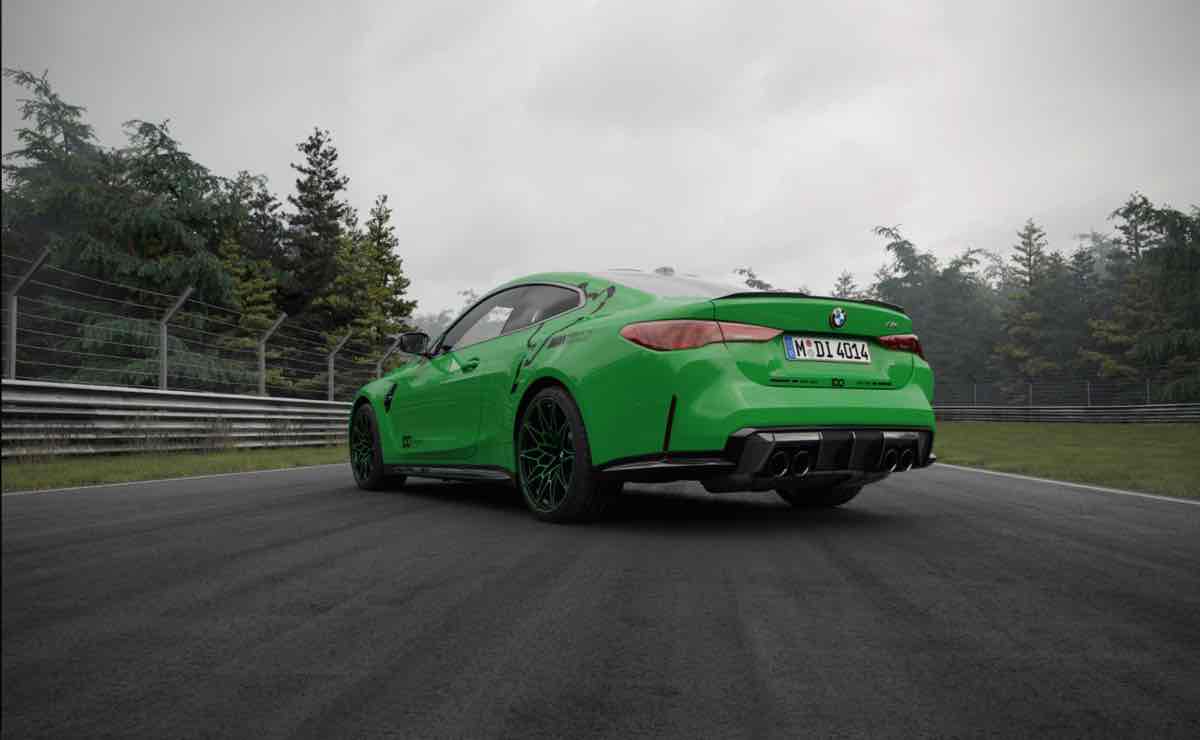
Few relationships in the automotive world run as deep as the one between BMW M and the Nürburgring. With the legendary German circuit approaching its 100th anniversary in 2027, BMW M and BMW Motorrad are marking the occasion with the “100 Jahre Nürburgring” collection — six special BMW M cars and three ultra-exclusive M motorcycles dressed in historic Nürburgring Green and loaded with details inspired by the infamous Nordschleife.
A Century of the Nürburgring Deserves Something Special
The Nürburgring officially opened on June 18, 1927, and over the following century it became far more than another European racetrack.
Its legendary Nordschleife — often referred to simply as the “Green Hell” — evolved into one of the most demanding performance benchmarks in the automotive industry.
BMW’s relationship with the circuit is particularly significant.
For decades, the company has used the Nürburgring as both a motorsport venue and an extreme development environment. BMW M production vehicles routinely undergo testing on the Nordschleife, where engineers can evaluate virtually every aspect of a high-performance car under extraordinarily demanding conditions.
For the circuit’s 100th anniversary, BMW is turning that relationship into a special-edition family carrying a simple philosophy:
“Born on the Racetrack. Made for the Streets.”
The collection consists of six BMW M automobiles:
BMW M2, BMW M3 Sedan, BMW M3 Touring, BMW M4 Coupe, BMW M5 Sedan and BMW M5 Touring.
BMW Motorrad joins the celebration with another three machines: the BMW M 1000 RR, M 1000 R and M 1000 XR.
Together, they form one of BMW’s most comprehensive Nürburgring tributes yet.
Historic Nürburgring Green Connects the Entire Collection
The most immediately recognizable feature is the paint.
BMW developed an exclusive historic Nürburgring Green finish specifically for the anniversary edition, creating a direct visual connection with the Green Hell.
Customers will also have the option of Black Sapphire metallic on the BMW M cars.
But BMW didn’t simply create a green paint color and call the project finished.
The cars receive model-specific graphics incorporating several important anniversary references, including a “100” logo, “Nürburgring since 1927” lettering and the unmistakable outline of the Nürburgring.
Depending on the model, these graphics appear across areas including the front doors, C-pillars and rear quarter sections.
BMW also developed special roof graphics for the anniversary cars.
The BMW M2, M3 Sedan, M4 Coupe and M5 Sedan carry the design across their M carbon roofs, while the M3 Touring and M5 Touring receive the distinctive treatment across their steel roofs.
The overall color palette mixes light gray, black and Nürburgring Green, while selected models add green accents to their wheels and kidney grilles.
The result is unmistakably special without transforming the cars into exaggerated rolling billboards.
BMW M2: The Compact Nürburgring Machine
The BMW M2 is arguably one of the most natural candidates for a Nürburgring anniversary edition.
Its relatively compact dimensions, rear-biased performance philosophy and turbocharged inline-six-cylinder engine already give the M2 a character closely connected to traditional BMW M values.
For the 100 Jahre Nürburgring edition, BMW adds the exclusive Nürburgring Green or Black Sapphire metallic exterior finish, distinctive door graphics incorporating the Nordschleife silhouette, anniversary branding and an edition-specific M carbon roof.
High-gloss black Style 930 M wheels complete the exterior treatment.
Inside, the M2 receives M carbon bucket seats with a green Nordschleife silhouette embroidered into the front headrests.
An M Alcantara steering wheel features contrasting green and white stitching along with a 12 o’clock marker, reinforcing the car’s track-oriented character.
Ordering for the anniversary M2 is expected to begin in January 2027.
BMW M3 Sedan Brings the Green Hell to an Everyday Performance Car
Few cars illustrate BMW M’s dual-purpose philosophy better than the M3.
It remains capable of functioning as an everyday sports sedan while delivering the performance required for serious circuit driving.
The anniversary M3 Sedan receives Nürburgring graphics across the body, an M carbon roof carrying special edition stripes and Style 826 M wheels with Nürburgring Green accents.
The interior continues the theme with contrasting green and white stitching and Nordschleife embroidery on the front headrests.
It’s a relatively restrained treatment by special-edition standards, but that restraint arguably suits the M3 particularly well.
The car remains immediately recognizable as an M3 while carrying details enthusiasts will quickly identify as something considerably more unusual.
BMW M3 Touring Combines Nürburgring Performance With Serious Practicality
The M3 Touring takes essentially the same high-performance philosophy and places it inside one of BMW M’s most versatile body styles.
That makes the anniversary edition especially interesting.
Few vehicles can combine serious racetrack capability with the ability to carry passengers, luggage and everyday cargo quite like a modern high-performance wagon.
The 100 Jahre Nürburgring M3 Touring receives the same Nürburgring Green or Black Sapphire metallic choices, anniversary graphics and green wheel accents.
Unlike the M3 Sedan, however, the Touring uses a steel roof rather than the M carbon roof.
BMW compensates visually with the same edition-specific stripe treatment, allowing the wagon to retain the common identity of the anniversary collection.
BMW M4 Coupe Looks Right at Home in Nürburgring Green
If one model in the collection appears particularly suited to the aggressive anniversary treatment, it may be the M4 Coupe.
Its two-door proportions provide an ideal canvas for the Nürburgring-inspired graphics.
The M4 receives the M carbon roof with exclusive stripes, Style 826 M wheels with green accents and an especially noticeable green treatment around the kidney grille.
The Black Sapphire metallic version creates perhaps the strongest visual contrast, with its Nürburgring Green details standing prominently against the dark bodywork.
Inside, the green theme continues through stitching and embroidered Nordschleife details.
But the most interesting changes to the six-cylinder cars go considerably deeper than cosmetics.
BMW M Ignite Brings Motorsport Technology to the Street
The M2, M3 and M4 anniversary models benefit from one of BMW M’s most interesting recent engineering developments: BMW M Ignite.
The patented pre-chamber ignition technology has been incorporated into BMW’s inline-six-cylinder M engines beginning in 2026.
Instead of chasing additional headline horsepower, the system focuses heavily on combustion efficiency under demanding operating conditions.
BMW says M Ignite improves efficiency particularly under high loads, reduces fuel consumption during racetrack use and helps the engines meet increasingly strict emissions requirements without sacrificing performance.
That’s significant because racetrack operation creates conditions dramatically different from ordinary highway driving.
Engines spend much more time operating at high loads and elevated temperatures, meaning improvements that appear relatively minor during normal driving can become much more meaningful during extended circuit use.
BMW therefore describes M Ignite as another example of technology moving directly from motorsport development into road-going production vehicles.
And there could hardly be a more appropriate collection in which to showcase it.
BMW M5 Sedan Adds Electrified Muscle to the Anniversary
The M5 represents a very different side of modern BMW M.
Where the M2 emphasizes compact dimensions and traditional sports-car character, today’s M5 combines enormous performance with the company’s M HYBRID technology.
For the Nürburgring anniversary edition, the M5 Sedan receives Nürburgring Green or Black Sapphire metallic paint, edition graphics across the doors, C-pillars and rear sections, plus an M carbon roof featuring the exclusive stripe treatment.
Style 951 M wheels receive green accents.
The cabin takes a slightly different approach from the six-cylinder cars. Black Nordschleife silhouettes are embroidered into the front headrests, while the M steering wheel carries the anniversary collection’s distinctive design theme.
The M5 therefore becomes an interesting demonstration of how dramatically BMW M technology has evolved while maintaining its connection with the same racetrack used to develop generations of earlier M cars.
BMW M5 Touring Might Be the Ultimate Anniversary All-Rounder
The M5 Touring takes that same M HYBRID performance philosophy and combines it with considerably greater cargo-carrying versatility.
Like the M3 Touring, it uses a steel roof rather than the carbon roof fitted to the sedan.
BMW nevertheless applies the exclusive anniversary stripes across the roof, ensuring that the wagon remains visually connected to the rest of the family.
Nürburgring graphics appear across the exterior, Style 951 M wheels feature green accents and black Nordschleife embroidery appears on the front headrests.
It’s difficult to think of many vehicles that better illustrate how far the definition of a high-performance car has evolved.
The M5 Touring can operate as a practical long-distance wagon while carrying technology developed and refined at one of the world’s most demanding racetracks.
The Motorcycles Are Even More Exclusive
BMW Motorrad isn’t merely participating symbolically in the anniversary.
Its three special models are serious collector machines.
The BMW M 1000 RR, BMW M 1000 R and BMW M 1000 XR 100 Jahre Nürburgring editions will each be limited to just 100 units worldwide.
All three receive the M Track Package and exclusive Nürburgring Green paint.
Anniversary decals distinguish them from regular production models, while carbon wheels receive Nürburgring Green accent stripes.
The rear swingarm and rear frame are finished in black, and the seats feature an Alcantara-style material with embroidered “100” branding.
BMW has even turned the fuel tank into part of the tribute.
Each motorcycle receives a painted tank featuring Nordschleife decoration, while the airbox cover carries an anniversary design and an individual “one of 100” marking.
A Certificate of Authenticity further reinforces the collector status of the bikes.
BMW also includes an exclusive M motorcycle mat and a rear-wheel paddock stand, while the M 1000 RR and M 1000 R additionally receive an M Cover Kit.
BMW M 1000 RR: The Racetrack Specialist
Of the three motorcycles, the M 1000 RR arguably has the most obvious connection to the Nürburgring theme.
The superbike is built around racetrack performance, lightweight engineering and aerodynamic efficiency.
Its anniversary treatment doesn’t fundamentally change that philosophy. Instead, it emphasizes what the M 1000 RR already represents: BMW Motorrad’s pursuit of maximum circuit performance in a road-legal motorcycle.
The exclusive Nürburgring Green finish and carbon components simply make that connection considerably more visible.
BMW M 1000 R: Superbike Performance Without the Fairings
The M 1000 R translates much of BMW Motorrad’s superbike performance into a hyper-naked format.
It prioritizes power, agility and direct rider feedback, producing a motorcycle that can operate on public roads while remaining entirely comfortable on a racetrack.
For the anniversary model, that dual personality fits neatly with BMW’s “Born on the Racetrack. Made for the Streets.” message.
BMW M 1000 XR Adds Long-Distance Ability
The M 1000 XR represents yet another interpretation of the M motorcycle formula.
Rather than focusing exclusively on pure circuit performance, it combines serious speed and high-speed stability with ergonomics better suited to longer journeys.
That makes it something of a motorcycle counterpart to the M3 Touring or M5 Touring: extreme performance without abandoning real-world versatility.
The Nürburgring edition adds exclusivity without fundamentally changing that character.
The Nordschleife Remains One of BMW M’s Most Important Development Tools
There is considerably more substance behind this anniversary collection than graphics and green paint.
The Nordschleife remains an important part of BMW M’s engineering process.
The circuit measures approximately 12.9 miles (20.8 kilometers) and includes 73 corners, significant elevation changes and an extraordinary variety of surfaces and corner types.
That combination places enormous simultaneous demands on virtually every major vehicle system.
Suspension tuning, steering behavior, braking performance, powertrain durability, aerodynamics, cooling and thermal management can all be evaluated under exceptionally difficult conditions.
A car that works well on the Nordschleife has been subjected to stresses that are extremely difficult to reproduce during ordinary road testing.
BMW’s connection with the circuit also extends almost all the way back to its beginning.
BMW Motorrad achieved its first victory there in 1927, the same year the Nürburgring opened.
A century later, that relationship remains very much alive.
This Is More Than a Centennial Paint Package
Special editions celebrating racetracks aren’t unusual, but BMW’s 100 Jahre Nürburgring collection goes considerably further than simply adding badges to existing vehicles.
The historic Nürburgring Green paint provides the obvious visual connection, while the circuit graphics, embroidered track silhouettes, special roofs, wheel details and anniversary interiors give each vehicle its own interpretation of the theme.
More importantly, cars such as the M2, M3 and M4 incorporate BMW M Ignite technology that illustrates the engineering relationship between motorsport development and production vehicles.
The motorcycles take exclusivity even further, with only 100 examples of each M 1000 model scheduled for worldwide production.
The result is an anniversary collection that reflects both sides of the Nürburgring’s importance to BMW.
It is part history lesson, part collector series and part engineering showcase.
One hundred years after the Nürburgring opened, BMW M is still using the Green Hell for exactly what it was built for: finding out just how fast a machine can go — and how much better the next one can become.