
















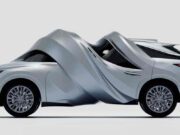














Lexus vehicles are generally associated with precision engineering, quiet luxury and carefully controlled design. But two familiar Lexus SUVs recently appeared in New York looking as though someone had grabbed their digital 3D models and deliberately broken every rule of automotive design. One RZ 450e has been stretched into an enormous loop, while an RX 450h+ has been twisted along its body like a giant piece of metal caught in a surreal vortex. They’re called Circle Car and Twisted Car, and they’re part of one of the strangest automotive art projects we’ve seen in years.
These Are Real Sculptures, Not AI-Generated Images
At first glance, the images are difficult to process. The proportions look impossible: body panels curve in directions automotive sheet metal simply isn’t supposed to go, windows stretch into unfamiliar shapes, and entire sections of the vehicles appear to have been distorted using tools from 3D modeling software.
Yet these aren’t AI-generated Lexus concepts or clever Photoshop experiments. They’re real, physical sculptures created for MOTOMORPHOSIS, a collaboration between Lexus and Brooklyn-based conceptual art collective MSCHF.
For the project, MSCHF took the recognizable visual identities of two electrified Lexus SUVs — the all-electric RZ 450e and plug-in hybrid RX 450h+ — and transformed them into objects that deliberately challenge our understanding of what an automobile should look like. Unlike traditional concept cars, neither sculpture is intended to preview a future Lexus. MSCHF calls them “Form Cars.”
Circle Car Turns a Lexus RZ 450e Into an Endless Loop
Perhaps the most immediately surreal creation is Circle Car. Its starting point is the Lexus RZ 450e, the brand’s battery-electric crossover. In production form, the RZ follows relatively conventional automotive proportions, even if its sharp surfaces and distinctive Lexus design language already give it a futuristic appearance.
MSCHF effectively threw those proportions out the window. Circle Car stretches and curves the RZ until the entire vehicle bends back toward itself, with the front and rear appearing to chase one another around a continuous arc. The result resembles a giant automotive ring.
Look closely and familiar Lexus elements remain visible. There are recognizable sections of the front and rear, windows, body panels and other details derived from the production vehicle, but they’re now connected by a wildly elongated and curved structure.
The result creates a wonderfully absurd visual contradiction. Cars exist to move from one location to another, while Circle Car instead represents a vehicle that could theoretically continue traveling forever while going absolutely nowhere — endlessly chasing its own tail. It’s automotive motion transformed into physical sculpture.
Twisted Car Looks Like Someone Wringed Out a Lexus RX
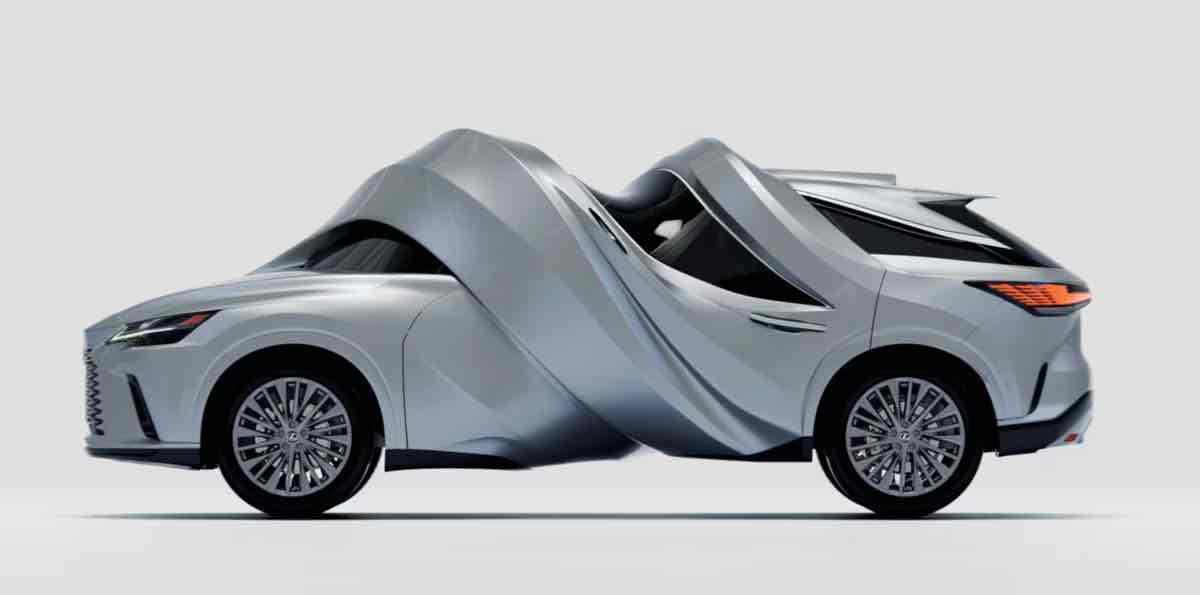
If Circle Car bends the rules, Twisted Car appears to destroy them completely. This sculpture is based on the Lexus RX 450h+, the plug-in hybrid version of Lexus’ popular luxury SUV.
Instead of wrapping the vehicle into a circle, MSCHF subjected its visual form to extreme longitudinal torsion. In simpler terms, imagine grabbing the front and rear of an RX and twisting them in opposite directions as though you were wringing water from a towel.
The front and rear remain surprisingly recognizable, but everything between them appears to spiral around the vehicle’s longitudinal axis. Windows, roofline, doors and body surfaces seem to melt into the rotation. From certain angles, Twisted Car almost resembles a screenshot taken from 3D modeling software at the exact moment somebody applied an extreme twist modifier to the vehicle — and that’s not accidental.
Digital Distortion Brought Into the Physical World
One of the most interesting elements of MOTOMORPHOSIS is where MSCHF found its inspiration. Anyone familiar with 3D modeling or animation will recognize operations such as stretching, bending, twisting and deforming objects.
Inside a computer, geometry doesn’t necessarily have to obey the physical restrictions of steel, glass, plastic or gravity. A designer can take a digital object and manipulate its proportions almost instantly. MSCHF wanted to translate that digital language into the physical world, so the sculptures resemble impossible 3D transformations somehow pulled through a computer monitor and reconstructed at full automotive scale.
There’s also an animation influence. Animators frequently exaggerate the shape of moving objects for individual frames to communicate speed and movement. These so-called smear frames can stretch or distort characters and objects far beyond realistic proportions. Freeze one of those moments, build it from physical materials and scale it to the dimensions of a luxury SUV, and the connection to Circle Car and Twisted Car becomes obvious.
Lexus Put the Normal Cars Beside Their Distorted Twins
MOTOMORPHOSIS becomes even more effective because Lexus and MSCHF didn’t display the sculptures alone. Each was positioned alongside the production vehicle that inspired it: the regular Lexus RZ 450e stood beside Circle Car, while the standard RX 450h+ accompanied Twisted Car.
That comparison is important. Without the original vehicle nearby, the sculptures could simply appear to be bizarre futuristic objects. Placing the production versions beside them immediately reveals exactly what has happened.
Visitors can visually follow familiar Lexus styling elements from the normal vehicle into its distorted counterpart and see how conventional automotive proportions have been stretched, bent and twisted into something almost unrecognizable. The ordinary cars become reference points for understanding the extraordinary ones.
They’re Not Concept Cars
Automakers have been creating outrageous concept cars for decades, but Lexus and MSCHF are making an important distinction here. Circle Car and Twisted Car aren’t concepts in the traditional automotive sense.
A conventional concept car usually exists to explore something about the future. It might preview a new design language, demonstrate upcoming technology, experiment with a new powertrain or gauge public reaction to ideas that could eventually reach production.
MOTOMORPHOSIS isn’t trying to predict anything. MSCHF’s “Form Car” description instead shifts the emphasis entirely toward shape. The question isn’t what the next Lexus might look like, but what happens when you take the idea of a Lexus and remove the physical restrictions normally imposed on automotive design.
No aerodynamics, passenger packaging, cargo capacity or crash regulations. No requirement that four wheels actually remain positioned sensibly on the ground — and, most importantly, no requirement that the object can actually drive. Suddenly the automobile becomes raw material for sculpture.
Electrification Becomes an Artistic Theme
The choice of vehicles isn’t random either. Both Lexus models represent electrification, although in different ways. The RZ 450e is fully electric, while the RX 450h+ is a plug-in hybrid combining electric driving capability with an internal-combustion engine.
Lexus has positioned the project within its broader “Electric Made Art” philosophy. Most discussions surrounding electrification naturally revolve around technical subjects such as batteries, range, charging speeds, efficiency, electric motors and infrastructure. MOTOMORPHOSIS deliberately moves the conversation somewhere else.
Instead of asking what electricity can do mechanically, Lexus wanted the installation to explore what electrification might inspire creatively. It’s certainly a very different approach to promoting electrified vehicles: there are no range charts or charging curves here, just two completely surreal Lexus-shaped objects.
MSCHF Was the Perfect Partner for Something This Strange
For anyone familiar with MSCHF, the bizarre nature of the project probably isn’t surprising. The Brooklyn-based collective has built its reputation around taking familiar products, ideas and cultural objects and transforming them into something deliberately unexpected.
Its projects frequently blur the boundaries between art, internet culture, fashion, product design and publicity stunt, and that philosophy works particularly well with cars.
Automobiles are among the most recognizable designed objects in everyday life. Even people who know very little about cars instinctively understand what one is supposed to look like: there should be a front, a rear, a roof, windows and wheels arranged in approximately predictable locations.
Destroy those proportions while retaining enough recognizable elements and the human brain immediately realizes something is wrong. That’s exactly what makes these sculptures so visually powerful.
Building Them Was Considerably Harder Than Clicking a Mouse
Creating the forms digitally would be relatively straightforward. Building them physically is another matter entirely.
The sculptures use fabricated structures beneath their surfaces, with numerous individual pieces assembled to create the distorted exterior forms. Elements from the actual vehicles could then be incorporated into those structures, helping preserve enough genuine Lexus visual DNA to make the transformation recognizable.
That’s an important distinction. These aren’t simply normal production Lexus SUVs that somebody heated up and physically twisted into shape. They’re carefully constructed artworks that combine automotive components with fabricated structural elements to recreate transformations that would normally exist only inside digital software.
The result makes the impossible appear strangely believable.
No, You Definitely Can’t Drive Them
Anyone secretly hoping Lexus might offer Circle Car as an optional body style will unfortunately be disappointed. Neither sculpture is intended to function as a road vehicle.
Lexus makes it clear that the project vehicles have been extensively modified using non-Lexus components and may not comply with normal safety or road-legality requirements. In practical terms, their automotive careers are over: Circle Car isn’t going to complete a range test, and Twisted Car won’t be attacking a canyon road.
But that’s precisely the point. Once the requirement to function as transportation disappears, the designers are free to explore what remains when a car becomes purely an object.
MOTOMORPHOSIS Took Over New York During Armory Week
The sculptures made their public appearance at Chelsea Industrial in New York City as part of the city’s Armory Week. The MOTOMORPHOSIS exhibition opened on September 24, 2026, followed by public viewing on September 25 and 26.
Visitors could see both sculptures alongside the production Lexus vehicles that inspired them. The setting made sense: rather than placing the cars on a traditional auto-show stand surrounded by specifications and product representatives, Lexus presented them in an environment where visitors were encouraged to approach them as artwork.
Viewed that way, the absence of functionality stops looking like a limitation. It becomes the entire idea.
The Weirdest Lexus Models May Also Be the Most Memorable
Neither Circle Car nor Twisted Car tells us anything concrete about the next generation of Lexus vehicles. There won’t suddenly be a circular RZ arriving at dealerships, and future RX owners probably don’t need to worry about their SUVs spiraling through the middle.
But MOTOMORPHOSIS succeeds at something conventional automotive marketing often struggles to accomplish: it makes you stop and look.
Circle Car transforms driving into an endless physical loop, while Twisted Car captures what appears to be a fleeting moment of violent movement and freezes it permanently in metal. Both begin with vehicles designed around practical engineering requirements and end as objects that deliberately ignore virtually all of them.
And perhaps that’s why these bizarre Lexus creations work so well. We already know exactly what a car is supposed to look like. MSCHF simply asked what would happen if, for once, it didn’t have to.