


























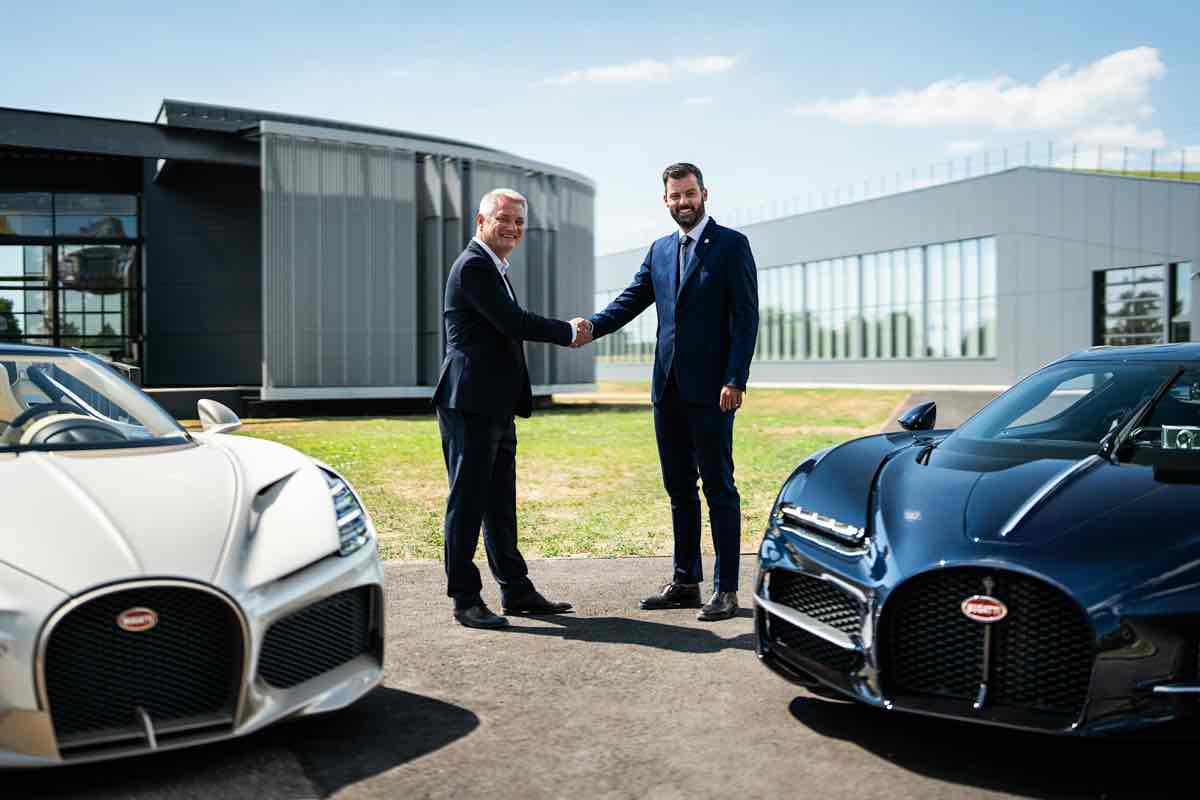
Few people have been as closely connected to the rebirth of Bugatti as Christophe Piochon. After 24 extraordinary years with the legendary French marque, the President of Bugatti Automobiles is preparing to leave Molsheim, closing a career that stretches from the earliest Veyron prototypes to the dawn of the new Tourbillon era. Along the way, he helped establish the quality standards behind modern Bugatti, personally experienced almost every hypercar produced in Molsheim and played a central role in transforming the historic site into the home of one of the world’s most exclusive automotive brands.
From the Impossible Veyron to the Tourbillon
Christophe Piochon’s Bugatti story began before the modern Bugatti story had truly been written. In late 2001, Piochon was working at Volkswagen’s prototype facility and became involved in assembling the first Bugatti Veyron prototypes as Bugatti Project Quality Manager.
At the time, the Veyron was unlike anything the automotive industry had attempted to put into series production. Bugatti wasn’t simply developing another supercar: the company was attempting to create a road car with approximately 1,000 horsepower, a top speed exceeding 250 mph and a level of refinement expected from one of the world’s most prestigious luxury marques.
That combination created an enormous engineering challenge and meant Bugatti effectively had to establish an entirely new set of quality standards. Piochon became one of the people responsible for defining them.
It wasn’t a job performed exclusively from behind a desk. Over the years, he accumulated approximately 100,000 kilometers — more than 62,000 miles — behind the wheel of Bugatti vehicles, including around 60,000 kilometers as a test driver. Those standards ultimately helped shape not just the Veyron, but generations of Bugatti hypercars that followed.
Almost 1,200 modern Bugatti vehicles later, many of the principles developed during those pioneering years remain embedded in the way cars are created in Molsheim.
He Personally Saw, Approved or Tested Almost Every Modern Bugatti
One statistic perhaps explains Piochon’s relationship with Bugatti better than any executive title ever could. Of all the modern Bugatti hypercars that have left the Atelier in Molsheim during his career, Piochon estimates that only around 40 cars departed without him personally seeing, approving or testing them.
That is remarkable considering the breadth of vehicles produced during his tenure. He was there for the Veyron and its derivatives, followed the introduction of the Chiron and the extraordinary collection of models that grew from its platform, and experienced Bugatti’s one-off creations and limited-production machines even as his responsibilities within the company expanded.
The list encompasses some of the most significant hypercars of the modern era: Veyron, Chiron, Divo, Centodieci, La Voiture Noire, Bolide, W16 Mistral and numerous highly specialized derivatives.
For Piochon, maintaining that physical connection to the automobiles remained essential. Test drives, final vehicle checks and direct conversations with the people engineering and assembling the cars were never merely ceremonial duties; they were part of how he approached leadership at Bugatti.
24 Years That Spanned an Entire Era
Piochon’s departure carries additional significance because it arrives almost simultaneously with the conclusion of Bugatti’s legendary W16 chapter. He joined the project when the Veyron was still regarded by many as an almost impossible engineering ambition, and more than two decades later he was present for another deeply symbolic moment: the assembly of the final Bugatti W16 engine at the factory in Salzgitter.
Few automotive executives can claim to have experienced an entire powertrain era from its experimental beginnings to its final production example. The W16 became one of the defining engines of the 21st century, powering the Veyron into territory previously considered unrealistic for a production automobile before evolving into the heart of the Chiron family and its increasingly specialized derivatives.
Its final road-going chapter arrived with the W16 Mistral, production of which concluded in 2026. Piochon’s career therefore almost perfectly brackets the W16 Bugatti story — while also extending into the beginning of what comes next.
Some of Bugatti’s Greatest Moments Happened Along the Way
Twenty-four years at Bugatti inevitably produced a remarkable collection of memories. Among Piochon’s most important was the inauguration of the Bugatti Atelier in Molsheim in 2005, when the reborn company was preparing to deliver the Veyron and establish relationships with its first customers.
There was also his first public Veyron drive during the Bugatti Festival in Molsheim. He participated in Bugatti’s 100th- and 110th-anniversary celebrations, witnessed the Chiron’s unforgettable world premiere at the Geneva Motor Show in 2016 and later helped introduce an entirely new generation of Bugatti to the world.
That moment came in 2024, when the Tourbillon was unveiled at Bugatti’s historic home in Molsheim during “La Grande Première,” bringing together customers, media, partners and members of the Bugatti family.
For someone who had helped transform the seemingly impossible Veyron into reality, the arrival of the Tourbillon represented a remarkable full-circle moment.
Tourbillon Begins a Completely New Bugatti Era
The Tourbillon represents perhaps the greatest technological change Bugatti has experienced during Piochon’s career. The quad-turbocharged W16 that defined the Veyron and Chiron generations is gone, replaced by an entirely new electrified powertrain built around a naturally aspirated V16 engine and electric motors.
Yet the fundamental mission hasn’t changed. Technology evolves, engines change and manufacturing facilities expand, but a Bugatti must still be engineered and assembled without compromise.
That philosophy is precisely what connects the pioneering Veyron project of the early 2000s with the Tourbillon more than two decades later. Piochon was able to experience both ends of that transformation, including the first test drives of the new hybrid hypercar.
Molsheim Grew Alongside Bugatti
Piochon’s legacy isn’t limited to the cars; it can also be measured in what happened to Molsheim itself. After serving as Bugatti Quality Director and spending a period in Dresden, Piochon returned to Molsheim in 2013 as Managing Director for Production and Logistics and Site Director.
At that time, Bugatti’s Molsheim operation employed approximately 70 people. Today, the number is approaching 200, reflecting how dramatically the modern company has evolved.
Bugatti opened new offices in 2024 to support its growing operations, followed by another major milestone in June 2026: the inauguration of La Manufacture. The new facility has been created to support production of the Tourbillon and represents a major investment in keeping Bugatti’s future firmly connected to its historic home.
For a brand whose identity is inseparable from Molsheim, that matters enormously.
His Relationship With Molsheim Extended Beyond the Factory
Piochon’s connection with the region also went well beyond building hypercars. Over the years, he helped strengthen Bugatti’s relationship with local institutions and the community surrounding the marque’s historic home.
He has long been an honorary member of Enthousiastes Bugatti Alsace and supported the Bugatti Festival in Molsheim. His local involvement also included charitable organizations such as Semeurs d’Étoiles, which supports hospitalized children and their parents, along with Banque Alimentaire du Bas-Rhin, the regional food bank.
That relationship between company, history and location has always been particularly important for Bugatti. Molsheim isn’t simply where Bugattis happen to be assembled; it is part of the identity of the marque itself.
Bugatti Rimac Opened Another Chapter
Another major transformation arrived in 2021 with the creation of Bugatti Rimac. The new company brought together Bugatti and Rimac under a structure that would ultimately guide the historic marque into the electrified hypercar era.
Piochon was appointed President of Bugatti Automobiles and Chief Operating Officer of Bugatti Rimac, placing him in a central position as the company prepared for one of the biggest transitions in its modern history.
The partnership also brought Piochon together with Mate Rimac, a relationship that became increasingly important as Bugatti moved beyond the Chiron and W16 generation toward the Tourbillon. Rimac has credited Piochon with helping shape not only Bugatti’s quality standards, but also the development of Molsheim and the culture of the team that will carry the company forward.
The People Behind Bugatti May Be His Greatest Legacy
It would be easy to define a 24-year Bugatti career through cars. The Veyron alone would be enough to make an automotive career memorable; add the Chiron, Bolide, W16 Mistral, Tourbillon and Bugatti’s extraordinary collection of coachbuilt and limited-production creations, and the scale becomes difficult to match.
But Piochon points to something else when discussing what matters most: the people.
During more than two decades with Bugatti, he worked alongside every President of the modern Bugatti era and helped build the team responsible for maintaining the company’s unusually demanding standards. The cars may attract the headlines, but every Bugatti depends on the engineers, craftspeople, designers, test drivers, technicians and specialists behind it.
Building that culture in Molsheim may ultimately prove every bit as important as any individual hypercar.
From 70 Employees to a Production Plan Filled Through 2030
Piochon leaves Bugatti in a very different position from the company he joined. When the Veyron prototypes were being developed, Bugatti’s modern identity was still being established. Today, the company has a global reputation, an expanded Molsheim operation, a new production facility and an entirely new generation of hypercars approaching production.
Perhaps most significantly, Piochon revealed that Bugatti’s production plan is already full through 2030. For an ultra-low-volume manufacturer producing some of the world’s most expensive automobiles, that provides considerable visibility as the Tourbillon era begins.
The foundation for the next chapter has effectively already been laid.
Mate Rimac Will Take Over as President of Bugatti Automobiles
Piochon’s departure also brings an important leadership change. Mate Rimac, currently CEO of Bugatti Rimac, will become the new President of Bugatti Automobiles.
It represents another symbolic transition. Piochon helped guide Bugatti from the experimental Veyron prototypes through the W16 age and into the beginning of the Tourbillon generation. Rimac will now lead the marque deeper into that next chapter.
Bugatti is entering an era in which electrification, traditional mechanical engineering, craftsmanship and extreme performance are being combined in ways radically different from the formula that created the Veyron more than two decades ago. Yet the intention is clearly not to abandon Bugatti’s identity; instead, the Tourbillon is designed to reinterpret it.
October 31 Will Officially Close a Remarkable Bugatti Career
Christophe Piochon will formally conclude his career with Bugatti on October 31, 2026, marking the end of 24 extraordinary years.
He arrived when Bugatti was trying to prove that Ferdinand Piëch’s seemingly impossible Veyron vision could actually become a production automobile. He leaves after helping prepare Molsheim to manufacture another machine that attempts to redefine what a hypercar can be.
Between those two moments came approximately 1,200 automobiles, 100,000 kilometers behind the wheel of Bugattis, an entire generation of W16-powered engineering and the transformation of Molsheim from a relatively small operation into the home of Bugatti’s next era.
There are executives who manage automotive brands, and there are engineers who develop automobiles. Piochon’s unusual Bugatti career crossed both worlds. He helped establish how a modern Bugatti should be built, tested the cars himself, helped expand the factory that produced them and remained directly connected with the people responsible for turning extraordinary engineering into finished automobiles.
The cars will inevitably be the most visible part of that legacy, but the standards, culture and team left behind in Molsheim may prove to be the more enduring one.
As the final W16 Bugattis give way to the V16 hybrid Tourbillon, one of the people who helped make the modern Bugatti story possible is stepping away. The next chapter begins without him — but much of the foundation it will be built upon carries his influence.
Forever Bugatti.