






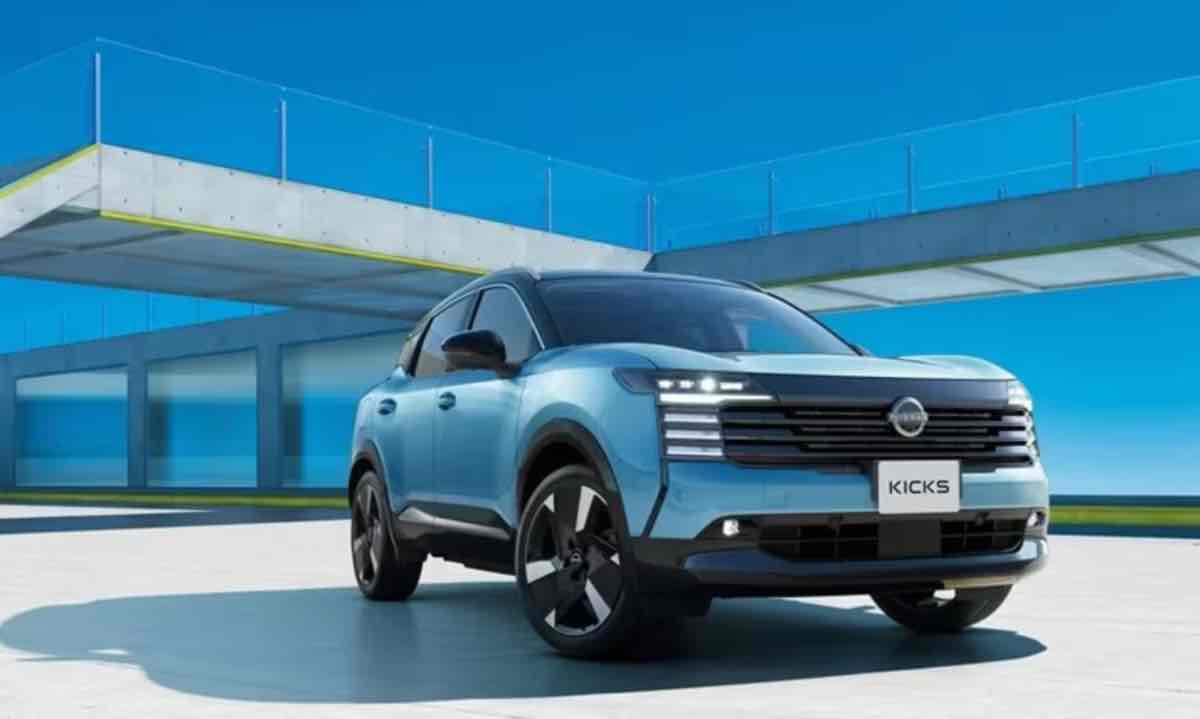
The Nissan Kicks is a familiar name to American drivers, but until now, the compact crossover has never really been part of Nissan’s European story. That is about to change. Nissan is preparing to launch the Kicks in Europe, where it will be produced at the company’s Sunderland plant in the United Kingdom and offered with Nissan’s unusual e-POWER hybrid technology. For American enthusiasts, the European Kicks is an interesting look at how differently the same nameplate can evolve on opposite sides of the Atlantic.
A Familiar Nissan Name Is Finally Heading to Europe
The Kicks has been around since 2016 and has developed into an important global model for Nissan. Its second generation debuted in 2024, bringing a considerably more substantial design and a more upscale approach than the original.
More than 1.8 million Kicks models have been sold globally, with the crossover now available in more than 70 markets.
Europe, however, has largely remained outside the Kicks story.
Nissan is now preparing to change that by introducing the model to European customers and building it locally at the company’s massive Sunderland manufacturing facility in northeast England.
The European Kicks will therefore not simply be a U.S.-market vehicle shipped across the Atlantic. It is being positioned as part of Nissan’s broader European electrification strategy.
Nissan Is Investing £170 Million in Sunderland
Bringing the Kicks to Europe requires a significant investment.
Nissan plans to spend approximately £170 million — roughly $230 million at recent exchange rates — preparing Sunderland for production of the new crossover.
Sunderland has played a major role in Nissan’s European operations for decades. Vehicle production began there in 1986 with the Nissan Bluebird, and the Kicks will become the tenth Nissan model produced at the facility.
The plant currently plays a key role in manufacturing vehicles including the Qashqai, Juke and Leaf.
Adding the Kicks gives Sunderland another high-volume crossover at a time when Nissan is gradually transforming its European lineup around electrified and fully electric powertrains.
Europe’s Kicks Will Be Very Different Under the Hood
This is where the story becomes particularly interesting from an American perspective.
Instead of following the conventional gasoline-powered formula familiar to U.S. Kicks buyers, the European version is expected to use Nissan’s latest third-generation e-POWER system.
Despite the name, e-POWER is not an EV and it isn’t a conventional parallel hybrid either.
The basic principle is surprisingly simple: the wheels are driven exclusively by an electric motor.
The gasoline engine does not mechanically drive the wheels during normal operation. Instead, it generates electricity for the electric propulsion system.
That creates a driving experience designed to resemble an EV, with immediate electric-motor response and smooth power delivery, while eliminating the need to plug the vehicle into an external charger.
You still fill the car with gasoline, but electricity actually provides the propulsion at the wheels.
A 1.5-Liter Engine Becomes a Generator
Nissan’s third-generation e-POWER technology uses a 1.5-liter turbocharged gasoline engine as part of its integrated powertrain.
Rather than serving as the vehicle’s primary mechanical propulsion source, the internal-combustion engine operates primarily to produce the electricity needed by the electric drive system.
It’s essentially Nissan’s answer to one of the biggest questions facing the auto industry: how can manufacturers deliver some of the characteristics of an electric vehicle without requiring drivers to change their refueling habits?
There is no charging cable to connect overnight and no requirement to find a DC fast charger during a road trip.
When the fuel tank gets low, the driver simply visits a gas station.
From behind the wheel, however, propulsion remains electric.
Why Doesn’t Nissan Sell e-POWER in the United States?
For American buyers, that naturally raises an interesting question.
Nissan has invested heavily in e-POWER in markets such as Europe and Japan, yet the technology remains largely unfamiliar in the United States.
The European Kicks makes that difference particularly noticeable because American consumers already know the Kicks name.
The U.S.-market Kicks entered its second generation with a conventional gasoline powertrain and available all-wheel drive, while Nissan’s European strategy is increasingly centered around electrification.
That means two vehicles wearing the same badge can represent noticeably different approaches to the market.
The European Kicks Is Nearly Qashqai-Sized
The latest Kicks is also larger than its original entry-level crossover positioning might suggest.
At approximately 171.7 inches (4.36 meters) long, it is only around 2.4 inches shorter than the European Nissan Qashqai.
That puts it into an increasingly competitive section of the European crossover market.
The Kicks will potentially compete for buyers considering models such as the Dacia Duster, Suzuki S-Cross and other compact European-market SUVs.
Its arrival also makes more sense when viewed alongside Nissan’s plans for the Juke.
The Juke Is Going Electric
Nissan’s European SUV lineup is undergoing a broader transformation.
The next-generation Juke is expected to become a fully electric vehicle. That potentially creates room for the Kicks to serve customers who want an electrified crossover but aren’t ready — or simply don’t want — to rely entirely on battery charging.
The resulting European lineup could offer several distinct approaches.
The Juke can cover the fully electric end of the smaller crossover market, the Kicks can offer e-POWER technology, and the larger Qashqai can continue serving buyers looking for more space while also offering Nissan’s electrified powertrain technology.
Above them sits the X-Trail as Nissan’s larger European SUV offering.
An Important Investment During a Difficult Period for Nissan
The timing of the announcement is significant.
Nissan has been restructuring its global operations and looking for ways to reduce costs, streamline production and improve profitability.
Against that backdrop, a £170 million commitment to Sunderland demonstrates the continued importance of the British factory to Nissan’s European operations.
It also gives the plant another product as the company moves deeper into electrification.
For Sunderland, the Kicks isn’t simply another crossover. It represents another piece of the factory’s transition toward Nissan’s next generation of vehicles.
Could e-POWER Make Sense in America?
The European Kicks inevitably raises the question of whether this type of powertrain could eventually become more important in the United States.
Series-hybrid and range-extended concepts have gained renewed attention as automakers search for solutions between conventional gasoline vehicles and battery-electric models.
Nissan’s approach is particularly interesting because e-POWER attempts to preserve the driving characteristics of an EV while retaining the convenience and infrastructure of gasoline.
There are compromises, of course. The vehicle still burns fuel and therefore remains dependent on an internal-combustion engine. Energy also has to pass through multiple stages before reaching the wheels.
But the concept could appeal to drivers who like electric propulsion yet remain hesitant about charging availability, apartment living or long-distance EV travel.
For now, though, the European Kicks remains exactly that: a European-market development.
Same Name, Very Different Nissan Kicks
The arrival of the Kicks in Europe provides an unusual example of how manufacturers are tailoring vehicles to increasingly different regional requirements.
American buyers know the Kicks primarily as an affordable compact crossover. European customers will be introduced to the nameplate through a vehicle closely connected to Nissan’s electrification strategy.
And unlike many globally sold vehicles imported from a centralized factory, Europe’s Kicks will be built locally in Sunderland.
With more than 1.8 million Kicks already sold worldwide, Nissan isn’t introducing an experimental nameplate. Instead, it is taking an established global crossover, adapting it for Europe and giving it one of the company’s most distinctive powertrains.
For U.S. enthusiasts, that may be the most interesting part of the story: Europe is getting a Nissan Kicks that Americans can’t buy — one that drives its wheels entirely with electricity but still stops at a gas station instead of a charging station.