












One of Nissan’s most legendary nameplates is preparing for a major comeback. The company is expected to unveil the 14th-generation Nissan Skyline in December 2026, marking the beginning of an important new chapter for the Japanese automaker. While full specifications remain under wraps, the next Skyline is expected to retain a rear-wheel-drive layout, potentially offer hybrid power, and could even feature a twin-turbo V6 producing more than 400 horsepower. For U.S. buyers, however, there is another reason to pay attention: the new Skyline could provide the foundation for a future Infiniti sports sedan.
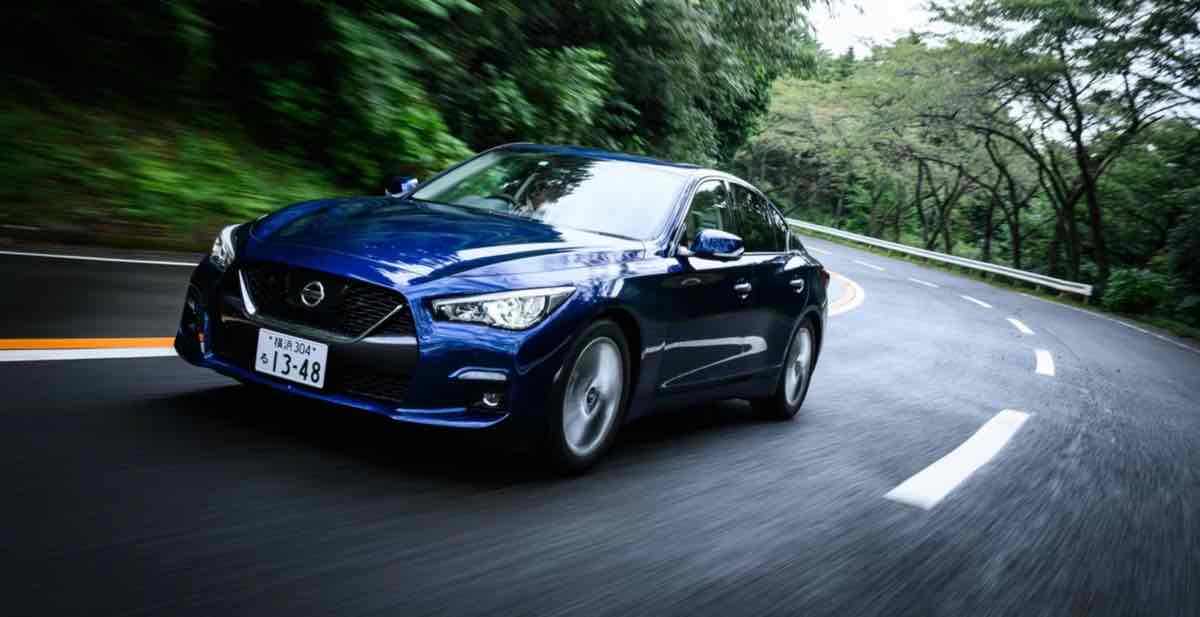
The New Nissan Skyline Will Debut in December
Nissan fans will not have to wait much longer to see the next generation of one of Japan’s most famous performance-oriented sedans.
Nissan President and CEO Ivan Espinosa has confirmed that the all-new Skyline is scheduled to make its official debut in December 2026.
The company had already provided an early glimpse of the project earlier this year, releasing limited preview imagery of the upcoming model. The latest announcement makes it clear that this is not simply a design study or distant concept — the production model is approaching its official reveal.
For Nissan, the importance of the car appears to extend far beyond the Skyline name itself.
Speaking with Japanese newspaper Asahi Shimbun, Espinosa described the upcoming model as an important symbol of Nissan’s renewal and broader comeback.
Nissan Cut Development Time From 55 Months to Just 26
One of the most remarkable aspects of the new Skyline may have nothing to do with horsepower.
Instead, it is how quickly Nissan developed it.
According to Espinosa, development of the previous-generation model required approximately 55 months. The new Skyline was reportedly developed in only 26 months — less than half that amount of time.
That represents a dramatic acceleration for a traditional global automaker.
Nissan accomplished this in part by incorporating generative artificial intelligence and advanced digital simulation technologies throughout the development process.
Those tools were reportedly used across several areas, including vehicle design, engineering, testing, and production preparation.
The Skyline could therefore become more than simply another new Nissan. It may serve as an early demonstration of a much faster vehicle-development strategy that could eventually influence future models across the company.
Nissan Has Been Learning From China
Espinosa has also acknowledged the rapidly changing competitive environment facing Japanese automakers.
Chinese manufacturers have become particularly aggressive when it comes to development speed, technology deployment, and cost-efficient production.
Nissan has gained firsthand experience with this environment through its joint venture with Dongfeng in China, and some of those lessons appear to have influenced the company’s new development strategy.
That matters because lengthy product-development cycles have become increasingly problematic in today’s automotive industry.
A vehicle that takes four or five years to develop risks entering production in a market that has already changed dramatically.
Bringing the Skyline’s development cycle down to 26 months suggests Nissan wants to operate much closer to the speed demonstrated by newer Chinese manufacturers.
The Skyline Will Still Be Built in Japan
Despite speculation that production could move elsewhere, Nissan has reportedly confirmed that the new Skyline will remain a Japanese-built vehicle.
Production is expected to continue at Nissan’s Tochigi facility.
The factory is becoming particularly important for the company’s enthusiast vehicles, as it is also associated with production of the Nissan Z.
Keeping Skyline production in Japan therefore carries symbolic significance.
Nissan may be modernizing the way it designs and develops cars, but one of its most historic nameplates will remain closely connected to its home country.
Rear-Wheel Drive Is Expected to Stay
Nissan has not yet released complete technical specifications for the 14th-generation Skyline.
However, current reports suggest that the car will retain a traditional rear-wheel-drive architecture.
If confirmed, that would be welcome news for enthusiasts concerned that the Skyline name could eventually be applied to a front-wheel-drive vehicle or crossover.
Instead, the new model appears likely to remain relatively faithful to the traditional sports-sedan formula: an engine up front, driven wheels at the rear, four doors, and an emphasis on performance.
Exactly which platform Nissan will use remains unclear.
Hybrid Power Could Meet a 400+ HP Twin-Turbo V6
The powertrain is where things could become particularly interesting.
Hybridization is expected to play a role in the next Skyline, which would make sense considering Nissan’s broader electrification strategy.
But that does not necessarily mean the combustion engine is disappearing.
Reports have suggested that Nissan could retain a version of its proven twin-turbocharged V6. Depending on the final configuration, output could exceed 400 horsepower.
At this stage, Nissan has not officially confirmed those specifications, so they should be treated as preliminary rather than final production figures.
Nevertheless, a rear-wheel-drive Skyline combining electrification with a powerful twin-turbo V6 would offer a considerably different proposition from the growing number of fully electric performance sedans.
A Manual Skyline Nismo Would Be Even More Interesting
There is also speculation surrounding a potential Nismo version.
One particularly intriguing possibility is a six-speed manual transmission for a higher-performance variant.
Again, Nissan has not officially confirmed such a configuration.
But if it happens, a manual-transmission Skyline Nismo could become an increasingly rare type of automobile: a powerful Japanese rear-wheel-drive sports sedan designed specifically with enthusiast drivers in mind.
The existence of the current Nissan Z also means the company already has modern components and expertise surrounding a high-output twin-turbo V6 and manual transmission.
Whether those ingredients ultimately make their way into the Skyline remains one of the biggest questions ahead of the December reveal.
Why American Buyers Should Pay Attention
There is one obvious problem for American Skyline enthusiasts: the Nissan Skyline itself is not expected to suddenly appear at U.S. Nissan dealerships.
However, the car could still have major implications for the American market.
The outgoing V37-generation Skyline is closely related to the Infiniti Q50, which was sold in the United States. A similar strategy could potentially be used with the new generation.
That raises the possibility of a future Infiniti model derived from the new Skyline architecture.
For Infiniti, such a vehicle could be particularly significant. A modern rear-wheel-drive sports sedan with hybrid technology and potentially more than 400 horsepower could give the luxury brand a new performance-focused model for North America.
No U.S.-market production model based on the new Skyline has been officially detailed yet, however, so the exact relationship between the upcoming Nissan and a future Infiniti remains to be seen.
The Current Skyline Dates Back to 2013
A replacement is certainly overdue.
The V37-generation Skyline has roots stretching back to 2013, making its underlying design more than a decade old.
Its American relative, the Infiniti Q50, arrived during the same period.
Although the V37 received updates during its unusually long production run, the automotive world has changed dramatically since the platform was originally developed.
Electrification has accelerated, software has become central to vehicle development, advanced driver-assistance technologies have expanded rapidly, and artificial intelligence is now entering the automotive engineering process itself.
The next Skyline therefore has the opportunity to represent a much larger generational leap than its exterior styling alone might suggest.
What About the Nissan GT-R?
The Skyline name inevitably brings the GT-R to mind, particularly for American enthusiasts who discovered cars such as the R32, R33, and R34 Skyline GT-R through video games, movies, and the import scene.
But the modern GT-R and Skyline need to be considered separately.
Nissan separated the GT-R from the Skyline family with the R35 generation, which debuted as a standalone model in 2007.
The arrival of a new Skyline therefore does not automatically mean a new Skyline GT-R is coming.
A high-performance Nismo version could nevertheless become the closest expression of that heritage within the new Skyline family.
It will also be fascinating to see how Nissan positions the Skyline alongside the Z and whatever eventually succeeds the R35 GT-R.
A Very Different Kind of Nissan Comeback
The 14th-generation Skyline could become one of Nissan’s most important launches in years.
Not necessarily because of sales volume, but because of what the car represents.
Nissan is attempting to combine one of its most recognizable historic nameplates with a radically faster development process, generative AI, digital engineering, electrification, and potentially traditional enthusiast ingredients such as rear-wheel drive, a twin-turbo V6, and even a manual transmission.
We should know much more when the new Nissan Skyline officially breaks cover in December 2026.
For American enthusiasts, the biggest question may ultimately be what comes afterward.
If the new Skyline does provide the basis for a next-generation Infiniti sports sedan, its arrival could eventually matter just as much in the United States as it does in Japan.